Audit Ready: Risk Based School Cleaning Standards for Facilities Teams
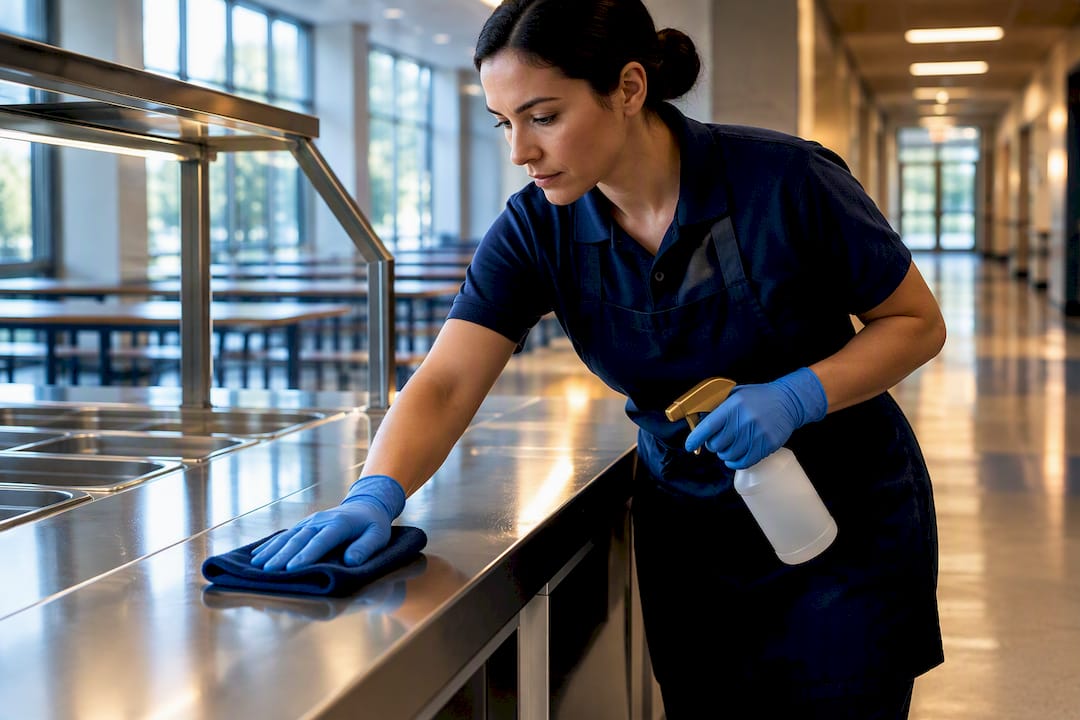
A usable school cleaning standard defines area risk, task frequency, responsible role, approved method, safety controls, and verification. Skip any one of those pieces and the standard falls apart the first time someone asks for proof. Start today by adopting a daily risk-based checklist, then schedule a supervisory audit or a spot round of ATP testing within the next two weeks to see where the gaps actually are.
TL;DR:
- Proper risk classification assigns high-risk areas like restrooms and cafeterias more frequent cleaning and stricter methods than low-risk spaces such as storage rooms.
- Cleaning protocols must include five key elements—product, dilution, contact time, PPE, and substitutes—to prevent chemical misuse and ensure effectiveness.
- Combining visual audits with objective ATP testing helps verify cleaning standards more reliably than visual checks alone, especially in high-risk areas.
- Emergency cleaning protocols require pre-written, specific steps including PPE use, waste disposal, and incident documentation to respond effectively to outbreaks.
- Integrating cleaning with pest control and maintenance under a single contract improves consistency, accountability, and compliance during critical situations.
Table of Contents
- Daily, Weekly, and Monthly School Cleaning Checklists
- Building a Risk-Based Standards Framework
- Cleaning vs. Disinfecting: Get the Sequence Right
- Choosing Products, Storing Them Safely, and Protecting Air Quality
- Verifying the Standard: Audits, ATP Testing, and Continuous Improvement
- Emergency Cleaning and Outbreak Response
- Training Staff and Communicating the Standard
- Why Integrated Facility Contracts Make Compliance Easier
- Get a Standards Gap Audit for Your School Facility
- Where These Standards Come From
- Sources
- FAQ
Daily, Weekly, and Monthly School Cleaning Checklists
A school cleaning standard only works when tasks are tied to a schedule someone actually follows. Break the workload into three tiers, and the whole program becomes more manageable and clear.
Daily tasks hit every occupied space before the doors reopen the next morning:
- Classrooms: empty trash, wipe desks and shared supplies, spot mop, disinfect high touch points like light switches and doorknobs
- Restrooms: clean and disinfect fixtures, restock supplies, mop floors, check for leaks or odor issues
- Cafeterias: sanitize tables between lunch periods, sweep and mop under seating, empty all waste bins
- Hallways and stairwells: spot clean spills, dust handrails, sweep or vacuum high traffic zones
- Gyms and locker rooms: wipe down mats and equipment, disinfect benches, mop locker room floors
Weekly and monthly tasks go deeper than a quick wipe down:
- Detail dusting of vents, blinds, and high shelving (weekly)
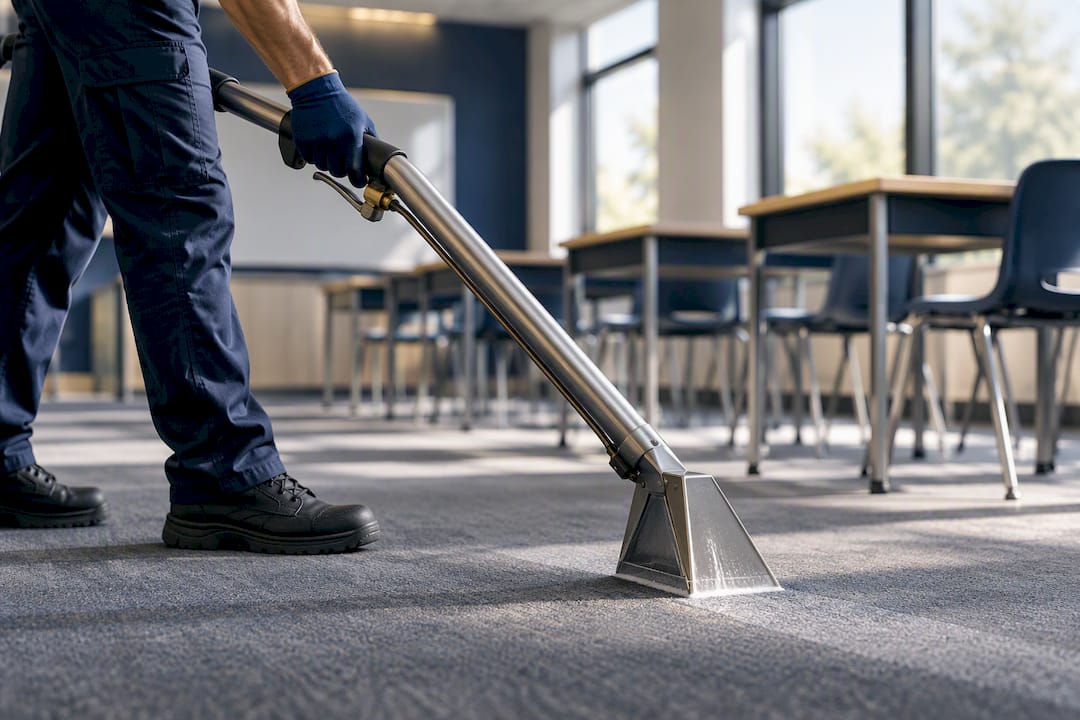
- Carpet extraction and grout scrubbing in cafeterias and entryways (monthly)
- HVAC filter checks and coil inspections tied to your interior floor care program (monthly)
- Full floor stripping and refinishing on hard surfaces, typically scheduled during school breaks
- Deep cleaning of upholstered furniture in common areas (monthly)
The fastest way to operationalize this is a task matrix. List every space, assign a risk tier, note the required frequency, name the responsible role, and specify the method. That single document becomes your printable checklist, your training reference, and your audit baseline all at once. A similar structure works well for translating size-based cleaning rules into a formal service spec, which facility teams can adapt directly for school buildings.
Building a Risk-Based Standards Framework
Every credible school cleaning standard starts with classifying space by risk, not by square footage. High-risk areas include restrooms, nurse’s offices, and cafeteria food-contact surfaces. Medium-risk covers classrooms and gyms. Low-risk includes storage rooms and rarely used offices. Each tier gets a different frequency and method, not a one-size checklist.
Your standard operating procedures need five fixed elements for every task: the approved product, the correct dilution ratio, the required contact time, the PPE the task calls for, and any approved substitute product if the primary one runs out. Leaving any of these out is how contact-time failures and chemical misuse happen.
ISSA’s Clean Standard: K-12 frames this as a “Clean, Measure, Monitor” cycle: define the cleanliness target for each area, verify it with sight, smell, and touch audits alongside ATP testing where it adds value, and trigger corrective action whenever a space misses its target, according to ISSA guidance.
- Custodians: execute the daily checklist and flag anything that needs escalation
- Lead custodians: spot-check completed work and retrain on the spot when something’s off
- Facilities managers: own the audit schedule, the SOP library, and the corrective-action log
Pro Tip: Write your SOPs so a substitute custodian on day one could follow them without asking a single question. If they can’t, the SOP isn’t finished.
Cleaning vs. Disinfecting: Get the Sequence Right
Cleaning removes dirt and organic matter. Disinfecting kills pathogens on an already-clean surface. Skip the first step and the second one barely works, because soil and grease block disinfectants from reaching the surface at all.
The CDC recommends daily cleaning and sanitizing of frequently touched surfaces, and reserving enhanced disinfection for specific situations rather than routine use. That means disinfecting makes sense for body-fluid spills, active outbreak periods, and regulated food-contact surfaces in the cafeteria kitchen. It does not need to happen on every desk every hour of every day.
Label compliance is where most programs quietly fail:
- Confirm the required contact time and keep the surface visibly wet for that entire window
- Wear the PPE the label specifies, every time, not just when it’s convenient
- Never mix chemicals, even ones that seem similar
- Rinse if the label requires it, especially on food-contact surfaces
Routine cleaning and hand hygiene do more to slow the spread of illness than reflexive disinfectant overuse, according to CDC guidance on transmissible infections in schools. Contact time failures happen constantly because a surface dries before the label’s required minutes pass. Fix it with pre-wetted wipes or a second application, and assign someone to actually verify it.
Choosing Products, Storing Them Safely, and Protecting Air Quality
Stick to your district’s approved-product list and favor third-party-certified low-toxicity options, such as those on EPA’s Safer Choice list, whenever they clean effectively. Microfiber cloths and mops paired with a standard all-purpose detergent already remove large numbers of microorganisms without a disinfectant at all, according to Connecticut’s Cleaning for Healthier Schools guidance.
Keep an approved-product register listing the SDS, dilution ratio, contact time, PPE, and expiration date for every product in the building. Storage needs to be secure and clearly labeled, and personal chemicals or air fresheners have no place in a classroom or storage closet.
- Schedule floor waxing, carpet cleaning, and other pollutant-releasing tasks during unoccupied hours
- Dry carpets and upholstery quickly after extraction to prevent mold growth
- Ventilate rooms during and after any chemical-heavy task
The EPA’s indoor air quality guidance treats source control and ventilation as part of the cleaning standard itself, not a separate concern.
Pro Tip: Time your carpet extraction so it does not leave carpets wet for extended periods when the building is unoccupied to prevent mold growth.
Verifying the Standard: Audits, ATP Testing, and Continuous Improvement
A completed checklist proves someone showed up. It doesn’t prove the room is actually clean. That gap is exactly why ISSA’s K-12 standard pairs staff self-checks with supervisor inspections and, where it adds value, objective ATP testing rather than relying on sight alone.
Build your audit form around three senses first: does it look clean, does it smell clean, does it feel clean to the touch. Add ATP swab testing on a rotating sample of high-risk surfaces like cafeteria tables and restroom fixtures, since ATP catches organic residue a visual check misses entirely.
| Audit element | What it checks | Trigger for corrective action |
|---|---|---|
| Sight/smell/touch | Visible soil, odor, sticky residue | Any fail during walkthrough |
| ATP swab sample | Organic residue on high-touch surfaces | Reading outside the target range |
| Supervisor spot check | Task completion vs. checklist | Recurring gaps by room or shift |
Set a clear cadence, weekly for high-risk areas, monthly for low-risk ones, with defined pass and fail thresholds tied to retraining rather than punishment. Track results by room and by shift over time. Patterns that repeat almost always point to a scheduling problem, a staffing gap, or a supply shortage rather than one person’s failure. A related framework built for audit-ready healthcare cleaning standards applies the same logic and translates well to school facilities. Document every inspection and every corrective action; that paper trail is what protects you when a parent, a board member, or a health inspector asks for proof.
Emergency Cleaning and Outbreak Response
Body-fluid spills and outbreak situations need a separate, pre-written protocol, not an improvised response in the moment.
- Restrict access to the area immediately and post a barrier or signage
- Put on the PPE specified in your emergency SOP before touching anything
- Remove solid material first, then clean the surface, then disinfect per the product label
- Bag and dispose of waste according to your district’s protocol
- Ventilate the space and allow the surface to dry completely
- Document the incident: time, location, response, and product used
Contact your local public health authority when an outbreak pattern emerges across multiple classrooms or grade levels, and keep a remediation contractor’s number on file for large-scale events beyond your staff’s capacity. The CDC’s guidance on transmissible infections treats this kind of pre-planning as a baseline expectation, not an optional extra.
Training Staff and Communicating the Standard
A standard nobody’s been trained on isn’t a standard, it’s a document sitting in a drawer. Write SOPs and quick-reference checklists in plain language, and translate them for multilingual custodial teams so nothing gets lost between the policy and the mop bucket.
- Pair every completion log with periodic supervisor spot checks, not just a signature
- Run a stakeholder review with the school nurse, food service lead, and facilities manager before finalizing your approved-product list
- Retrain on a schedule, not just after something goes wrong
- Keep four templates on hand: cleaning policy, daily checklist, incident report, and approved-product register
Every one of those templates should live somewhere staff can actually find it during a shift, not buried in an email from six months ago.
Why Integrated Facility Contracts Make Compliance Easier
Cleaning standards fall apart when they’re managed in isolation from pest control, maintenance, and emergency response. Over 30 years of facility work has shown us that schools maintaining separate vendors for each function lose time and consistency exactly when it matters most, during an outbreak, a plumbing failure, or a surprise inspection. One integrated contract keeps the standard, the SOPs, and the emergency response under a single accountable team.
— Nationwide Maintenance.
Get a Standards Gap Audit for Your School Facility
Audit-ready cleaning programs involve risk-based checklists, documented SOPs, and a verification plan a school can defend to a board or a health inspector.
Where a lot of school districts get stuck is juggling separate vendors for cleaning, pest control, and maintenance emergencies, each with its own contract, its own schedule, and its own paperwork trail—precisely why maintenance request management is critical to streamline responses and keep facility standards consistent. Managing cleaning, pest control, and maintenance emergencies under one contract, with emergency response built in for incidents that can’t wait, allows a single team to design your checklist matrix, train custodial staff, and respond promptly, avoiding multiple calls to different companies. Request a standards gap audit or a sample daily checklist through our commercial cleaning services page and see exactly where your current program stands against an audit-ready benchmark.
Where These Standards Come From
- Clean Standard: K-12 - ISSA
- Everyday actions for schools to prevent and control the spread of transmissible infections | CDC
- Healthy indoor environments in schools | EPA
- WASH in schools - WHO
Sources
- Clean Standard: K-12 - ISSA
- Everyday actions for schools to prevent and control the spread of transmissible infections | CDC
- Healthy indoor environments in schools | EPA
FAQ
What Are the CDC Guidelines for School Cleaning and Disinfecting?
The CDC recommends daily cleaning and sanitizing of frequently touched surfaces, reserving enhanced disinfection for specific situations like outbreaks or body-fluid spills. Visible soil should be cleaned immediately, and disinfectant labels should always be followed for contact time and dilution.
What Is the Standard for Cleaning in Schools?
A usable standard defines area risk, task frequency, responsible role, approved method, and a way to verify results. ISSA’s Clean Standard: K-12 frames this as a “Clean, Measure, Monitor” cycle combining visual audits with objective testing.
What Are the Responsibilities of a School Cleaner?
Custodial staff handle daily task execution, from high-touch disinfection to restroom sanitation, following the SOPs for product, dilution, and contact time. Lead custodians and facilities managers add supervisory checks, retraining, and corrective-action documentation on top of that daily work.
What Are Some Common School Cleaning Tasks?
Daily tasks include disinfecting desks and doorknobs, sanitizing cafeteria tables between lunch periods, and cleaning restroom fixtures. Weekly and monthly tasks add carpet extraction, HVAC filter checks, and detail dusting of vents and blinds.
Does Nationwidemaintenance Offer School Cleaning Services?
Yes, Nationwidemaintenance provides commercial cleaning and janitorial services built around audit-ready standards for educational facilities. Current pricing is available directly on the site since scope varies by building size and service frequency.
Recommended
Need this handled at your facility?
Our crews cover commercial properties across New York, New Jersey, and Connecticut.