Retail Store Cleaning: A Practical Guide for Managers

For most retail environments, the right answer is to contract a qualified commercial cleaning or facility-maintenance partner for recurring work and reserve in-house staff for shift-level spot tasks. If you’re managing a single location with light traffic and a disciplined team, the SOP below will get you there. Multi-site operators, high-traffic stores, or anyone facing pre-promotion or post-construction cleanup should skip the DIY debate and go straight to a scoped quote.
Three actions to take right now:
- Assign a shift lead to own the daily checklist (entrance mats, high-touch wipe-downs, restroom checks)
- Schedule a walkthrough with a commercial cleaning contractor to scope nightly, weekly, and monthly services
- Request a quote from Nationwidemaintenance before your next peak season
Pro Tip: Before you call any vendor, walk your store with a clipboard and note every surface customers touch, every floor transition, and every area that smells or looks neglected. That 15-minute audit becomes your scope of work and protects you from vague proposals.
Table of Contents
- What does retail store cleaning actually cover?
- How often should you clean each area of your store?
- How do you maintain retail floors without destroying them?
- What disinfecting standards apply to high-touch surfaces and restrooms?
- Which equipment and products should your cleaning program use?
- How do you choose and evaluate a commercial cleaning partner?
- Why does integrated facility maintenance reduce cost and downtime?
- Key Takeaways
- Why I think most retail operators underestimate their cleaning program
- Nationwidemaintenance handles retail facility maintenance across the Tri-State area
- Useful sources and standards
What does retail store cleaning actually cover?
Retail store cleaning covers far more than sweeping the sales floor. A complete scope of work breaks into four distinct zones, and missing any one of them creates gaps that show up in customer complaints, health inspections, or slip-and-fall incidents.
Customer-facing areas:
- Sales floor: sweeping, vacuuming, mopping, display dusting, and fixture wipe-downs
- Checkout lanes: POS counter disinfection, belt cleaning, pin-pad wipe-downs
- Fitting rooms: floor cleaning, mirror polishing, hook and bench disinfection
- Windows and glass doors: streak-free cleaning inside and out
- Entryway and mats: debris removal, mat vacuuming or replacement, threshold mopping
- Restrooms: full disinfection, supply restocking, fixture scrubbing, floor mopping
Back-of-house tasks:
- Stockroom floors, shelving, and receiving dock areas
- Break rooms: appliance wipe-downs, sink and counter disinfection, floor mopping
- Waste handling: liner replacement, bin disinfection, compactor area cleaning
- Loading dock: debris removal, spill cleanup, pest-prevention sweeping
Periodic and specialty services:
- Stripping and waxing VCT floors, carpet extraction, power washing exterior surfaces
- HVAC filter service, ceiling tile cleaning, light fixture dusting
- Post-construction or post-renovation cleanup
- Pest control and prevention treatments on a scheduled or reactive basis
Who does what: Store staff typically handle shift-level tasks (spot mopping, restroom checks, trash). A daytime porter covers visible maintenance during open hours. A nightly janitorial crew handles machine scrubbing, restroom deep cleans, and floor care. Specialty crews, whether for stripping/waxing or pest control, operate on a separate periodic schedule.
How often should you clean each area of your store?
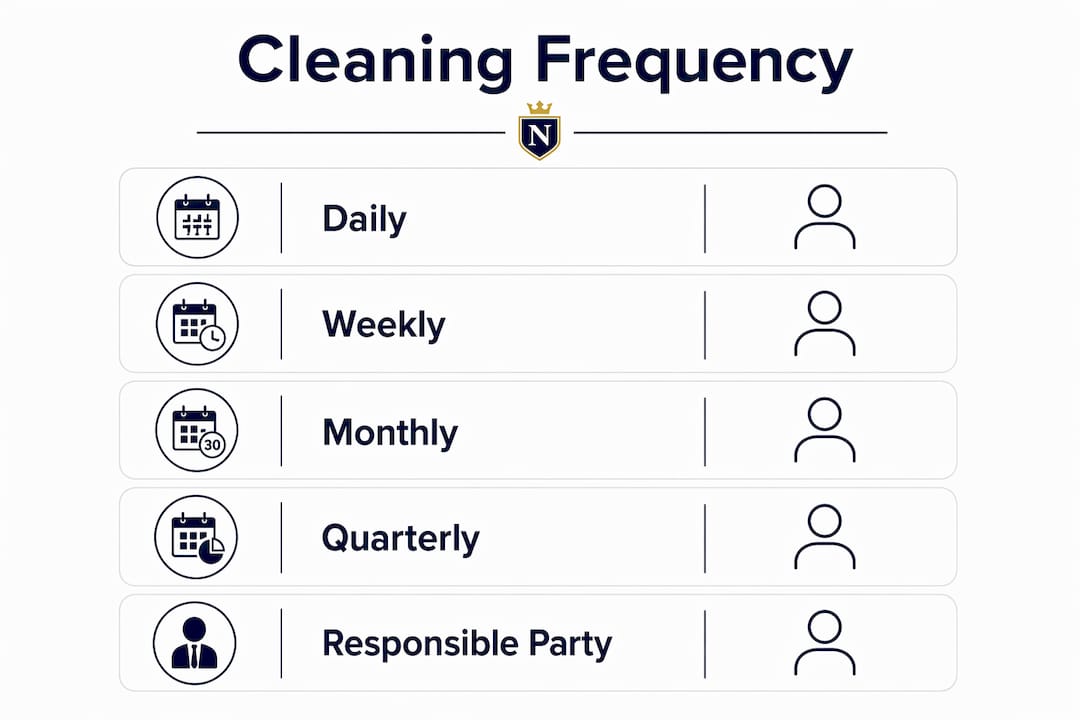
A standard daily retail checklist covers 35 inspection points across seven sections and takes 60–90 minutes per shift to complete. That’s the baseline. Layer weekly, monthly, and quarterly tasks on top of it and you have a full maintenance schedule.
| Task Group | Daily | Weekly | Monthly | Quarterly | Responsible Party |
|---|---|---|---|---|---|
| Entrance mats and entryway | ✓ (each shift) | Deep vacuum/replace | Inspect for wear | Replace worn mats | In-house / porter |
| Sales floor sweep/vacuum | ✓ (twice daily) | Edge and perimeter | — | — | In-house / porter |
| Hard floor mopping | ✓ (nightly) | — | — | — | Nightly crew |
| Machine scrubbing (auto-scrubber) | — | ✓ | — | — | Contractor |
| VCT strip and wax | — | — | ✓ | — | Contractor |
| Carpet extraction (high-traffic paths) | — | ✓ (spot) | Full extraction | — | Contractor |
| High-touch surface disinfection | ✓ (every 1–2 hrs peak) | — | — | — | In-house / porter |
| Restroom inspection and clean | ✓ (every 30–60 min) | Full deep clean | — | — | Porter / nightly crew |
| Window and glass cleaning | — | ✓ | — | — | Porter / contractor |
| HVAC filter check | — | — | ✓ | Full service | Contractor |
| Power washing (exterior) | — | — | — | ✓ | Contractor |
| Pest prevention treatment | — | — | — | ✓ | Contractor |
Daily tasks split across shifts: opening (entrance mats, quick vacuum, restroom check, high-touch wipe-down) and closing (full sweep, nightly mop, waste removal, restroom final clean). Scheduling auto-scrubbing and stripping/waxing after hours avoids customer disruption and protects sales-floor productivity.
Pro Tip: Post a printed version of the daily checklist at the janitorial closet and require a dated signature for each shift. That paper trail becomes your first line of defense in a slip-and-fall claim.
How do you maintain retail floors without destroying them?
Floor care is where most retail operators either overspend on emergency repairs or underspend until the floor looks irreplaceable. The right cadence depends on your floor type, but the principles apply across VCT, polished concrete, tile, wood, and carpet.
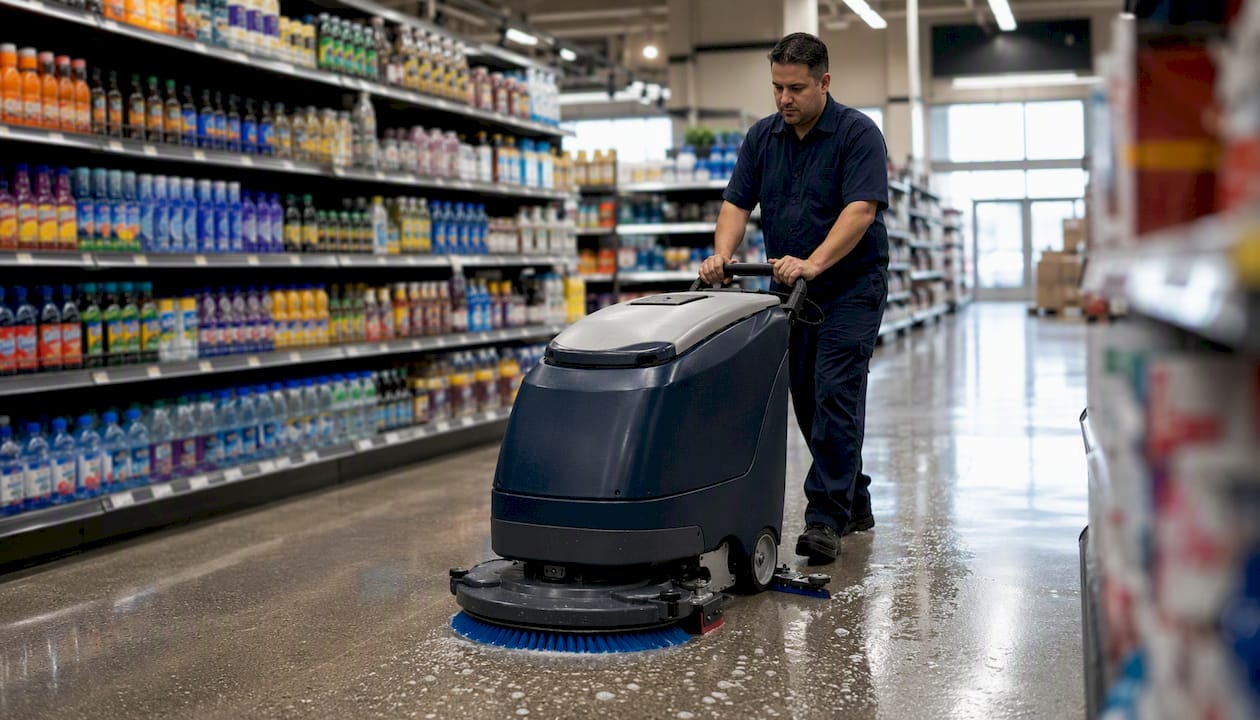
Daily maintenance starts with sweeping or vacuuming twice daily on high-traffic sales floors and spot mopping any spills immediately. Entry mat maintenance matters here: a properly sized mat traps grit before it reaches your floor finish. The Carpet and Rug Institute’s entryway mat guidance recommends a minimum of 12–15 feet of matting at each entrance to capture the majority of tracked-in soil.
Weekly: Run an auto-scrubber on all hard floors after hours. Hit perimeter edges and corners manually, since machines miss them. For carpeted areas, machine-extract high-traffic paths weekly to prevent soil from bonding to fibers.
Monthly and periodic: VCT floors need stripping, recoating, and burnishing on a cycle that depends on traffic and finish build-up. Skipping this creates a yellowed, uneven surface that no amount of mopping fixes. Commercial interior floor care specialists can assess your current finish condition and set a realistic recoat schedule. Carpet in fitting rooms and low-traffic areas typically needs full extraction monthly or quarterly.
What to avoid:
- Dirty mop buckets: a soiled mop spreads bacteria and leaves a film that dulls finish faster than foot traffic
- Wrong pH cleaners: acidic cleaners strip floor finish; alkaline cleaners leave residue on polished concrete
- Over-waxing without stripping: finish build-up creates slip hazards and traps dirt in the layers
Pro Tip: Gloss management is a safety issue, not just an aesthetic one. The National Floor Safety Institute reports that slips and falls account for over one million hospital emergency room visits per year. Maintaining consistent finish levels and using slip-resistant coatings in wet zones directly reduces that risk in your store.
What disinfecting standards apply to high-touch surfaces and restrooms?
High-touch surfaces in a retail environment include POS terminals, pin pads, door handles, cart handles, fitting room latches, and checkout counters. During peak hours, these surfaces need attention every 60–90 minutes. Off-peak, a full wipe-down every two to three hours is reasonable.
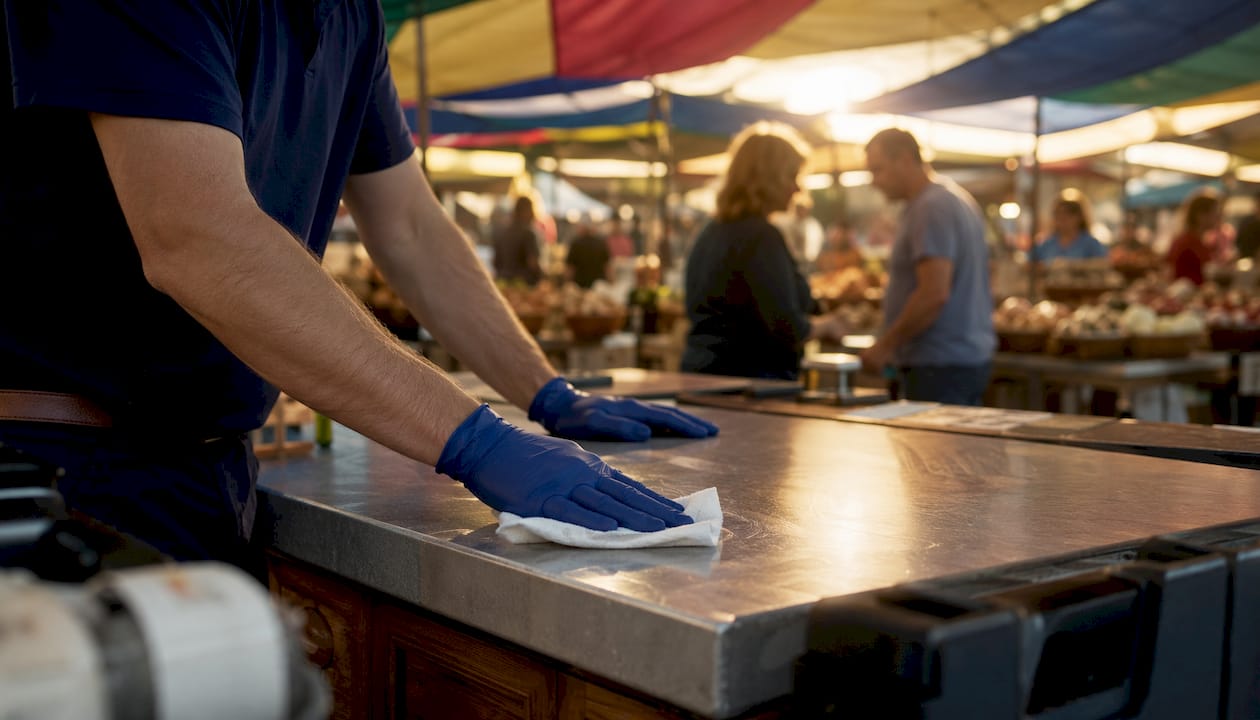
EPA-registered disinfectants are the right choice for high-touch disinfection. The critical detail most staff miss: contact time. A disinfectant only works if the surface stays visibly wet for the time listed on the label, often 30 seconds to four minutes depending on the product. Wiping dry immediately after application is cleaning, not disinfecting.
For POS equipment and touchscreens, use manufacturer-approved wipes or alcohol solutions at the concentration the equipment maker specifies. Spraying liquid directly onto electronics causes corrosion and voids warranties. Coordinating cleaning schedules around security cameras at checkout also matters: cleaning crews should know where cameras and cabling are located to avoid accidental damage during after-hours work.
Restroom protocols:
- Inspect every 30–60 minutes during busy periods; log each check with time and initials
- Full disinfection routine after close: scrub fixtures, disinfect all contact surfaces, mop floors with a fresh mop head
- Restock supplies (paper, soap, liners) at each inspection, not just at open and close
Restrooms are a reputation benchmark. Posting cleaning logs in a visible location signals to customers that the store takes hygiene seriously. It costs nothing and consistently improves customer perception.
Which equipment and products should your cleaning program use?
Equipment choices determine how effective your program is and how long it takes. Cutting corners on equipment usually means more labor hours for worse results.
Essential equipment:
- HEPA-filter vacuums: capture fine particulates rather than recirculating them; required for any store near food service or with allergy-sensitive customers
- Microfiber cloths and mop heads: pick up more bacteria per pass than cotton and reduce chemical consumption by up to 95% in some applications
- No-dip (flat) mop systems: eliminate cross-contamination from dirty mop buckets; color-coded by zone (restroom vs. sales floor)
- Auto-scrubbers: the single biggest upgrade for hard-floor maintenance; a walk-behind unit covers a 5,000 sq ft floor in under 30 minutes
- Commercial carpet extractors: hot-water extraction removes embedded soil that dry vacuuming leaves behind
Product categories:
- Neutral pH floor cleaners for daily mopping on VCT, tile, and polished concrete
- EPA Safer Choice-certified products where available: these meet performance standards while reducing chemical exposure for staff and customers
- Glass cleaners with streak-free formulas for display cases and windows
- Enzymatic cleaners for break rooms and any area with food residue
Green cleaning options: Request Green Seal-certified products from your vendor. Green Seal’s GS-37 standard covers commercial cleaning products and requires third-party verification of both performance and environmental impact. Microfiber alone reduces the volume of cleaning chemicals needed, which lowers VOC exposure and disposal costs.
Operational basics: PPE (gloves, eye protection) is required when handling concentrated chemicals. All products should be diluted per label instructions, stored in labeled secondary containers, and kept in a locked janitorial closet with SDS sheets accessible to staff.
How do you choose and evaluate a commercial cleaning partner?
The difference between a good and a bad cleaning contract usually shows up in the scope document, not the price. A vague scope is the single biggest predictor of disputes, missed tasks, and re-cleaning costs.
Selection criteria
- Verifiable retail experience with references from comparable store types and sizes
- Insurance: general liability minimum $1 million per occurrence, workers’ compensation current and in force
- Integrated service capability: a partner who handles cleaning, pest control, and minor repairs under one contract eliminates the coordination overhead of managing three separate vendors
- Written SOPs and training records available on request
- QA process: digital checklists, scheduled audits, and photo documentation for SLA verification
- 24/7 emergency response for spills, flood cleanup, or post-incident restoration
Questions to ask before signing
- Does the scope list every area, task, and frequency explicitly?
- Who is the on-site supervisor, and what is the substitution policy when a crew member is absent?
- Who supplies chemicals and equipment, and are they EPA-registered and Green Seal-certified?
- How is access managed (keys, codes, alarm protocols)?
- What is the audit and escalation process when a task is missed?
- Can you produce SDS sheets and proof of EPA-registered disinfectant use for high-touch areas?
Pricing models and ballpark estimates
Commercial cleaning pricing varies by store size, traffic, frequency, and service mix. Pricing calculators exist to generate per-square-foot or per-visit estimates, but these ranges give you a working baseline for RFP comparisons:
Bundled monthly contracts that combine nightly janitorial, weekly machine scrubbing, and periodic specialty services typically cost less per task than ordering each service separately. Commercial maintenance contracts structured around a single SLA also simplify billing and accountability.
Red flags
- Scope of work is verbal or described in vague terms (“general cleaning”)
- No references from retail clients, or references who don’t respond
- Cash-only pricing or no certificate of insurance on request
- Inability to produce SOPs, training records, or SDS sheets
- No defined QA or audit process
Nationwidemaintenance has served retail chains including Costco and CVS for over 30 years, combining cleaning, pest control, construction, and 24/7 emergency response under a single contract. Request references and case studies directly when scoping your program.
Why does integrated facility maintenance reduce cost and downtime?
Managing cleaning, pest control, and repairs through separate vendors creates a coordination gap that shows up as delayed responses, duplicated site visits, and finger-pointing when something goes wrong. Integrated maintenance contracts address this directly.
When a floor finish fails after a water intrusion event, a single-vendor model means one call triggers the water extraction crew, the floor restoration team, and the pest prevention follow-up if moisture attracts insects. Three separate vendors means three calls, three scheduling windows, and three invoices, often with each vendor waiting on the others before starting.
Digital checklists aligned with OSHA and ISSA standards reduce missed tasks during peak shifts and create auditable records useful for SLAs and property managers. That same documentation becomes the evidence base when a vendor disputes whether a task was completed.
Integrated maintenance contracts reduce vendor-management overhead for multi-location retail operators by centralizing emergency response and preventative maintenance under one SLA.
Single-point billing and coordinated scheduling also reduce the friction store teams experience when managing multiple service relationships. A facilities coordinator at a 10-location chain who consolidates to one integrated partner typically eliminates dozens of monthly vendor touchpoints, freeing time for store-level priorities.
Key Takeaways
A qualified commercial cleaning partner, a written scope, and a daily SOP are the three non-negotiables for any retail store that takes customer experience and asset protection seriously.
| Point | Details |
|---|---|
| Daily SOP is the foundation | Assign a shift lead to own the 35-point daily checklist; completion takes 60–90 minutes per shift. |
| Schedule heavy work after hours | Auto-scrubbing, stripping, and waxing should run after close to avoid customer disruption. |
| Pricing scales with store size | Nightly janitorial ranges from — for small stores to — for large footprints. |
| Demand written SOPs from vendors | Vague scopes and missing training records are the top predictors of missed tasks and disputes. |
| Nationwidemaintenance offers integrated retail contracts | Cleaning, pest control, and 24/7 emergency response under one SLA for Tri-State retail operators. |
Why I think most retail operators underestimate their cleaning program
Most retail managers treat cleaning as a cost to minimize rather than a system to manage. The result is a patchwork of in-house tasks, a nightly crew with a vague scope, and a periodic vendor who shows up when called. That approach works until it doesn’t: a slip-and-fall, a health inspection, or a viral photo of a dirty fitting room.
The operators who get this right treat their cleaning program the way they treat their inventory system: documented, assigned, audited, and reviewed quarterly. They know their floor finish schedule the way they know their reorder points. They ask vendors for SDS sheets and QA reports the same way they ask suppliers for certificates of conformance.
The integrated model matters more than most people realize. When cleaning, pest control, and maintenance share a single contract and a single point of contact, response times drop and accountability sharpens. There’s no ambiguity about who owns a problem. For multi-location operators, that clarity compounds across every site.
The buying guide in this article gives you the questions. The schedule gives you the SOP. What’s left is choosing a partner who can actually execute both.
Nationwidemaintenance handles retail facility maintenance across the Tri-State area
For retail operators in New York, New Jersey, and Connecticut who want cleaning, pest control, floor care, and emergency response under one contract, Nationwidemaintenance delivers exactly that. With over 30 years serving retail chains, the company brings custom SOPs, commercial cleaning services, and 24/7 emergency support to every engagement. No juggling multiple vendors. No gaps in coverage when something goes wrong at 2 AM.
Nationwidemaintenance serves property managers and retail operators across the Tri-State area with integrated facility maintenance contracts built around your store’s specific footprint and traffic patterns. Request a scoped quote today and get a written proposal with task-level detail, frequency, and pricing within days.
Useful sources and standards
- EPA Safer Choice Program: Searchable database of certified cleaning products that meet performance and environmental standards; use it to verify vendor product claims.
- Green Seal Certification (GS-37): Third-party standard for commercial cleaning products; request GS-37 certification from vendors as a baseline green-cleaning requirement.
- National Floor Safety Institute: Research and quick facts on slip-and-fall prevention; useful for justifying floor finish schedules and slip-resistant coating specifications.
- Carpet and Rug Institute: Entryway Mat Guidance: Specifications for mat sizing and placement to reduce tracked-in soil and protect floor finishes.
- SafetyCulture: Store Cleanliness Guide: Practical guidance on restroom inspection cadence, cleaning logs, and customer-facing trust signals.
- POPProbe: Daily Retail Store Cleaning Checklist: A 35-point digital checklist aligned with ISSA and OSHA references; downloadable and assignable by shift.
- Nationwidemaintenance: Retail Chain Store Maintenance: Service details for integrated retail maintenance contracts including floor care, pest control, and emergency response.
- Nationwidemaintenance: Commercial Janitorial Services: Porter and nightly janitorial models with staffing and scope details for retail environments.
Recommended
Need this handled at your facility?
Our crews cover commercial properties across New York, New Jersey, and Connecticut.