Punch List in Construction: The Complete Closeout Guide

A punch list is the formal, documented record of defects, incomplete work, and unacceptable conditions that must be corrected before the owner grants final acceptance and releases retainage. It sits at the intersection of contract law, cash flow, and field operations — and how well you manage it determines whether closeout takes two weeks or two months.
Before you read further, run this quick site check:
- Master list exists: A single, numbered document covers every open item across all trades.
- Items have owners: Each entry names the responsible subcontractor or crew, not just a trade category.
- Photo evidence is attached: Every item has at least one timestamped photo showing the deficiency.
- Deadlines are set: Each item carries a correction due date, not just a vague “ASAP.”
- Verification is planned: The superintendent has a scheduled re-walk date before the owner returns.
If any of those five are missing, your closeout is already at risk.
Table of Contents
- Where does a punch list fit in your project schedule?
- Who owns what on a punch list?
- What items actually show up on a punch list?
- How to write punch list items that actually get fixed
- How to run the punch list process from pre-punch to final sign-off
- What fields belong in your punch list template?
- Is a punch list legally binding, and how does it affect retainage?
- How to verify completed items and trigger retainage release
- Key Takeaways
- Why a disciplined punch list workflow protects everyone at closeout
- Nationwidemaintenance handles punch-list completion across NY, NJ, and CT
- Useful sources and further reading
Where does a punch list fit in your project schedule?
The punch list does not appear at the end of a project by accident. It emerges from a defined sequence of contract milestones, and understanding that sequence is what separates teams that close out cleanly from those that argue over retainage for months.
The pre-punch walkthrough
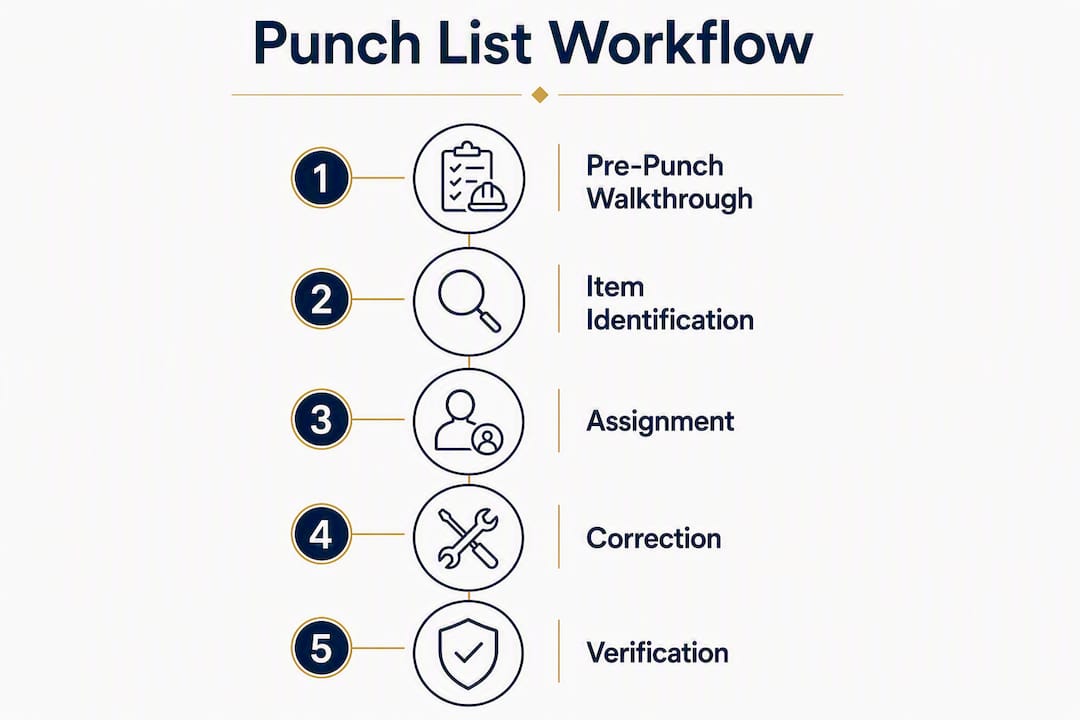
Before the owner or architect ever sets foot on site for a formal inspection, the general contractor should run an internal pre-punch. This is a trade-by-trade sweep of every space, conducted by the superintendent and relevant foremen, to catch and correct obvious deficiencies before they become formal punch items. Teams that skip this step hand the owner a long list and a bad first impression.

Substantial completion and its contract trigger
Substantial completion is the point at which the work is sufficiently complete that the owner can use or occupy the facility for its intended purpose, even though minor corrections remain. Under AIA A201 General Conditions, the contractor is required to prepare and submit a list of items to be completed or corrected before requesting the architect’s inspection for substantial completion. The architect then issues a Certificate of Substantial Completion, which formally starts the punch-list clock.
The AIA A201 framework makes substantial completion the legal dividing line: the owner may take possession and begin operations, but the contractor retains the obligation to correct every listed item. Retainage, typically 5–10% of the contract value, is held by the owner until every punch list item is signed off. The cash-flow pressure alone is reason enough to treat the punch list as a financial document, not just a field checklist.
Who owns what on a punch list?
The most common reason punch lists stall is simple: nobody is clearly in charge of a specific item. Here is how responsibility should be assigned.
| Role | Responsibility |
|---|---|
| General Contractor | Prepares the internal pre-punch list; assembles the master list; assigns items to subs; verifies corrections before owner re-walk |
| Subcontractors | Correct deficiencies within their scope; notify GC when items are ready for verification |
| Architect / Designer | Conducts the substantial-completion walkthrough; adds items to the formal list; issues the Certificate of Substantial Completion; verifies final closure |
| Owner | Participates in the walkthrough; approves or disputes the list; signs off on final completion; authorizes retainage release |
| Owner’s Representative | May conduct independent inspections; escalates unresolved items; coordinates with the GC on backcharges if corrections are not made |
A few points that table cannot fully capture:
- The GC owns the master list even when the architect adds items. One document, one owner.
- Subcontractors are responsible for their own scope only. A plumber is not responsible for a drywall patch unless the contract says otherwise.
- Backcharges are the GC’s escalation tool when a sub fails to correct an item by the agreed deadline. Document the notice in writing before pulling another crew.
- The architect’s sign-off is not a formality. If the architect disputes a correction, the item stays open regardless of what the sub says.
Pro Tip: Assign a single point of contact at the GC level — typically the project engineer or superintendent — who owns the master list, tracks status daily, and communicates directly with each sub’s foreman. Diffuse ownership is where items go to die.
What items actually show up on a punch list?
The following table covers the most common categories. These are not exhaustive, but they represent what shows up on nearly every commercial project.
| Trade | Common Punch List Items |
|---|---|
| Electrical | Outlet covers missing or misaligned; breaker labels incomplete; light fixtures not level; GFCI outlets not tested; panel schedules not posted |
| Plumbing | Fixture caulking incomplete; water pressure not balanced; drain covers missing; supply valves not labeled; water heater commissioning not documented |
| HVAC / Mechanical | Diffusers not balanced; filters not installed; thermostat programming incomplete; duct insulation exposed; equipment startup sheets missing |
| Doors & Hardware | Door closers not adjusted to latch; locksets not keyed per schedule; thresholds not sealed; door stops missing; frames not caulked |
| Finishes | Paint touch-ups at corners and reveals; tile grout incomplete or cracked; flooring transitions not secured; base molding gaps; wall patches visible |
| Exterior | Caulking at penetrations incomplete; concrete flatwork cracking or spalling; landscaping not per plan; exterior lighting not aimed; signage not installed |
| Life Safety | Exit signs not illuminated; fire extinguisher brackets not mounted; sprinkler head escutcheons missing; smoke detector testing not documented |
A note on misclassification: not every deficiency belongs on a punch list. If the owner requests something that was never in the original contract documents, that is a change order, not a punch item. Accepting it as a punch item without a signed change order is how GCs absorb cost they were never paid for. When an item is ambiguous, reference the spec section and the contract drawings before you add it to the list.
Pro Tip: Photograph every item the moment you identify it. A timestamped photo showing the deficiency and its location eliminates “it was always like that” arguments later.
How to write punch list items that actually get fixed
Vague descriptions create rework cycles. A subcontractor who receives “fix door” will make a guess, and the guess will probably be wrong. The goal is to write every item so precisely that the sub can act without a single follow-up call.
The required fields for every item
A compliant punch list item must include precise identifying information, an actionable description, the responsible party, and photo evidence. Here is the full field set:
- ID number: Sequential, never reused.
- Location hierarchy: Building > floor > room number > wall or surface (e.g., Building A, 2nd floor, Room 204, north wall).
- Description: What is wrong, where exactly, and what “corrected” looks like.
- Spec reference: The applicable specification section, if relevant (e.g., Spec 08 71 00 for door hardware).
- Responsible party: Named subcontractor or crew, not just a trade.
- Due date: A calendar date, not “ASAP.”
- Priority: Critical (life safety / occupancy), standard, or minor cosmetic.
- Photo link: At least one timestamped photo of the deficiency.
- Status: Open, in progress, ready for verification, closed.
- Verifier: Name of the person who confirmed the correction.
- Closure date: Date the item was verified closed.
Good vs. poor item descriptions
| Poor | Actionable |
|---|---|
| Fix door | Room 204 north wall: door closer does not latch. Adjust hydraulic closer to achieve 5mm gap at latch per Spec 08 71 00 and manufacturer torque settings. |
| Paint touch-up needed | Lobby, east wall at window reveal: section of paint missing at drywall joint. Touch up with matching finish to adjacent surface. |
| Plumbing issue | Men’s restroom, 3rd floor: lavatory faucet drips at cold supply. Replace cartridge per manufacturer spec. Confirm no leaks before closing. |
The difference is not just clarity. A precise description creates a paper trail. If the sub corrects the wrong thing, the original description is the record that protects the GC.
How to run the punch list process from pre-punch to final sign-off
A structured workflow prevents items from falling through the cracks between trades, walkthroughs, and correction cycles.
- Internal pre-punch (2–4 weeks before substantial completion): Superintendent and project engineer walk every space, trade by trade. Log all deficiencies into the master list. Assign items and set correction deadlines before the formal walkthrough.
- Subcontractor self-inspection: Each sub reviews their own scope against the pre-punch list and corrects items before the owner walkthrough. GC verifies corrections.
- Formal substantial-completion walkthrough: Owner, architect, and GC walk the project together. Architect adds items to the formal list. GC notes any items the owner requests that may be change orders.
- Correction cycle 1: Subs correct their assigned items by the first deadline. GC superintendent re-walks each corrected item, confirms with photo evidence, and updates status.
- Verification walkthrough: GC and architect re-walk open items. Architect signs off on corrected items. Remaining items carry forward with revised deadlines.
- Final verification and sign-off: All items closed. GC assembles final closeout package. Architect issues final completion certificate. Owner authorizes retainage release.
Trade-by-trade inspections consistently outperform random walkthroughs. Walking all electrical items in sequence, then all plumbing, then finishes, keeps your attention focused and reduces the chance of missing a cluster of related deficiencies in one area. A consistent room path helps too: entry, left wall, far wall, right wall, ceiling, floor. Follow it in every space and you will not skip a surface.
Platforms like Procore integrate directly into this workflow. Teams use mobile apps to attach photos, assign responsibility, and timestamp every status change in the field. That audit trail is far more defensible than a spreadsheet when a dispute arises. Purpose-built punch-list software attaches photos, timestamps, and responsibility filters that spreadsheets simply cannot replicate at scale.

Pro Tip: The superintendent must physically re-walk every item the sub marks “done” and photograph the corrected condition before updating the status. A verbal “it’s fixed” is not a closed item.
What fields belong in your punch list template?
A well-structured template is the difference between a list that drives closeout and one that creates confusion. The table below covers every field a commercial project needs.
| Field | Purpose | Required? |
|---|---|---|
| Item ID | Unique reference number for tracking | Yes |
| Project name / number | Ties the item to the contract | Yes |
| Building / floor / room | Location hierarchy for field navigation | Yes |
| Description | Actionable deficiency and correction standard | Yes |
| Spec reference | Ties correction to contract documents | Recommended |
| Photo link | Timestamped evidence of deficiency | Yes |
| Responsible party | Named sub or crew | Yes |
| Due date | Calendar deadline for correction | Yes |
| Priority | Critical / standard / cosmetic | Yes |
| Status | Open / in progress / ready / closed | Yes |
| Verifier name | Person who confirmed the fix | Yes |
| Closure date | Date item was verified closed | Yes |
| Cost to complete | Estimated cost if backcharge is needed | Optional |
| Backcharge notes | Documentation if another party is assigned | Optional |
| Dependency notes | Items blocked by another trade | Optional |
For teams working in spreadsheets, export the table as a CSV and import it into Excel or Google Sheets. Add conditional formatting to flag overdue items in red and items ready for verification in yellow. For teams using Procore or similar platforms, most of these fields map directly to the platform’s built-in punch-list module, and items can be assigned, updated, and closed from a mobile device in the field.
Smart facility integration tools can augment this workflow further by capturing sensor-based data during commissioning that feeds directly into verification records.
Is a punch list legally binding, and how does it affect retainage?
The short answer: yes, in most contracts, punch-list completion is a condition of final payment. Practical Law notes) that many contracts require contractor-prepared punch lists at pre-final inspection, and that punch-list completion is often the contractual trigger for final completion and payment.
The punch list is not just a field document — it is a contract deliverable. Failure to complete listed items on time gives the owner grounds to withhold final payment, apply liquidated damages, or hire another contractor and backcharge the GC for the cost.
The most common sources of punch-list disputes:
- Vague item descriptions that allow the sub to argue the correction meets the standard.
- New scope added as punch items by the owner, which should be change orders.
- Missing documentation — no photos, no spec references, no dated sign-offs.
- Verbal agreements about what “done” means that are never written down.
Dispute-avoidance strategies that actually work:
- Write every item with a spec reference and a measurable acceptance standard.
- Document every owner request made during the walkthrough. If it is outside the original scope, issue a change order before adding it to the list.
- Use timestamped photos at both the deficiency stage and the correction stage.
- Set written deadlines and send written notice when a sub misses one.
- Never accept verbal confirmation of completion. The superintendent re-walks every item.
For projects where disputes escalate to adjudication or litigation, the quality of your punch-list documentation is often the deciding factor. Construction law practitioners consistently point to incomplete or undated records as the primary reason contractors lose payment disputes.
How to verify completed items and trigger retainage release
Closing out a punch list is not just marking items “done.” It is assembling a documentation package that gives the owner, the architect, and the lender everything they need to release final payment with confidence.
Verification steps before requesting final payment:
- Superintendent re-walks every item marked “ready for verification” and photographs the corrected condition against the original deficiency photo.
- Cross-check each closed item against the original description to confirm the correction meets the stated standard, not just a reasonable approximation.
- Confirm that all spec references cited in the item have been satisfied (torque settings, material matches, pressure tests).
- Update item status to “closed” only after physical verification, not when the sub reports completion.
Final closeout documentation package:
- Completed punch list with all items showing “closed” status, verifier name, and closure date.
- Timestamped photo log for every item (before and after).
- As-built drawings submitted and approved.
- All warranties and guarantees submitted in writing.
- O&M manuals delivered to the owner.
- Certificate of occupancy from the authority having jurisdiction.
- Final lien waivers from all subcontractors and suppliers.
- Architect’s Certificate of Final Completion.
Typical commercial closeout windows run two to six weeks from the final walkthrough, depending on project complexity and how many items remain open. The GC should set a hard internal deadline for sub corrections that falls at least five business days before the owner’s final walkthrough, leaving time for verification and re-walk before the formal meeting.
Key Takeaways
A punch list in construction is a cash-flow document as much as a field checklist: every unresolved item holds retainage and delays final payment, so disciplined item writing, clear ownership, and physical verification are the three levers that control closeout speed.
| Point | Details |
|---|---|
| Retainage is at stake | Retainage typically runs 5–10% of contract value; slow punch-list closure directly delays final payment. |
| Timing is contractual | Run an internal pre-punch before the formal walkthrough; AIA A201 requires the contractor to submit a list before requesting substantial-completion inspection. |
| Write items precisely | Every item needs a location hierarchy, actionable description, spec reference, photo, responsible party, and due date. |
| Verify physically | The superintendent must re-walk and photograph every corrected item before marking it closed — verbal confirmation is not sufficient. |
| Nationwidemaintenance supports closeout | Nationwidemaintenance provides punch-list repair, final cleaning, and verification support for commercial projects across NY, NJ, and CT. |
Why a disciplined punch list workflow protects everyone at closeout
The conventional wisdom treats the punch list as a formality — a short list of cosmetic fixes you knock out in a day or two before handing over the keys. That framing is wrong, and it costs contractors real money.
The punch list is where project risk concentrates. By the time you reach substantial completion, the owner has leverage: they have possession, and you have retainage sitting in their account. Every day an item stays open is a day that leverage works against you. A vague description, a missed photo, a sub who marks something done without a re-walk — any one of those creates a dispute that can hold up final payment for weeks.
What actually works is treating the punch list the way you treat a contract deliverable, because legally, it is one. That means starting the internal pre-punch early enough to correct obvious items before the architect ever sees them. It means writing descriptions that leave no room for interpretation. It means the superintendent physically walks every closed item with a camera, not a clipboard.
The teams that close out fastest are not the ones with the fewest punch items. They are the ones with the best documentation. An owner who receives a complete closeout package — photos, spec references, verifier signatures, warranties, O&M manuals — has no reason to delay final payment. An owner who receives a spreadsheet with “done” typed next to every item has every reason to push back.
Nationwidemaintenance handles punch-list completion across NY, NJ, and CT
Punch-list closeout on commercial projects often stalls not because the GC lacks a process, but because the trades needed for final corrections — carpentry, cleaning, touch-up painting, hardware adjustment — are already mobilized on the next job. That is where Nationwidemaintenance fills the gap.

With over 30 years serving commercial, retail, and industrial clients across the Tri-State area, Nationwidemaintenance delivers the handyman and carpentry services that punch lists demand: door hardware adjustments, trim and base molding repairs, caulking, and finish touch-ups. The same contract covers post-construction cleaning and final floor care, so the GC does not need to coordinate three separate vendors to close out one project. Property managers and GCs working in Manhattan, New Jersey, and Connecticut use Nationwidemaintenance to compress the gap between “items corrected” and “owner sign-off.”
Request a closeout quote or visit the property management services page to see how the integrated service model fits your project’s final phase.
Useful sources and further reading
- Punch List — Wikipedia — A solid starting point for the definition, etymology, and general process overview, including the rolling punch-list approach during commissioning.
Recommended
Need this handled at your facility?
Our crews cover commercial properties across New York, New Jersey, and Connecticut.