Template First Preventive Maintenance Checklist for Facility Managers

A preventive maintenance checklist is a structured list of measurable, scheduled tasks (inspections, lubrication, part swaps, cleaning) that keeps equipment running and creates a paper trail you can defend in an audit. Done right, it cuts unplanned downtime, standardizes what technicians actually do on-site, and turns scattered work into data you can trend. This guide gives you the checklist fields, asset-by-asset templates, and the CMMS setup to make it stick.
TL;DR:
- Properly constructed checklists include asset ID, measurable pass/fail criteria, safety steps, parts needed, and clear sign-off fields to ensure accountability and audit readiness.
- Frequency triggers should be based on either calendar days or usage hours, with intervals refined over time using failure data and the 10% timing rule to maintain data accuracy.
- Checklists must be tailored to each asset by incorporating OEM specifications and failure history, rather than relying solely on generic templates or manufacturer defaults.
- Using a CMMS to automate triggers, reserve parts, and log completed tasks improves compliance and provides key metrics like completion rate, downtime, and failure interval trends.
- A single-contract maintenance provider fosters better coordination, staging, and accountability across multiple assets and locations, reducing schedule drift and failure to follow through.
Table of Contents
- What Is a Preventive Maintenance Checklist, and What Fields Does It Need?
- What Should a Preventive Maintenance Checklist Include?
- Sample Preventive Maintenance Checklists by Asset and Frequency
- How Do You Build a Preventive Maintenance Checklist for Your Facility?
- How Do You Track and Operationalize a Preventive Maintenance Checklist?
- Best Practices, Common Pitfalls, and Contract Considerations
- Nationwide Maintenance’s Take on Making Checklists Actually Work
- Sources
- FAQ
What Is a Preventive Maintenance Checklist, and What Fields Does It Need?
A preventive maintenance checklist is a structured, step-by-step document outlining routine tasks, including inspections, cleaning, lubrication, adjustments, and part replacements, performed at set intervals to keep assets running and catch failures before they happen. It exists for three reasons: it standardizes what “maintained” actually means across shifts and vendors, it creates accountability through sign-off, and it generates the measurement data you need to spot trends before a bearing seizes or a compressor trips.
A checklist that skips key fields is just a to-do list with extra steps. The ones that hold up in an audit, and actually help you find failure patterns, include:
- Asset ID: make, model, serial number, and location so nobody guesses which of five identical rooftop units got serviced
- Task description: the specific action, not “check unit,” but “inspect belt tension and record deflection”
- Frequency or trigger: calendar based (monthly) or usage based (every 500 run-hours)
- Measurable tolerance or pass/fail spec: a number or range, not a feeling
- Safety steps: lockout/tagout points, required PPE, confined-space notes
- Parts and tools needed: staged before the technician arrives, not discovered mid-job
- Findings field: space to record what was actually observed, not just a checkbox
- Sign-off: technician name, date, and supervisor review
The pass/fail spec is the piece most checklists get wrong. “Inspect belt” invites a shrug. A measurable version, like “belt deflection: 0.25 to 0.5 inches under 10 lbs force, replace if cracked or glazed,” removes the guesswork and gives you a number to compare next quarter.
What Should a Preventive Maintenance Checklist Include?
Every checklist should follow the same skeleton, whether it is running a chiller or a delivery van. Standard PM checklists organize around six blocks: the asset and service header, safety precautions, inspection items with criteria, measurements to record, parts and consumables used, and a findings/sign-off section that closes the loop.
Here is how that structure plays out on an actual work order:
- Header: asset ID, work order number, technician, date, checklist version
- Safety: LOTO points identified, PPE required, hazards flagged before work starts
- Visual inspection items: corrosion, leaks, loose fasteners, unusual noise or vibration
- Measured checks with specs: this is where generic checklists fail and specific ones earn their keep
- Lubrication and consumables: type, quantity, and part number used
- Findings and corrective action needed: anything outside tolerance gets flagged for a follow-up work order
- Sign-off: technician and supervisor signatures, timestamp
The measured-check line is where detail matters most. A rooftop HVAC unit might specify refrigerant pressure within a manufacturer range, filter pressure drop under 0.5 inches of water column, and condenser coil temperature split of 15 to 20 degrees. A conveyor motor might call for bearing temperature under 180°F and belt tension torqued to spec, in foot-pounds, per the OEM manual. A fleet PM might require brake pad thickness above 4mm and tire tread depth above 4/32 inch.
Pro Tip: Write every checklist item so a second technician, someone who never touched that asset before, could read the spec and know instantly whether it passed. If the item requires “experience” to judge, it is not a checklist item yet.
Sample Preventive Maintenance Checklists by Asset and Frequency

The most reliable way to organize a facility maintenance checklist is by frequency tier mapped to asset criticality, with each tier triggered by either the calendar or actual run-hours, whichever hits first.
HVAC systems
- Daily/weekly (operator): visual check for unusual noise, thermostat calibration spot check, filter visual inspection
- Monthly (technician): filter replacement or cleaning, condensate drain flush, belt inspection
- Quarterly (technician): coil cleaning, refrigerant pressure check, electrical connection tightness
- Annual (contractor or specialized technician): full refrigerant charge verification, compressor amperage draw, control system calibration
Electrical systems
- Monthly: panel visual inspection, breaker labeling check, GFCI test in wet areas
- Quarterly: infrared thermal scan of panels for hot spots, tightness check on lugs and terminals
- Annual: full switchgear inspection, emergency generator load bank test, grounding system verification
Mechanical and production equipment
- Weekly: lubrication points, guard integrity, vibration listening check
- Monthly: belt tension and alignment, bearing temperature log
- Quarterly: gearbox oil analysis, motor amperage baseline comparison
- Annual: full alignment laser check, bearing replacement per run-hour schedule
Fleet and vehicles
- Daily (driver, run-hour triggered): fluid levels, tire pressure, lights and signals
- Monthly: brake inspection, battery terminal check
- Quarterly: rotation and alignment, fluid replacement per OEM interval
- Annual: full DOT inspection, transmission service
Building envelope and grounds
- Monthly: roof drain and sidewalk inspection for cracking or ponding, exterior lighting check
- Quarterly: caulking and sealant inspection at windows and joints, gutter clearing
- Seasonal: irrigation system winterization or startup, landscaping equipment servicing
- Annual: full roof membrane inspection, parking lot surface assessment
Safety and life-safety systems
- Monthly: fire extinguisher pressure gauge check, exit sign illumination test
- Quarterly: fire alarm panel test, sprinkler valve inspection
- Annual: full emergency system test, fire pump flow test, backup power transfer test
IT infrastructure
- Monthly: server room temperature and humidity log, UPS battery status check
- Quarterly: backup power test under load, network closet dust and airflow check
- Annual: full UPS battery replacement per manufacturer life cycle, data closet fire suppression inspection
Daily and weekly tiers usually fall to the equipment operator who’s already on-site. Monthly and quarterly work generally needs a certified technician who can read a torque wrench correctly and knows what “in spec” means for that asset. Annual and life-safety items often require a licensed contractor, both for liability reasons and because the equipment (fire pumps, elevators, backup generators) usually falls under jurisdictional inspection requirements anyway.
How Do You Build a Preventive Maintenance Checklist for Your Facility?
Generic templates get you started, but a checklist that actually prevents failures has to reflect your specific assets, your specific failure history, and your specific operating conditions.
- Inventory every asset and pull the OEM manual. Manufacturer-recommended intervals and tolerances are your starting baseline, not a suggestion to improve on blindly.
- Layer in your own failure history. If a specific pump has failed twice from bearing seizure, add a monthly bearing temperature check even if the OEM manual only calls for annual lubrication.
- Choose the trigger type per asset. Calendar-based scheduling works for corrosion-prone or environmentally exposed equipment; run-hour triggers fit anything with variable usage, like forklifts or backup generators.
- Apply the 10% timing rule. A monthly task should happen within roughly plus or minus 10% of its due date (about three days on a 30-day cycle) to keep data comparable and avoid drift that eventually turns monthly into “whenever.”
- Assign an owner per task, not per checklist. One name per line item, so nothing falls into the gap between two job titles.
- Stage parts and tools in advance based on what the checklist calls for, and specify the safety steps and sign-off requirement right on the line item.
- Pilot it for one cycle, then refine. Run the checklist on a small asset group first and fix the vague items before rolling it facility-wide.
- Let 12 to 18 months of CMMS data tell you where intervals are wrong. If a component consistently passes inspection three cycles running, the interval might be too aggressive; if it fails right before the next scheduled check, tighten it.
Pro Tip: Don’t copy a downloaded template item-for-item and call it done. The single biggest gap between a checklist that looks good and one that actually prevents failures is whether it reflects your equipment’s real failure history, not a generic manufacturer’s worst-case assumption.
How Do You Track and Operationalize a Preventive Maintenance Checklist?
A checklist sitting in a binder does nothing. A CMMS automates the trigger, populates the work order with the right checklist template, reserves the parts flagged in the line items, and logs the completed record with a timestamp, so you get an auditable history instead of a stack of paper.
Once it’s running, a handful of KPIs tell you whether the program is actually working:
- PM completion rate: percentage of scheduled PMs completed on time
- Corrective work generated: how many reactive work orders trace back to a missed or late PM
- Mean time between failures (MTBF): rising MTBF means your intervals are working
- Downtime hours: unplanned vs. planned, tracked by asset
- Maintenance cost per asset: to catch equipment that’s becoming a money pit before replacement makes more sense than repair
The 10% timing rule matters more than most facility teams give it credit for. A PM that’s supposed to happen every 30 days but regularly slips to day 35 or 40 isn’t just late, it’s corrupting your trend data, because you can no longer compare this month’s reading to last month’s on a consistent basis.
Contracts and service level agreements need the same specificity as checklist items. Clear SLA language defining what counts as an emergency versus routine work, the maximum response time for each category, and the escalation path if that time gets missed, prevents the kind of ambiguity that erodes a maintenance relationship over time. If you’re managing multiple vendors, tenant-facing repair workflows benefit from the same clarity; structured call and escalation models reduce the back-and-forth that turns a five-minute fix into a three-day ticket.
Best Practices, Common Pitfalls, and Contract Considerations
The checklists that survive contact with a busy facility team share a few traits, and the ones that get abandoned after two months share the opposite ones.
- Every item needs a number, not a feeling. “Inspect for wear” invites a shrug six months from now; “record belt deflection in inches” gives you something to compare.
- Contracts should spell out inclusions and exclusions explicitly. An annual maintenance contract (AMC) typically covers labor only, while a comprehensive maintenance contract (CMC) covers labor plus parts and consumables. Mixing up which one you signed is a common source of billing disputes on mission-critical assets.
- Train technicians on the why, not just the how. Knowing that a bearing temperature check catches early-stage lubrication failure makes a technician more likely to flag a borderline reading instead of rounding it to “fine.”
- Stage parts before the work order goes out, not after the technician discovers a filter is out of stock mid-shift.
- Review and adjust intervals using actual failure data, not just OEM defaults, especially for assets running harder or in dirtier conditions than the manufacturer assumed.
Pro Tip: If a checklist item has ever caused an argument about whether it “passed,” rewrite it with a number before the next cycle. Subjective checklist items are where PM programs quietly fall apart.
Nationwide Maintenance’s Take on Making Checklists Actually Work
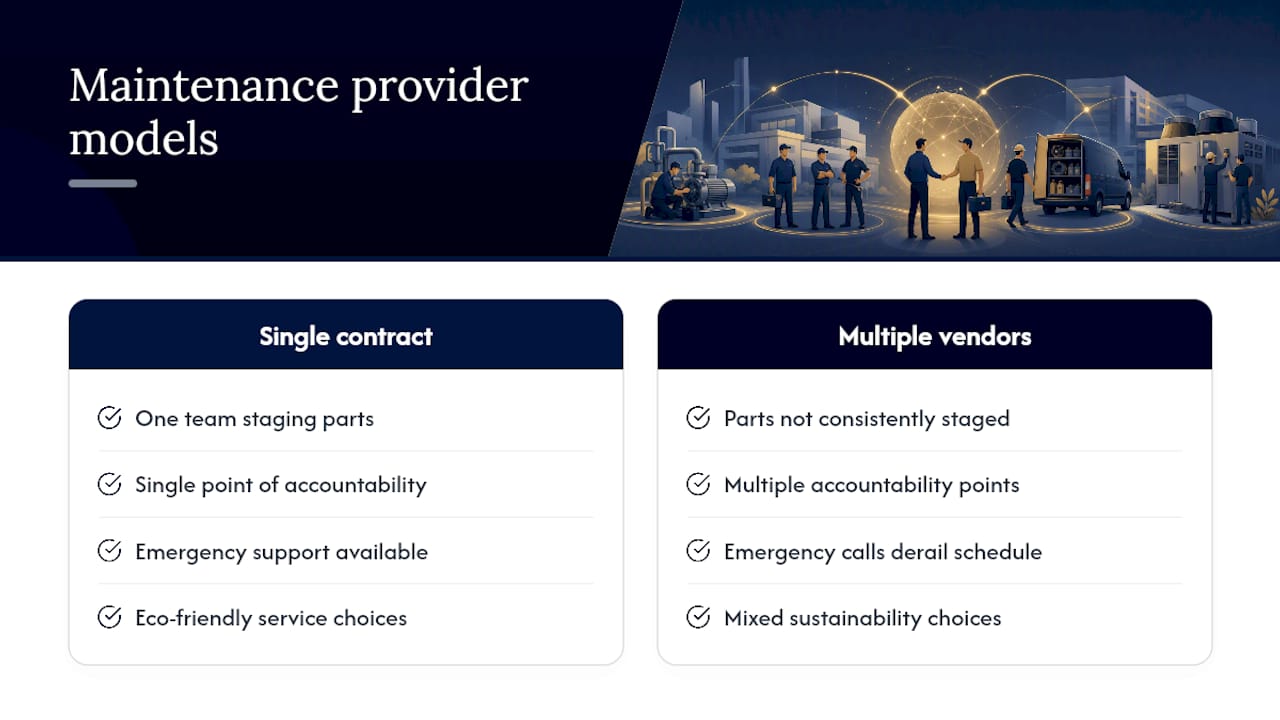
The technical side of a preventive maintenance checklist is the easy part. What breaks PM programs is coordination: parts that weren’t staged, a vendor who missed a window, an emergency call that derailed the week’s schedule. After three decades of running maintenance programs across retail, industrial, and commercial sites, our view at Nationwide Maintenance is that a checklist is only as strong as the operation behind it.
Some service providers build their offering around a single contract covering cleaning, pest control, construction, and grounds work instead of five separate vendors. One contract means one team staging parts consistently and one point of accountability when a PM slips. Emergency support available around the clock doesn’t replace scheduled PM, but it catches what the schedule inevitably misses. Eco-friendly service choices, from cleaning chemicals to equipment lifecycle decisions, can extend asset life as part of sustainability efforts.
— Nationwide Maintenance.
For facilities juggling multiple properties, a single-contract facility maintenance partner can keep PM compliance consistent across sites where separate vendors typically let schedules drift. Certain companies provide commercial cleaning, pest control, handyman, construction, and landscaping services under one agreement across multiple locations, offering support alongside existing preventive maintenance programs.
Sources
You don’t have to build a checklist from a blank page. A free downloadable template, like a 44-point checklist with asset headers and action/result fields, gives you a starting structure to adapt with your own asset IDs and tolerances.
- MaintainNow — Preventive maintenance checklist definition
- eWorkOrders — The Ultimate Preventive Maintenance Checklist
- Factory Investigator — Preventive maintenance checklist examples and frequency guidance
FAQ
What Is a Preventive Maintenance Checklist?
It’s a structured document listing scheduled maintenance tasks, inspection criteria, and measurable pass/fail specs for an asset, used to prevent failures and create an auditable maintenance record technicians and supervisors can both rely on.
What Are the Most Important Items on a Preventive Maintenance Plan?
The essentials are asset identification, a clear task description, a defined frequency or trigger, a measurable tolerance or pass/fail spec, and a completion sign-off, since these five fields are what make a checklist auditable and repeatable rather than just a suggestion list.
What Is the 10 Percent Rule in Preventive Maintenance?
It means a scheduled PM task should be completed within about 10% of its due interval (roughly three days on a 30-day cycle) to keep the timing consistent enough that trend data stays comparable from one cycle to the next.
How Often Should a Preventive Maintenance Checklist Be Updated?
Review intervals and tolerances after every failure that wasn’t caught by the current checklist, and do a full review at least annually using 12 to 18 months of CMMS data to see which intervals are too loose or too aggressive.
Should Daily Checks Be Done by Operators or Technicians?
Daily and weekly checks are typically handled by the equipment operator already on-site, while monthly, quarterly, and annual tasks that require measured tolerances or specialized tools usually need a trained technician or licensed contractor.
Recommended
Need this handled at your facility?
Our crews cover commercial properties across New York, New Jersey, and Connecticut.