Outsourcing Facilities Management: A Strategic Guide

What is outsourcing facilities management, and why does it matter?
Outsourcing facilities management means contracting specialized third-party providers to handle non-core building services, from janitorial and HVAC maintenance to landscaping, pest control, and security. Rather than staffing and managing each function internally, organizations delegate these responsibilities to experts who do this work every day, at scale.
The most compelling version of this model is Integrated Facilities Management (IFM), where a single provider or coordinated contract covers multiple service lines. One contract, one point of accountability, one invoice. That consolidation alone eliminates the coordination overhead that quietly drains facility managers’ time.
The core benefits are well established:
- Cost savings: Hidden internal costs, including payroll taxes, equipment upkeep, insurance, and administrative burden, often make in-house management more expensive than it appears on paper.
- Risk transfer: Vendor liability covers staff absences, equipment failures, and compliance gaps, reducing your organization’s exposure.
- Specialized expertise: External providers bring industry knowledge and sustainability approaches that most internal teams cannot match.
- Operational agility: Outsourced services scale up or down with demand, unlike fixed in-house headcount.
- Regulatory compliance: Providers stay current on OSHA standards, EPA regulations, and local codes as part of their core business.
Services most commonly outsourced include janitorial and commercial cleaning, HVAC and mechanical maintenance, landscaping and grounds care, pest control, security, and parking lot maintenance. The facility management outsourcing market is expected to surpass $1 trillion globally, driven by cost pressure and demand for specialized expertise. That trajectory reflects a structural shift, not a trend.
Table of Contents
- What are the real risks of outsourcing facility services?
- How do you build a successful outsourcing strategy?
- How has the post-COVID era changed facility management outsourcing?
- How Nationwidemaintenance delivers integrated facility management
- Nationwidemaintenance: one contract for every facility need
- Key Takeaways
What are the real risks of outsourcing facility services?
The benefits are real, but so are the pitfalls. Understanding them before you sign a contract is what separates a successful outsourcing relationship from an expensive lesson.
- Loss of organizational knowledge: When institutional knowledge walks out the door with departing in-house staff, space planning and specialized maintenance can suffer. Vendors unfamiliar with your building’s quirks, workflows, or equipment history need time to get up to speed.
- Reduced direct control: Day-to-day decision-making shifts to the vendor. If your SLAs are vague, you lose visibility into how work actually gets done.
- Vendor dependency: A single provider failure, whether a staffing crisis or a financial problem on their end, can disrupt your entire operation.
- Hidden contract complexity: Scope creep, change orders, and ambiguous contract language generate administrative costs that erode the savings you expected.
- Staff impact: Internal employees whose roles overlap with outsourced functions face uncertainty. Poorly managed transitions damage morale and institutional knowledge retention.
- Quality and accountability gaps: Without clear performance metrics and escalation procedures, it is difficult to hold vendors accountable when service quality slips.
None of these risks are reasons to avoid outsourcing. They are reasons to structure it carefully.
How do you build a successful outsourcing strategy?
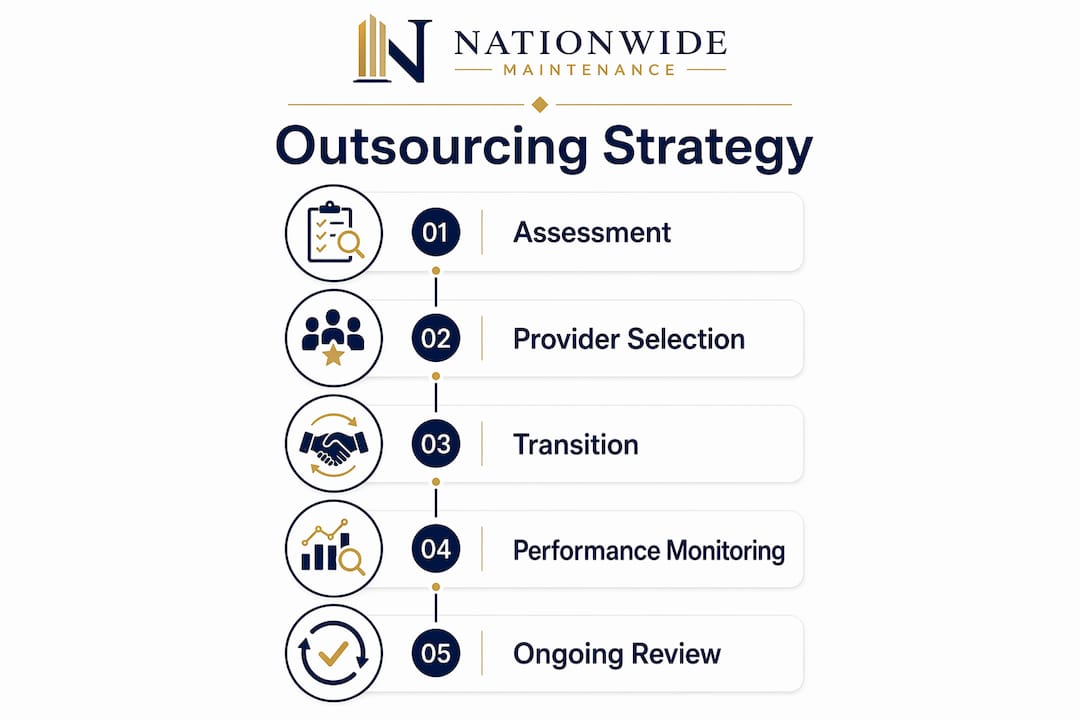
The difference between outsourcing that delivers and outsourcing that disappoints usually comes down to three things: who you pick, what the contract says, and how you manage the relationship after signing.

Vendor selection is where most organizations underinvest. Price matters, but alignment matters more. Evaluate vendors on their values, processes, and long-term track record, not just their bid. Ask for references from clients with similar facility types and service complexity. Use a structured vendor evaluation checklist to compare candidates on safety records, technology capabilities, and sustainability credentials.
Contract management is the operational backbone. Effective contracts specify measurable outcomes rather than prescribing methods, giving providers room to innovate while keeping you in control of results. Every facilities management contract should include:
- Defined SLAs with response times, completion standards, and escalation paths
- Governance structures for regular performance reviews
- Transparency requirements, including reporting and data access
- Flexibility clauses that allow scope adjustments as your needs change
Transition planning is frequently underestimated. Clear onboarding and offboarding protocols prevent service gaps when switching providers. Document your building systems, maintenance histories, and vendor contacts before the handover, not after.
Ongoing performance monitoring keeps the relationship honest. Schedule quarterly business reviews, track KPIs against SLA benchmarks, and address issues before they compound. The goal is a genuine partnership, not a transactional vendor relationship.
Pro Tip: When evaluating providers, ask specifically how they handle technology integration. Vendors using IoT sensors, CMMS platforms, or smart building tools give you data visibility that manual reporting cannot match. That data becomes your leverage in contract negotiations and performance conversations.
How has the post-COVID era changed facility management outsourcing?
The pandemic did not just change how buildings are used. It changed what facility managers are expected to deliver and how outsourcing contracts need to be structured to support that.
- Agility is now a baseline requirement: Hybrid work patterns mean occupancy fluctuates week to week. FM outsourcing must accommodate dynamic scaling of cleaning frequencies, HVAC adjustments, and space reconfigurations without requiring contract renegotiation every time.
- Health and sanitation standards have permanently risen: Enhanced hygiene protocols, air quality monitoring, and sanitation compliance are now standard expectations, not premium add-ons. Contracts written before 2020 almost certainly need updating.
- Technology expertise is a differentiator: Providers using IoT and smart building platforms to optimize space utilization and track maintenance in real time deliver measurably better outcomes than those relying on manual processes.
- Sustainability is contractually enforceable: Organizations with ESG commitments can now build green targets and reporting requirements directly into FM contracts, including LEED-aligned cleaning products, energy efficiency benchmarks, and waste diversion metrics.
- Data security provisions matter: As facilities become more connected, contracts must address who owns operational data, how it is stored, and what happens to it at contract end.
The organizations getting the most from outsourced facility services right now are the ones that updated their contracts to reflect this new operating reality, not the ones still running on pre-pandemic templates.
How Nationwidemaintenance delivers integrated facility management
Nationwidemaintenance has spent over 30 years building a service model that solves the core problem with most outsourcing arrangements: too many vendors, too little coordination. Serving commercial, retail, industrial, healthcare, government, and hospitality clients across the Tri-State area (New York, New Jersey, and Connecticut), the company operates as a single-contract provider across service lines that most organizations manage through four or five separate vendors.
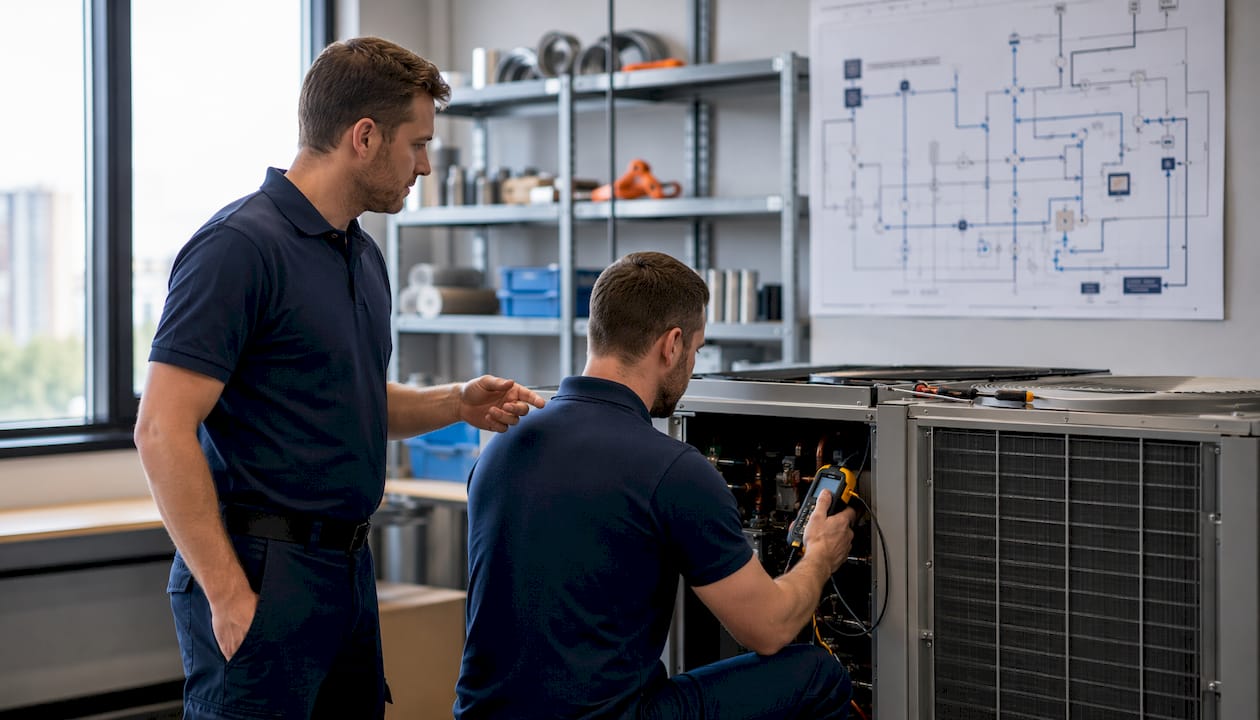
The integrated offering covers commercial cleaning and janitorial services, pest control and prevention, power washing, parking lot maintenance and repairs, handyman services, construction and renovation, landscaping and grounds care, and 24/7 emergency facility response. Clients like Costco and CVS rely on Nationwidemaintenance precisely because that breadth means one call handles what would otherwise require multiple dispatches, multiple invoices, and multiple accountability conversations.
| Service Category | Nationwidemaintenance Offering | Client Benefit |
|---|---|---|
| Cleaning & Janitorial | Daily, periodic, and specialty cleaning | Consistent standards across all locations |
| Pest Control | Prevention programs and emergency response | Regulatory compliance and brand protection |
| Landscaping & Grounds | Design, maintenance, and seasonal care | Curb appeal and property value preservation |
| Construction & Renovation | Commercial build-out and kitchen/bath renovation | Single vendor for facility upgrades |
| Emergency Response | 24/7 dispatch for facility incidents | Minimized downtime and liability exposure |
| Handyman & Repairs | Routine repairs and preventive maintenance | Reduced deferred maintenance backlog |
Eco-friendly practices are built into the service model, not offered as an upgrade. That matters for organizations with sustainability reporting requirements or LEED certification goals. The 24/7 emergency responsiveness means that when something goes wrong at 2 AM, there is a real answer, not a voicemail.
The professional janitorial services that anchor most facility contracts deliver more than cleanliness. They protect flooring investments, reduce slip-and-fall liability, and maintain the brand environment that high-traffic commercial spaces demand. Nationwidemaintenance’s commercial facility maintenance approach treats those outcomes as the standard, not the exception.
Nationwidemaintenance: one contract for every facility need
If you manage facilities across multiple locations, or even a single complex commercial property, the vendor coordination problem is probably costing you more than you realize. Nationwidemaintenance eliminates it.
Instead of managing separate contracts for cleaning, pest control, landscaping, and emergency repairs, property managers and facility directors in the Tri-State area work with one provider, one contract, and one team that knows their buildings. The result is faster response times, cleaner accountability, and a facility operation that does not depend on you personally tracking down five different vendors when something needs attention.
Nationwidemaintenance serves commercial, retail, industrial, healthcare, government, and hospitality clients across New York, New Jersey, and Connecticut. Whether you need a maintenance contract for ongoing facility care or a provider who can handle everything from a renovation project to a pest emergency, the integrated model is built for exactly that. Reach out to Nationwidemaintenance to discuss what a unified facility maintenance contract looks like for your properties.
Key Takeaways
Outsourcing facilities management under a single integrated contract delivers the strongest combination of cost control, service quality, and operational simplicity for U.S. commercial facilities.
| Point | Details |
|---|---|
| IFM consolidation wins | A single integrated contract reduces vendor overhead, simplifies accountability, and cuts administrative costs. |
| SLAs determine outcomes | Contracts with measurable performance metrics and escalation procedures are what separate successful outsourcing from costly disappointments. |
| Post-COVID contracts need updating | Agility clauses, enhanced sanitation standards, and sustainability targets are now baseline requirements, not optional additions. |
| Technology integration matters | Providers using IoT and smart building platforms deliver data visibility that manual reporting cannot replicate. |
| Nationwidemaintenance as integrated partner | Nationwidemaintenance serves Tri-State commercial clients with a single-contract model covering cleaning, pest control, landscaping, construction, and 24/7 emergency response. |
Recommended
Need this handled at your facility?
Our crews cover commercial properties across New York, New Jersey, and Connecticut.