Exact Timing Maintenance SLA Examples for Property Managers
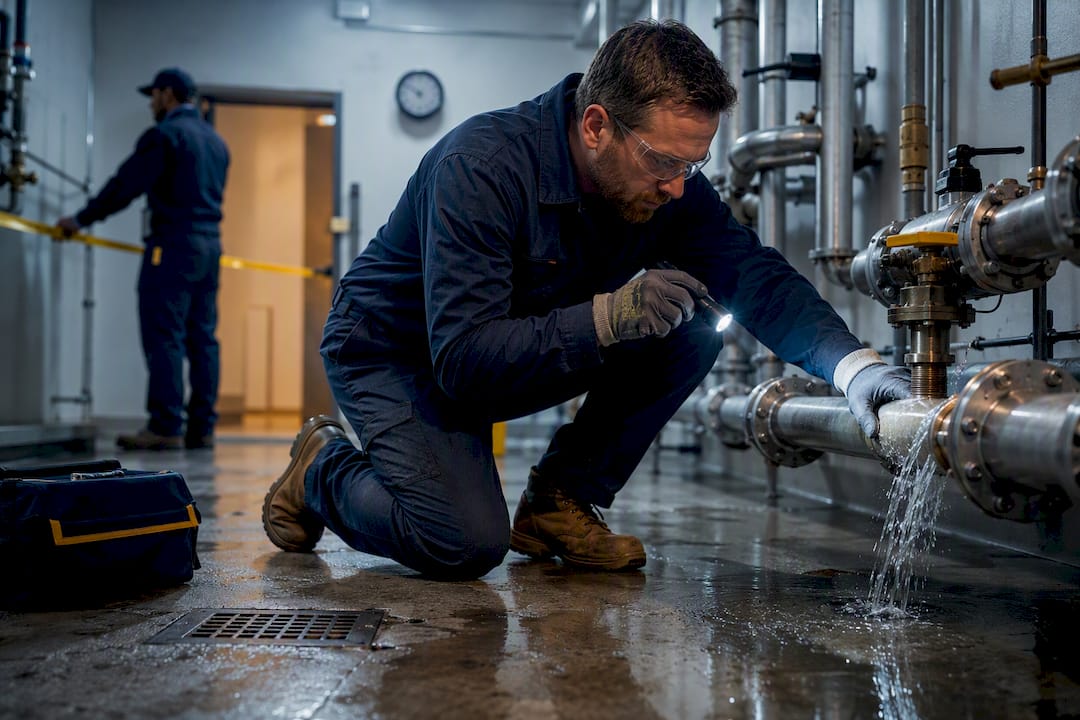
Most facility portfolios need one of three SLA patterns: emergency-focused for critical or 24/7 sites, mixed-portfolio for buildings juggling several trades, or preventive-only for vendors handling scheduled work like landscaping or HVAC filters. A mixed-portfolio template fits the majority of commercial and retail properties. Copy the sample clauses below, adjust the numeric windows to your site’s risk profile, and attach them to your next vendor contract.
TL;DR:
- Emergency SLA response windows should be within 15 to 30 minutes acknowledgment and four hours for technician arrival, with same-day resolution targets.
- Response times must be precisely defined using timestamps for acknowledgment, arrival, and repair, with automated system logs to prevent disputes.
- Key performance indicators include a first-time fix rate, on-time completion, and response time, all measured against verified timestamps and detailed reporting.
- Vendor capacity, site location, and weather seasonality heavily influence achievable response targets, requiring renegotiation or pilot periods before finalizing SLAs.
- Bundling multiple trades under one SLA reduces conflict, with nationwide providers offering integrated enforcement and accountability for diverse property portfolios.
Table of Contents
- Maintenance SLA Examples for Different Property Types
- What Every Maintenance Service Level Agreement Should Include
- How Fast Should Vendors Respond? Priority Tiers Explained
- Which Metrics Actually Prove an SLA Is Working?
- Sample SLA Clause Language You Can Copy
- How to Adjust These Templates for Your Portfolio
- What We’ve Learned Running SLAs Across Multiple Trades
- Let Nationwide Maintenance Build and Enforce Your SLA
- Templates and Standards Worth Bookmarking
- Sources
Maintenance SLA Examples for Different Property Types
A maintenance service level agreement only works if the numbers inside it match the risk of the building. A single-tenant warehouse doesn’t need the same response windows as a 24/7 urgent care clinic, and treating them the same is how facility teams end up paying for service they don’t need or, worse, waiting hours for a burst pipe that should have been a same-shift fix. Here are three templates built around real-world usage patterns.
Emergency-focused SLA. Built for hospitals, data centers, grocery stores, and any site where downtime creates liability. Priority 1 (P1) events, think flooding, power loss, or a security breach, get a defined acknowledgment window (often 15 to 30 minutes), a technician arrival target (2 to 4 hours), and a resolution or workaround deadline (often same-day). Everything else routes through slower tiers.
Mixed-portfolio SLA. The workhorse template for property managers running retail centers, office parks, or multi-tenant buildings with cleaning, HVAC, plumbing, and electrical all under one roof. It balances P1, P2, and P3 windows by trade instead of applying one blanket standard, since a broken thermostat in July is not the same emergency as a flickering hallway light.
Preventive-only SLA. Used for landscaping, sidewalk and exterior upkeep, pest inspections, and seasonal grounds work where there’s no “emergency” tier at all, just scheduling windows, access notice requirements, and completion deadlines tied to a calendar rather than a ticket.
Choose based on tenant expectations, not just building type. A Class A office with ground-floor retail behaves like a hospital when it comes to lobby cleanliness complaints, even though nothing about the HVAC system is life-safety critical.
What Every Maintenance Service Level Agreement Should Include
A maintenance SLA that skips precise definitions is a document that generates disputes instead of preventing them. The Arizona campus maintenance SLA is a useful public reference because it spells out scope, responsibilities, and priority tiers in plain language rather than legal boilerplate.
At minimum, every maintenance service level agreement needs:
- Scope and exclusions naming exactly which trades, equipment, and materials are covered, and which repairs (tenant-caused damage, code upgrades, capital replacements) fall outside the contract.
- Parties and term identifying the client, vendor, site locations, and renewal or termination dates.
- Timing definitions that separate ticket creation, acknowledgment, technician arrival, and work completion into distinct, timestamped events.
- Service hours covering standard business coverage and after-hours or emergency escalation paths.
- Priority tier definitions with concrete examples of what qualifies as P1 versus P2, so a vendor can’t reclassify a routine leak as an emergency to inflate billing, or downgrade a real one to dodge the response clock.
- Measurement method naming the system of record, whether that’s a CMMS platform, a shared ticketing tool, or photo-verified work orders.
The biggest drafting mistake is leaving “response time” undefined. Does the clock start when the ticket is logged, when a dispatcher confirms it, or when the technician calls ahead? SLA template guidance consistently separates acknowledgment from arrival from resolution because conflating them is the single most common source of vendor disputes.
Pro Tip: Require your vendor’s system to timestamp every status change automatically. A manually updated spreadsheet is where “we responded on time” claims go to die under a dispute review.
How Fast Should Vendors Respond? Priority Tiers Explained
Numeric SLA targets only mean something when they’re tied to a specific event and a specific trade. Here’s a workable structure for most commercial and retail portfolios.
P1, Emergency. Active flooding, total power loss, elevator entrapment, security system failure, or anything creating an immediate safety hazard. Acknowledge within 1 hour (some sites require 15 to 30 minutes), dispatch a technician immediately, arrive on-site within 4 hours, and resolve or install a temporary workaround within 24 hours.
P2, Urgent. HVAC failure in occupied space, plumbing leaks not actively flooding, non-functioning restroom fixtures, or lighting outages in high-traffic areas. Acknowledge within 4 hours, arrive within 24 to 48 hours, resolve within 3 to 5 business days.
P3, Routine. Cosmetic repairs, non-urgent carpentry, minor landscaping issues, filter replacements. Acknowledge within 1 business day, complete within 5 to 10 business days depending on parts availability.
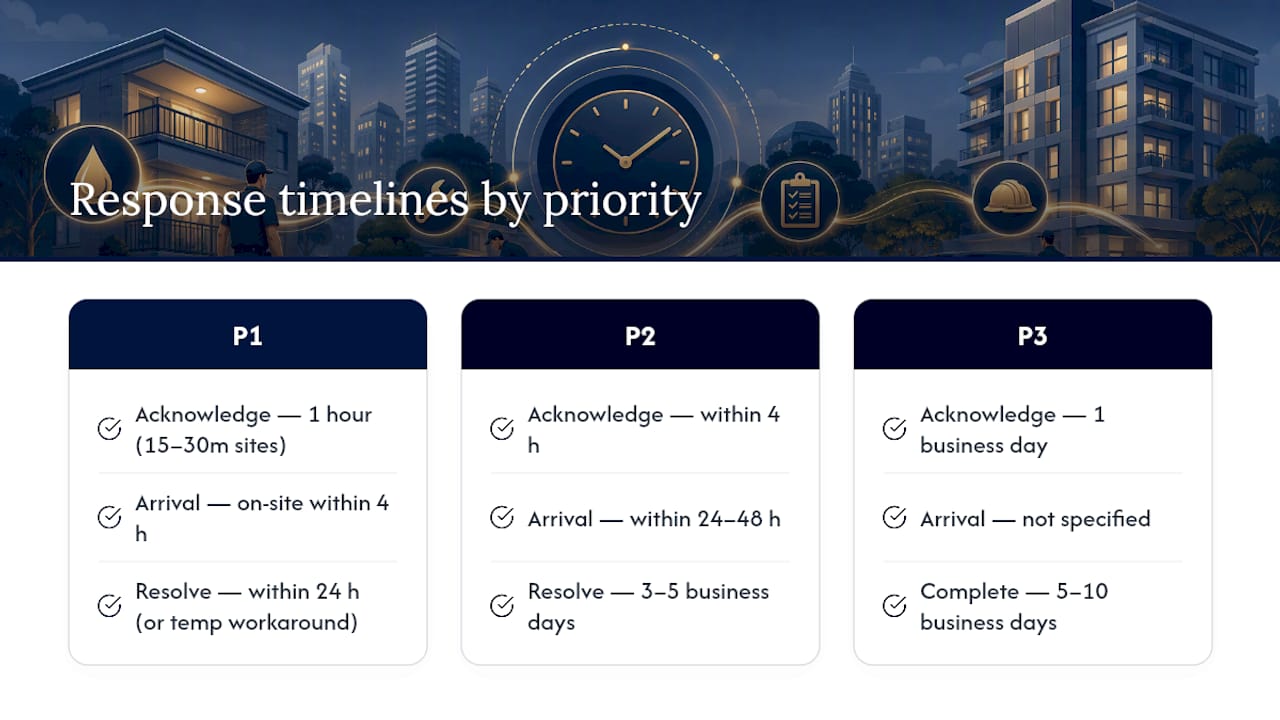
Property managers who write these numbers into contracts, rather than leaving response expectations verbal, report fewer disputes and more predictable maintenance budgets, largely because everyone is arguing from the same document instead of memory.
Build in exceptions for parts procurement, permit delays, and tenant access refusal, because a resolution clock that ignores a locked door or a backordered compressor part is a clock nobody can actually hit. One Australia-based maintenance framework makes this explicit: resolution times are targets, not guarantees, which is honest language most US contracts should borrow. Document which events trigger a P1 versus P2 classification in writing, with photo or system evidence required, so neither side can argue after the fact about what actually happened.
Which Metrics Actually Prove an SLA Is Working?
Response time promises are worthless without measurement behind them. A functional maintenance SLA tracks a small set of KPIs, defined precisely enough that two people looking at the same ticket would calculate the same number.
- First-time fix rate: the percentage of work orders resolved on the initial visit without a callback. This is often the single best indicator of vendor competence, since chronic return visits usually mean under-stocked trucks or undertrained technicians.
- On-time completion rate: percentage of tickets closed within their assigned priority window, measured against the acknowledgment timestamp, not the ticket creation timestamp.
- Average response time: mean time from ticket logged to technician acknowledgment, broken out by priority tier so a P3 backlog doesn’t quietly drag down your P1 average.
- Uptime or availability, where relevant: applicable mainly to mechanical systems, elevators, or IT-adjacent equipment where downtime is a real cost.
Good SLAs pair each of these with defined measurement methods and remedies, not just a target number sitting in isolation. Reporting cadence matters as much as the metrics themselves: monthly reports should include work-order IDs, timestamps for every stage, before-and-after photos for completed repairs, and parts used. Quarterly rollups should show trend lines, not just the current month’s snapshot.
Pro Tip: Ask your vendor for a sample report before signing anything. If they can’t produce one with real timestamps and photo evidence, they don’t have the systems to hit the SLA you’re about to sign.
Sample SLA Clause Language You Can Copy
Below is starter language for the sections most facility teams struggle to draft from scratch. Adjust the bracketed numbers to your site.
-
Definitions clause: “Response Time” means the elapsed time between Vendor’s receipt of a service request and Vendor’s written or system-generated acknowledgment. “Arrival Time” means the elapsed time until a qualified technician is physically on-site. “Resolution Time” means the elapsed time until the reported issue is corrected or a temporary workaround is installed.
-
Priority response clause: For P1 Emergency events, Vendor shall acknowledge within [1] hour, arrive within [4] hours, and resolve or install a workaround within [24] hours of arrival.
-
Preventive maintenance clause: Vendor shall perform scheduled preventive maintenance according to the attached calendar and shall provide [48] hours’ written notice before requiring site access, except for emergency response work.
-
Service credit clause: For each P1 event where Vendor fails to meet the Response Time or Resolution Time above, Client shall receive a service credit equal to [5%] of that month’s invoice, up to a maximum of [20%] per month.
-
Exclusions clause: This Agreement excludes damage caused by tenant misuse, acts of God, code-mandated capital upgrades, and equipment beyond its manufacturer-rated service life.
Downloadable versions of most of these sections exist in free maintenance SLA templates, which can save drafting time if you’re building your first agreement from scratch.
How to Adjust These Templates for Your Portfolio
Distance and vendor staffing drive realistic targets more than anything else. A vendor with technicians stationed within 20 minutes of your site can commit to a tighter P1 window than one dispatching from across a metro area, so ask about staging locations before agreeing to aggressive numbers.
Negotiate a 90-day pilot period with the option to revisit response targets once real data exists. Before signing, confirm the vendor maintains on-call staffing outside business hours, keeps common parts stocked or staged nearby, and can integrate with (or at least export data compatible with) your CMMS platform.
- Add a seasonal amendment clause allowing landscaping or snow-removal windows to shift with weather patterns.
- Include a portfolio-growth clause specifying how new sites get added without renegotiating the entire contract.
Pro Tip: If a vendor agrees to every number you propose without pushback, that’s a warning sign, not a good deal. A vendor who understands their own capacity will negotiate at least one target.
What We’ve Learned Running SLAs Across Multiple Trades
Bundling cleaning, pest control, landscaping, and repairs under one SLA instead of four separate vendor contracts cuts down on the finger-pointing that happens when nobody owns a problem. We’ve seen fewer disputes and clearer escalation paths when one accountable contract, not four competing ones, defines the response clock.
— Nationwide Maintenance.
Let Nationwide Maintenance Build and Enforce Your SLA
Writing a strong SLA is only half the job. Enforcing it across dozens of sites, multiple trades, and shifting tenant demands is where most in-house teams run out of bandwidth. An integrated maintenance provider offers an alternative to juggling separate vendor contracts for cleaning, pest control, landscaping, and repairs: one signed agreement covers all of it, with a single point of accountability instead of multiple companies pointing fingers at each other during a dispute.
Nationwidemaintenance customizes response and resolution windows by site type and enforces them with 24/7 emergency support, preventive scheduling, and documented reporting across every trade under the contract. That means the P1 window you negotiate for a flooding basement applies the same way whether the technician is a plumber, an electrician, or a pest control specialist. Whether you manage a single retail location or a multi-state portfolio, our property management maintenance programs are built around the exact SLA structure outlined above. Request an SLA review today and see how a single contract compares to what you’re currently piecing together across vendors.
Templates and Standards Worth Bookmarking
For deeper reference, review the Arizona campus SLA example, downloadable SLA templates, and Atlassian’s SLA framework for ticket-based measurement standards.
Sources
- Maintenance Service Level Agreement (SLA) Terms
- Service Level Agreement (SLA): example, template and downloads
- Service Level Agreement Template: How to Write an SLA | Contractable
- Property Maintenance SLA Template for Service Providers
Recommended
Need this handled at your facility?
Our crews cover commercial properties across New York, New Jersey, and Connecticut.