Facility Managers: 6 Steps to Audit Ready LEED Cleaning Requirements
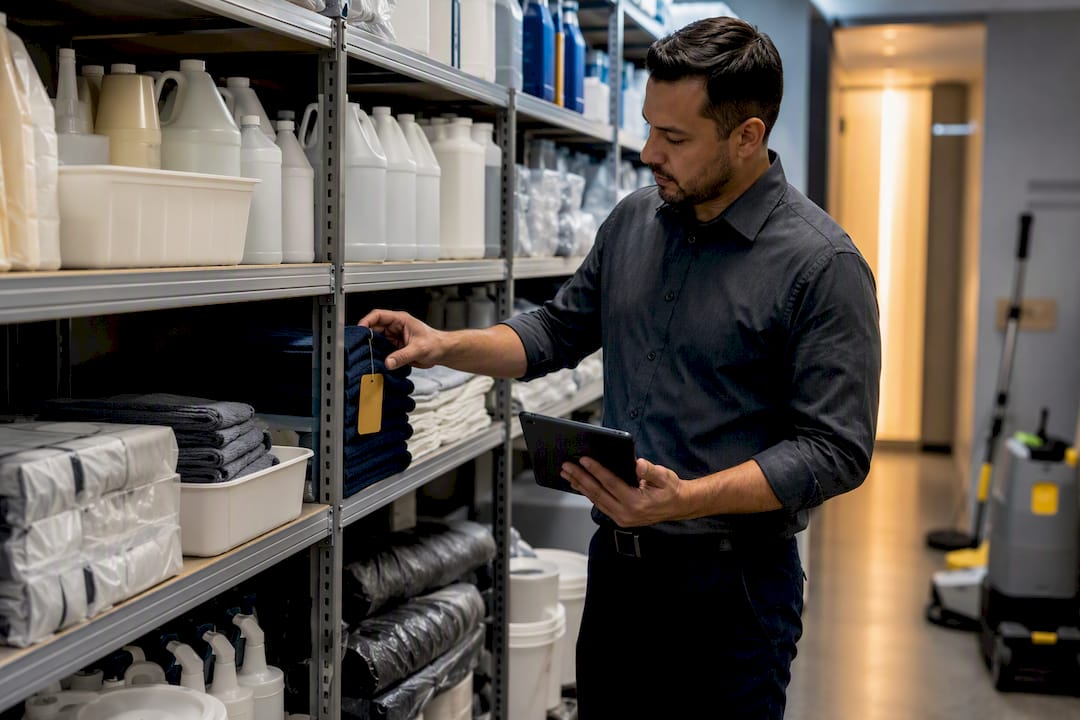
LEED requires a building-specific green cleaning policy plus documented evidence covering products, equipment, training, and audits, delivered either through an in-house program or a certified cleaning vendor. Products need certifications like Green Seal, UL EcoLogo, or EPA Safer Choice to count toward the purchasing threshold. Choose Option 1 (in-house policy) if you want direct control, or Option 2 (certified vendor) if you’d rather outsource the paperwork.
TL;DR:
- Achieving LEED green cleaning certification requires documented policies, procedures, and proof of compliance for products, equipment, training, and audits within the certifying performance period.
- Certification of cleaning products and equipment depends on specific standards like Green Seal, UL EcoLogo, and EPA Safer Choice, with around 75% of purchases by cost needing to meet these benchmarks.
- Ongoing staff training, equipment maintenance, and purchase record tracking must be performed within the certification window, with quarterly documentation being crucial for audit readiness.
- Choosing between in-house policy management and outsourcing to a certified vendor impacts the documentation process, requiring clear contractual clauses and audit access provisions.
- Most failures in LEED audits stem from paperwork gaps, such as lapsed certifications or missing logs, not product quality, making timely, organized documentation the top priority.
Table of Contents
- What Do LEED’s Green Cleaning Prerequisite and Credits Actually Cover?
- Green Cleaning Policy: Required Components and Sample Content
- Products and Purchasing: Which Certifications Count and How Much You Need
- Equipment and Performance Standards You Need to Document
- How Often Do You Need Training, Audits, and Recordkeeping?
- Option 1 vs. Option 2: In-House Policy or Certified Cleaning Vendor?
- Turning Requirements Into an Audit-Ready Checklist
- How Nationwide Maintenance Builds LEED-Aligned Cleaning Programs
- Perspective: Where LEED Cleaning Audits Actually Go Wrong
- Get LEED Audit-Ready Without Managing Five Vendors
- Sources
What Do LEED’s Green Cleaning Prerequisite and Credits Actually Cover?
LEED for Existing Buildings treats green cleaning as both a baseline requirement and a scoring opportunity. The scope is wider than most facility managers expect: it covers cleaning products, janitorial paper, trash liners, equipment, written procedures, and how you protect occupants during and after cleaning operations. A single missing category, like undocumented liner specs, can knock out points that seemed secure.
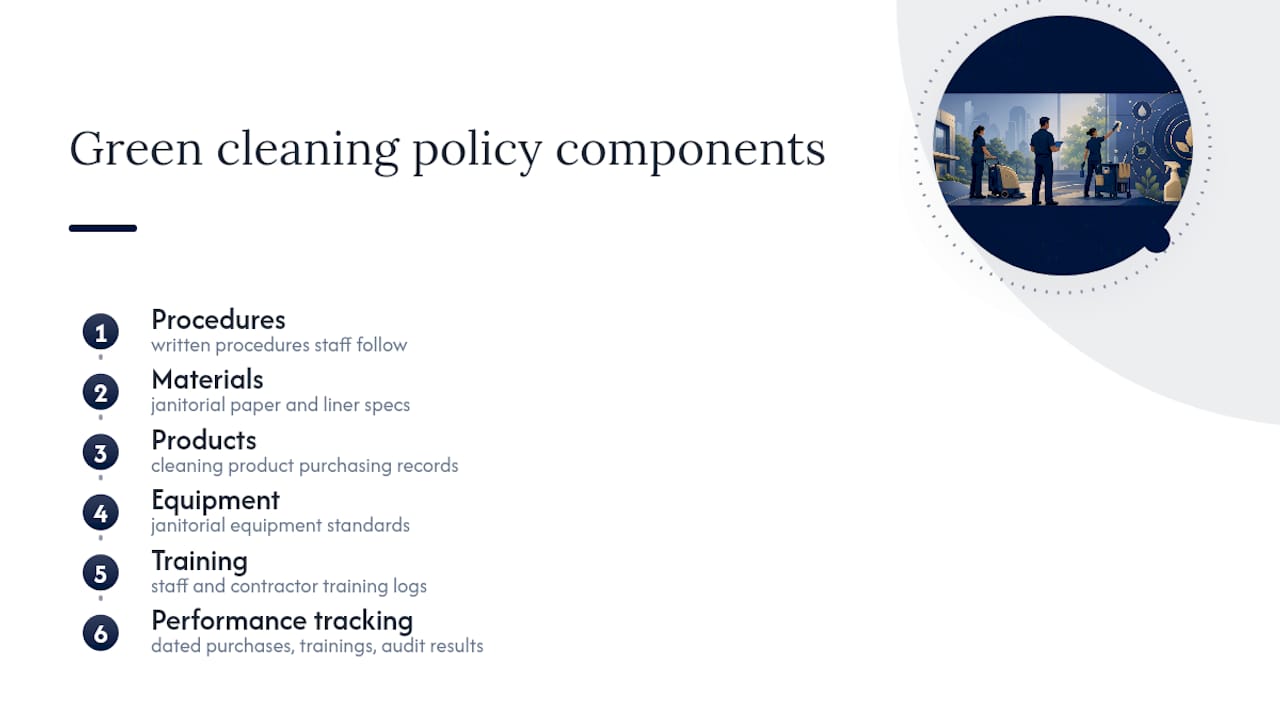
The LEED v5 O+M Rating System ties green cleaning to a building-specific policy that spans procedures, materials, products, equipment, training, and performance tracking. That policy isn’t a formality. USGBC expects it to function as an operating document your janitorial staff or contractor actually follows, not something drafted once and filed away.
Several credit paths reference cleaning directly: sustainable purchasing for cleaning products, equipment standards, and integrated pest management often overlap with the green cleaning credit category. Indoor environmental quality credits also lean on cleaning practices, since chemical off-gassing and particulate disturbance during cleaning affect air quality scores elsewhere in the certification.
Timing matters as much as content. Your documentation needs to align with the performance period you’re certifying against, typically a 12-month window before submission. That means purchase records, training logs, and audit results all need dates that fall inside that window. A green cleaning policy written in January doesn’t help if your performance period started the previous March and you have no purchase tracking to show for those first ten months. Start documentation on day one of the performance period, not when you remember LEED is coming.
Green Cleaning Policy: Required Components and Sample Content
Your policy document needs to function as a working reference, not a checkbox exercise. LEED and third-party standards like GS-42 expect the same structural backbone whether you’re managing cleaning in-house or overseeing a contractor.
Core sections every policy needs:
- Standard operating procedures for daily, weekly, and periodic cleaning tasks by area type
- Waste collection and recycling procedures, including how trash and recyclables are separated and hauled
- Chemical handling and storage protocols, including dilution control and material safety data sheet access
- Equipment maintenance schedules and inspection logs
- Staffing plans with defined roles, plus contingency coverage for absences or emergencies
Each section needs an owner. That’s the piece most facility managers skip. Assign a named person or role, building engineer, janitorial supervisor, or contracted account manager, who signs off on each component and updates it when procedures change. If a certified vendor handles cleaning, the contract should name who at the vendor level is accountable for policy compliance and who at your organization verifies it.
For evidence an auditor will actually want to see, build a simple documentation trail:
- A dated policy document with revision history
- Signed sign-off sheets tied to each SOP update
- Waste stream logs showing collection frequency and diversion rates
- Chemical inventory sheets cross-referenced against your approved products list
- Equipment maintenance records with dates and technician initials
A work instruction is not the same thing as an SOP. The distinction matters here: SOPs describe the overall process and standard, while work instructions give a cleaner the specific step-by-step for a task. Auditors look for both.
Products and Purchasing: Which Certifications Count and How Much You Need
LEED doesn’t require every cleaning product to carry an ecolabel, but it does require a documented percentage of your purchases to meet accepted standards. Guidance from USGBC points to a percentage-by-cost threshold, commonly cited around 75% of purchases by cost, or an equivalent local standard where one applies.
Accepted certifications include:
- Green Seal GS-37 (general cleaning products), GS-40 (industrial and institutional hand cleaners), and GS-42 (cleaning services)
- UL EcoLogo certified products across multiple cleaning categories
- EPA Safer Choice / DfE labeled products and approved disinfectants
- Carpet and Rug Institute (CRI) Seal of Approval for carpet cleaning products and equipment
- WoolSafe certification for wool carpet and rug care products
Tracking this requires more than a supplier invoice pile. Set up a purchase log that records product name, SKU, cost, certification held, and purchase date, updated at the point of purchase rather than reconstructed later. Include a substitution clause in vendor contracts requiring written notice before swapping any certified product for an alternative, so your percentage calculation never drifts without your knowledge.
For janitorial paper and trash liners, specify minimum post-consumer recycled content directly in your procurement contract language rather than leaving it to vendor discretion. A sample clause: “Vendor shall supply janitorial paper products containing no less than 30% post-consumer recycled content and shall provide certification documentation with each quarterly shipment.” Cross-reference product performance claims against recognized test methods like ASTM G122 for all-purpose cleaners so purchasing decisions rest on verified data, not marketing copy. The EPA’s guidance on greener product claims is worth keeping on hand for exactly this reason: plenty of products claim “eco-friendly” without any third-party backing at all.
Equipment and Performance Standards You Need to Document
Cleaning equipment gets less attention than products in most compliance conversations, but LEED reviewers and GS-42 auditors both check it. Vacuums need to meet filtration standards that actually capture fine particulates rather than redistributing them into the air.
What auditors expect to see:
- Vacuums carrying HEPA filtration or the CRI Seal of Approval for particle-capture performance
- Powered floor equipment with variable-rate chemical dispensing to prevent overuse
- Sound-level documentation for powered equipment, particularly in occupied buildings during business hours
- Low-emission engines on any gas-powered equipment used indoors or in enclosed loading areas
- Closed-loop or metered dilution systems for concentrated chemicals, reducing spill risk and overuse
GS-42 spells out most of these equipment expectations directly, including noise limits on powered equipment and dispensing system requirements meant to cut both chemical waste and exposure risk.
Build an equipment inventory that lists model, certification status, purchase date, and maintenance schedule for every vacuum, floor machine, and dispensing unit in your building. Update it whenever equipment is replaced or serviced. This inventory becomes one of the easier documents to produce during an audit, provided you keep it current instead of assembling it after the audit notice arrives.
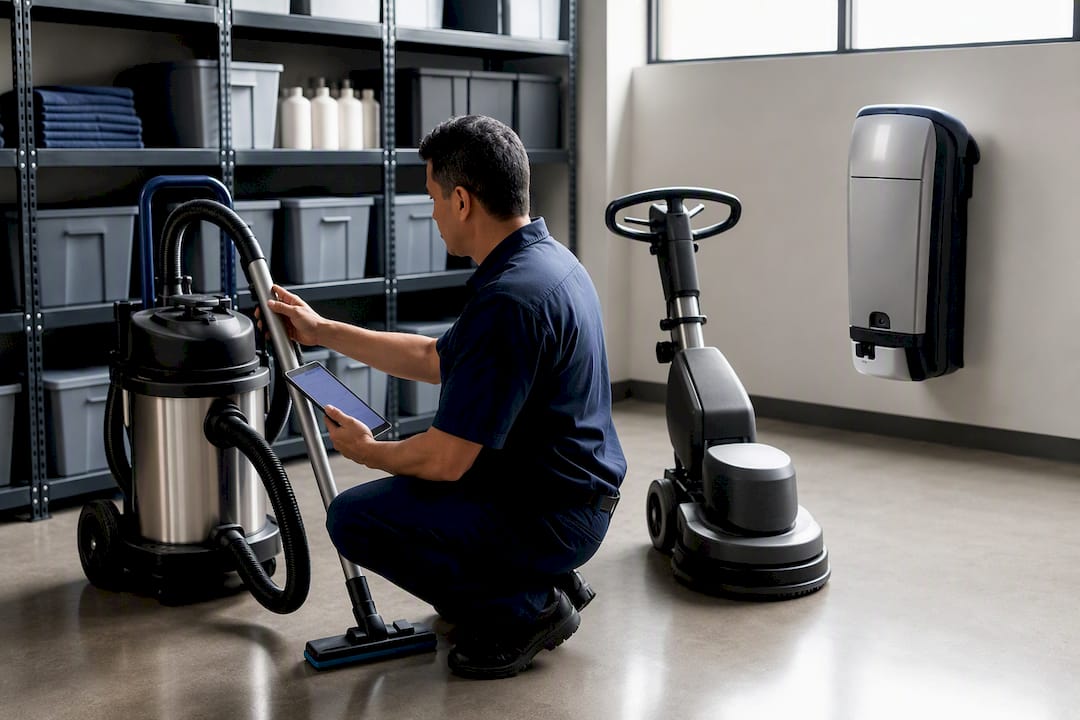
Pro Tip: Keep equipment specification sheets in the same folder as your purchase records. Auditors frequently ask for both at once, and hunting through separate vendor emails to match a vacuum model to its HEPA certification wastes time you don’t have during a review window.
How Often Do You Need Training, Audits, and Recordkeeping?
Training isn’t a one-time orientation checkbox. LEED and certification standards like GS-42 expect ongoing education tied to actual job function, with records that prove it happened.
New cleaning staff typically need initial training covering chemical handling, dilution control, equipment operation, and the building’s specific green cleaning policy before they start unsupervised work. First-year staff generally need refresher sessions as procedures or products change, and every staff member needs at least some documented annual continuing education after that.
Audit timing follows a stricter rule. USGBC guidance expects certification audits to stay current within 12 months of the performance period’s end. An expired GS-42 or CIMS-GB certification, even by a few weeks, can invalidate documentation you were counting on.
| Recordkeeping item | Recommended frequency | Retention period |
|---|---|---|
| Purchase tracking (products, cost, certification) | Quarterly | 3 years minimum |
| Staff training logs | Per session, reviewed annually | Duration of employment plus 2 years |
| SOP revision log | At each policy update | Life of the building’s LEED certification |
| Equipment maintenance records | Per service event | 3 years minimum |
| Vendor certification verification | Annually, before renewal | Current cycle plus 1 prior cycle |
Quarterly purchase tracking matters more than any other item on this list because it’s the one auditors ask about first, and it’s the one most facilities let slip between certification cycles.
Option 1 vs. Option 2: In-House Policy or Certified Cleaning Vendor?
LEED gives you two paths, and picking the wrong one for your situation wastes time you don’t have during a certification cycle.
Option 1 (in-house policy) requires you to write and maintain your own green cleaning policy, run internal audits against it, and produce your own evidence trail: purchase logs, training records, equipment inventories, and SOP documents, all generated and stored by your team.
Option 2 (certified cleaning service) shifts most of that burden to a vendor holding GS-42 or CIMS-GB certification. You still need to verify the certification is current, but the vendor supplies audit evidence, training documentation, and purchase records as part of their certified program.
Choosing between them comes down to internal capacity:
- If you have a dedicated facilities team with time to manage documentation, Option 1 gives you more control over specifics.
- If your team is stretched thin across multiple properties, Option 2 shifts the documentation load to a vendor already built for it.
- Mixed buildings, where some areas use in-house staff and others use contracted specialty cleaning, need a clear map showing which option covers which zone.
Whichever path you choose, require vendor contracts to include audit-access clauses letting you pull certification and training evidence on demand, not just at renewal time.
Turning Requirements Into an Audit-Ready Checklist
Most compliance failures trace back to sequencing, not effort. Teams buy certified products before they’ve written a policy, or they train staff before procurement specs exist to tell them what “certified” even means for this building.
Follow this order:
- Run a gap assessment. Compare current products, equipment, and procedures against LEED and GS-42 requirements to find what’s missing.
- Draft the policy. Write SOPs, waste protocols, and chemical handling procedures using the gap assessment as your outline.
- Update procurement specs. Rewrite purchasing contracts to require named certifications and recycled-content minimums, not vague “green” language.
- Train staff. Deliver initial training on the new policy before rolling out new products or procedures.
- Verify or select a vendor. If using Option 2, confirm certification currency; if switching vendors, build certification requirements into the RFP.
- Track and pre-audit. Run an internal mock audit 60 to 90 days before your actual submission window closes.
Build your contract wording around specifics: name the certification standard, require quarterly documentation submittals, and set a substitution notice period. A property manager’s guide to green commercial cleaning programs walks through how this looks applied to real building operations.
A short pre-audit checklist:
- Policy document dated and signed within the current performance period
- Purchase log showing percentage-by-cost calculation with supporting invoices
- Training records for every active cleaning staff member
- Equipment inventory with certification and maintenance dates
- Vendor certification proof, if using Option 2, dated within 12 months of period end
Pro Tip: Run your internal review at least one full quarter before the actual audit. That gives you time to fix a gap, like a lapsed certification or a missing training log, instead of discovering it when it’s too late to correct.
Review this checklist quarterly, not just before certification renewal. Operational changes, like adjusting cleaning frequency by area type, can shift your documentation needs without anyone noticing until an audit exposes the gap.
How Nationwide Maintenance Builds LEED-Aligned Cleaning Programs
Managing green cleaning compliance across multiple vendors, one for cleaning, another for pest control, a third for grounds, multiplies your documentation headaches. Some companies bundle these services under a single contract to reduce complexity, so purchase tracking, training records, and audit evidence come from one accountable source instead of multiple disconnected ones.
Operationally, that means SOP templates built around each client building’s actual layout, quarterly purchase reports formatted for LEED documentation needs, and training programs structured around initial certification plus annual refreshers. When an audit window opens, the paperwork already exists in one place rather than scattered across separate vendor systems.
Some firms support facility teams managing certification requirements for commercial clients, including retail chains, where consistent documentation across multiple locations is important. The specifics of any individual client’s certification outcome vary by building and performance period, and site-specific results are available on request through direct consultation.
Perspective: Where LEED Cleaning Audits Actually Go Wrong
The audits I’ve seen fail rarely fail on product quality. They fail on paperwork: a purchase log with gaps, a certification that lapsed three months before submission, an SOP so generic it could describe any building in the country.
The bigger trade-off facility managers underestimate is timing. Swapping every product to a certified alternative overnight sounds decisive, but it often creates budget spikes and vendor scrambling that phased compliance avoids entirely. A better sequence: fix documentation gaps first, since they cost nothing but time, then phase product and equipment upgrades against your next few procurement cycles. Before any audit, prioritize the cheapest fixes first: expired certifications and missing training logs take a phone call or a signature, not a budget line.
— Nationwide Maintenance.
Get LEED Audit-Ready Without Managing Five Vendors
There are companies that provide integrated cleaning, pest control, and grounds contracts to help facilities meet LEED green cleaning requirements efficiently. One contract means one source for purchase logs, training records, and audit evidence instead of chasing three vendors for three different paperwork formats.
Onboarding typically starts with a facility walkthrough to map current cleaning procedures against LEED and GS-42 standards, followed by SOP development, equipment and product inventories, and a training schedule tailored to the building’s performance period. Deliverables include documented green cleaning policies, quarterly purchase reports, staff training logs, and audit-support documentation your team can hand directly to a certifying body.
Our green and eco-friendly cleaning services are built around exactly this documentation trail. If you’re managing a property portfolio and need consistent compliance across every site, visit our property management services page to talk through your building’s specific certification timeline.
Sources
- GS-42 Commercial and Institutional Cleaning Services (Green Seal)
- EPA Safer Choice and Design for the Environment (DfE) Standard (PDF)
- Green cleaning - products and materials (USGBC)
Recommended
Need this handled at your facility?
Our crews cover commercial properties across New York, New Jersey, and Connecticut.