5 Fixes to Improve Landscape Lighting Safety for Homeowners & Managers

Yes, proper landscape lighting reduces trips and supports home security, but only when it’s designed and wired correctly. Prioritize path and step illumination, cool-running LED fixtures, GFCI-protected power at the transformer, correctly sized wiring, and inspections at least twice a year. Skip any of those five, and the lighting that’s supposed to make your property safer can quietly become a hazard itself.
TL;DR:
- Proper landscape lighting requires correct wiring, GFCI protection, and regular inspections to prevent electrical hazards that can cause fires or shocks.
- Effective safety lighting focuses on overlapping path and step lights, with even brightness and glare control to prevent trips and falls in low light conditions.
- LED fixtures are safer than halogens due to lower heat output, especially when placed near ground cover or mulch, reducing fire risks significantly.
- Installation mistakes like shallow burial, overloaded transformers, and missing GFCI protection are common hazards that can cause failures or injury if not addressed properly.
- Solar and battery-powered fixtures eliminate wiring risks but still demand regular seal checks and cautious placement to avoid overheating and moisture damage.
Table of Contents
- Why Landscape Lighting Safety Depends on Two Different Goals
- Where Fixtures Actually Prevent Falls
- Choosing Fixtures That Are Actually Safer
- The Installation Mistakes That Cause Most Failures
- Designing for Safety Without Creating Glare
- A Maintenance Schedule That Actually Prevents Problems
- What 30 Years of Facility Maintenance Teaches About Lighting Risk
- Our Take: Skip the Fixtures, Fix the Fundamentals First
- Battery and Solar-Powered Lighting: Where the Rules Change
- Get a Professional Look at Your Landscape Lighting Setup
- Sources
Why Landscape Lighting Safety Depends on Two Different Goals
Most homeowners lump “safety” and “security” together, but they solve different problems and call for different fixture placement. Safety lighting stops people from tripping on a step, missing a walkway edge, or stumbling into a low retaining wall in the dark. Security lighting is about deterrence and visibility, making sure a person approaching your home can be seen and a stranger can’t hide in shadow near a door or window.
A safety-first design treats every elevation change as a liability point. Consistent, low-glare light along a path does more to prevent a fall than one blazing floodlight at the garage, because falls happen at the edges of light, not in the dark itself. Uneven brightness creates “shadow pools,” pockets where a step or root looks flat until someone’s foot finds it.
A few numbers make this concrete:
- Path lighting generally works best with moderate brightness per fixture, spaced to overlap slightly rather than leaving gaps.
- Step lights should aim for even contrast on the riser, not just the tread, since most falls happen going down.
- Glare control matters as much as brightness. A fixture that blinds someone walking toward it is more dangerous than one that’s slightly dim but evenly placed.
Where Fixtures Actually Prevent Falls
Placement decides whether landscape lighting earns its keep. A fixture in the wrong spot looks fine in daylight and fails completely at 9 p.m.
- Space path lights to overlap, not just line up. A common mistake is spacing fixtures so evenly that the light pools stop just short of touching, leaving dim gaps exactly where someone plants a foot. Shielded, downward-facing lenses keep the beam on the ground instead of in a visitor’s eyes.
- Treat every step as its own lighting zone. Step-mounted units or riser lights that wash the vertical face of each step give the eye contrast between one level and the next. A single overhead light aimed down a staircase almost never does this well, since it flattens the shadows that would otherwise define each edge.
- Layer light at entrances so people are recognizable before they’re close. One fixture lighting the door and a second lighting the approach path gives you a two-step visual cue, first “someone’s there,” then “I can see who it is.”
- Eliminate shadowed transition points, the spot where a patio meets a lawn, or a driveway meets a walkway. These transitions are where trip hazards hide because the eye assumes the surface is continuous when it isn’t.
Getting this right often means walking your own property after dark with a notepad, standing at each transition, and asking whether you’d notice a curb or step if you weren’t already expecting it.
Choosing Fixtures That Are Actually Safer
Fixture choice is where landscape lighting safety and fire safety start to overlap, and it’s an area where the “upgrade” is genuinely worth it.
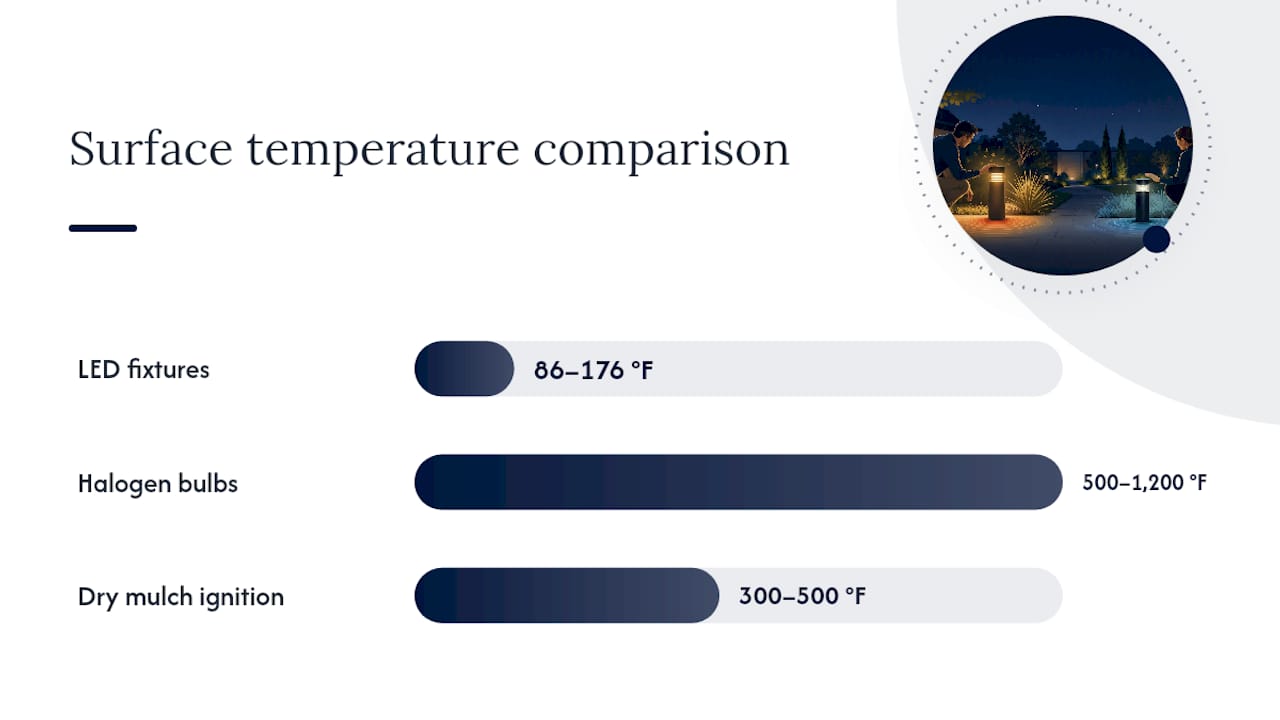
LED landscape lighting safety comes down largely to heat. LED surface temperatures typically run 86 to 176 degrees Fahrenheit, while halogen bulbs can reach 500 to 1,200 degrees. Dry mulch or leaves ignite at roughly 300 to 500 degrees, which means a halogen fixture nestled against ground cover sits well inside the danger zone every time it’s on. An LED fixture in the same spot simply doesn’t generate enough heat to pose a fire hazard.
Fire risk by the numbers: halogen bulbs run hot enough to ignite dry mulch on contact; LEDs stay far below that threshold even after hours of continuous use, which is the single biggest reason to retrofit older halogen systems.
Low-voltage 12V systems add a second layer of protection. Because the output side of a landscape transformer is Class 2, a shock from a bare low-voltage wire is far less dangerous than contact with a 120V line. That said, the primary side, the cord and connection feeding the transformer, is still full household voltage and needs to be treated with the same respect as any other outdoor outlet.
Match fixtures to the job:
- Path lights for walkways and low borders, spaced for overlap.
- Well lights (in-ground, flush-mounted) for uplighting trees or architectural features without a visible fixture underfoot.
- Motion-activated floodlights at entry points and dark side yards, where constant illumination isn’t needed but sudden visibility is.
- Moonlighting fixtures mounted high in trees, casting soft, dappled light down over a patio or lawn for ambient security without glare.
Always confirm a fixture carries a wet-location rating, not just damp-location, if it’s exposed to sprinklers, rain, or standing water, and check its ingress protection (IP) rating if it will sit below grade or near irrigation lines.
The Installation Mistakes That Cause Most Failures
Nearly every landscape lighting hazard traces back to one of a handful of shortcuts taken during installation, not to the fixtures themselves.
Missing GFCI protection on the transformer’s power source. The National Electrical Code requires GFCI protection on 120V outdoor receptacles that feed low-voltage transformers. The 12V output side is exempt because it’s Class 2, but the outlet upstream of the transformer is not optional. Skipping this step, or wiring around an existing GFCI outlet, removes the one safeguard designed to stop a ground fault from becoming a shock hazard.
Shallow burial and indoor-rated splices. Outdoor wiring lives in moisture and shifting soil that indoor-rated materials were never built to handle, and electrical contractors consistently flag this mismatch as a leading cause of corrosion and shorts. Direct-burial cable and gel-filled, listed connectors are the minimum standard, not an upgrade.
Transformers mounted directly on or buried in mulch. A transformer needs airflow and needs to stay visible and accessible for inspection. Burying it in ground cover traps heat and hides the one component most likely to need attention.
Overloaded transformers and undersized wire. Keeping total fixture load under about 80% of the transformer’s rated capacity prevents overheating, and runs longer than roughly 75 feet need thicker gauge wire to avoid voltage drop that causes dimming at the far end and higher current draw throughout the circuit.
Pro Tip: If you’re not sure your system was installed to these standards, start at the outlet and follow the circuit: GFCI first, then the transformer’s mounting and ventilation, then the buried cable route, then each connector. That order catches most latent problems before they cause a failure.
Designing for Safety Without Creating Glare
A lighting layout can hit every code requirement and still be unpleasant, or unsafe, to live with if glare and light pollution aren’t part of the plan.
- Light the task, not the yard. Aim for even, moderate illumination on walking surfaces rather than one or two very bright fixtures. Consistent lux across a path reduces the contrast that makes eyes struggle to adjust between bright and dark patches.
- Shield every fixture near a sightline. A bare bulb visible from a neighbor’s window or from the street isn’t just inconsiderate, it also creates glare that makes it harder to see, not easier. Tight beam angles and full cutoff fixtures keep light where it’s needed.
- Use timers, dimmers, and motion zoning instead of running everything at full output all night. Motion-activated zones near entry points give you a burst of visibility exactly when it’s needed while keeping ambient glare low the rest of the time.
- Layer low path lights with targeted uplighting instead of leaning on a single bright source. Two or three modest fixtures almost always produce safer, more even coverage than one powerful floodlight.
A Maintenance Schedule That Actually Prevents Problems
Landscape lighting isn’t a set-it-and-forget-it system, and most hazards develop slowly enough that a quarterly check catches them before they become a real problem.
- Quarterly: inspect fixture seals for cracking, check lenses for fogging (a sign of a failed gasket), and clear mulch, grass clippings, or leaf litter packed against fixtures, since debris that insulates heat around a fixture can undermine even an LED’s safety margin.
- Monthly, and after any storm: test the GFCI outlet feeding the transformer. A GFCI that trips once might be nothing. One that trips repeatedly is signaling a real ground fault, usually a wet splice or a damaged seal, and needs to be traced and repaired rather than reset and ignored.
- Annually: check transformer load against its rated capacity and confirm it’s still running under roughly 80%, especially if you’ve added fixtures over time. Watch for dimming at the far end of long runs, a sign of voltage drop that may call for upgraded wire gauge.
Call a licensed electrician if GFCI trips persist after you’ve checked obvious causes, if you spot damaged or exposed 120V wiring, if the panel itself needs modification, or if you see corrosion at any connector.
What 30 Years of Facility Maintenance Teaches About Lighting Risk
Scheduled inspections catch the small stuff before it becomes an emergency call, and that holds just as true for a homeowner’s front walk as it does for a commercial parking lot. One of the recurring failure points Nationwide Maintenance sees across facility contracts is coordination gaps: the landscaper doesn’t touch electrical, the electrician doesn’t touch the beds, and problems fall into the space between them.
Managing landscaping, electrical work, and general maintenance under single contracts can help close that coordination gap. When picking any contractor for lighting work, residential or commercial, ask for proof of licensing and insurance, a written inspection report rather than a verbal “looks fine,” and documented voltage and load readings, not just a visual check.
Our Take: Skip the Fixtures, Fix the Fundamentals First
Most landscape lighting advice online obsesses over fixture style, warm white versus cool white, brass versus aluminum, when the real safety gap sits upstream of any of that. A beautiful fixture on an unprotected circuit or a buried splice is still a hazard waiting to happen. The homeowners who get this right start at the panel, not the catalog.
The conventional wisdom that low-voltage systems are inherently safe and can be treated as a weekend DIY project undersells the primary-side risk. The 120V feed into that transformer carries the same code requirements, and the same consequences for getting it wrong, as any other outdoor circuit. Confidence in the low-voltage side has led plenty of homeowners to skip GFCI checks entirely.
If you take one thing from this guide, make it the inspection order: power source, then protection, then transformer, then cable route, then fixtures. Skipping that sequence is how small problems turn into service calls, or worse.
— Nationwide Maintenance.
Battery and Solar-Powered Lighting: Where the Rules Change
Battery and solar fixtures sidestep most of the wiring hazards discussed above, but they introduce their own set of safety considerations that are easy to overlook.
Because there’s no hardwired circuit, solar path lights and battery-powered accent lights eliminate GFCI and burial-depth concerns entirely. That makes them a reasonable option for renters, for quick fixes on a problem step, or for areas where running cable isn’t practical. But “no wiring” doesn’t mean “no risk.” Lithium-ion battery packs used in higher-output solar fixtures can overheat or swell if they’re consistently exposed to direct summer sun and poor ventilation, particularly in fixtures with sealed, non-vented battery compartments.
Water intrusion is the other recurring issue. Solar fixtures often use lower-cost weatherproofing than their wired counterparts, and a cracked seal lets moisture into the battery compartment long before it’s visible on the lens. Check the wet-location rating the same way you would on a wired fixture, and don’t assume “outdoor” on the box means the seals will hold up over multiple seasons.

Solar lighting also can’t be relied on for consistent safety coverage the way a wired system can. Output drops during long stretches of cloudy weather or short winter days, exactly the season when reliable step and path lighting matters most. Treat solar and battery fixtures as a supplement to hardwired safety lighting near steps and main walkways, not a full replacement, especially anywhere a fall risk is genuine.
Get a Professional Look at Your Landscape Lighting Setup
If you’ve read this far and started mentally auditing your own property, that instinct is the right one, but a proper fix usually means combining electrical know-how with landscaping work, not just swapping a bulb. Some companies bring landscape design, installation oversight, electrical maintenance, and scheduled inspections under one contract, so a property manager isn’t juggling separate landscapers and electricians who never talk to each other.

That’s the practical advantage of a bundled facility-maintenance approach: one team documents the transformer load, checks the GFCI, clears debris from fixtures, and handles the landscape design around them, all on the same visit and the same report. For residential property managers overseeing multiple units or common areas, that consolidation cuts down on the coordination failures that let small electrical issues turn into liability claims. If you’re weighing a contractor selection process for a larger property, a structured sales and vendor evaluation approach can help clarify what to ask for in writing before signing anything.
Request an inspection through Nationwide Maintenance’s property management services and get a documented look at your current lighting setup, from the panel to the last fixture on the run.
Sources
Recommended
Need this handled at your facility?
Our crews cover commercial properties across New York, New Jersey, and Connecticut.