Irrigation System Maintenance for Commercial Facility Managers
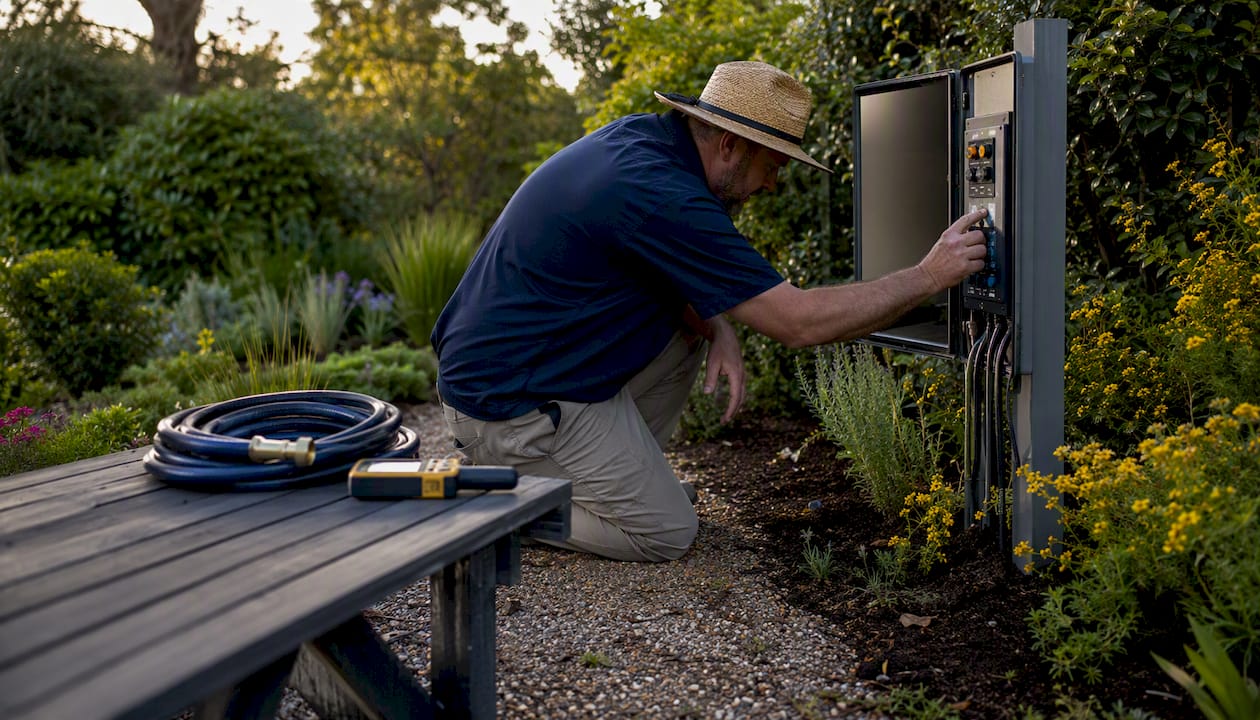
Run a preventive irrigation system maintenance program that enforces seasonal controller adjustments, monthly in-season inspections, and a full audit at least every five years. That single directive covers the majority of what separates a well-managed commercial system from one that generates emergency repair calls and inflated water bills.
The USGA’s irrigation maintenance playbook frames the goal clearly: maximize distribution uniformity and fix root causes, not symptoms. The EPA WaterSense program reinforces that framing with water-efficiency benchmarks. The Irrigation Association provides the certifications that separate qualified contractors from generalists.
Schedule these now if they are not already on the calendar:
- Spring slow-fill startup over multiple hours without rapid pressurization
- Controller seasonal programming review
- Monthly head and valve inspections through the growing season
- Backflow prevention test certificate verification
- Annual or biennial spot audits; full audit every five years
Table of Contents
- What does a seasonal irrigation maintenance schedule look like?
- Your on-site inspection checklist: what to check and when
- How do you diagnose common irrigation failures at the root cause?
- How do you measure irrigation system efficiency with audits and testing?
- Which technologies speed up repairs and improve reporting?
- What should you require from an irrigation contractor?
- Key Takeaways
- Why the “fix it when it breaks” approach costs more than you think
- Nationwidemaintenance covers irrigation maintenance under one contract
- Authoritative sources for audits, training, and compliance
What does a seasonal irrigation maintenance schedule look like?
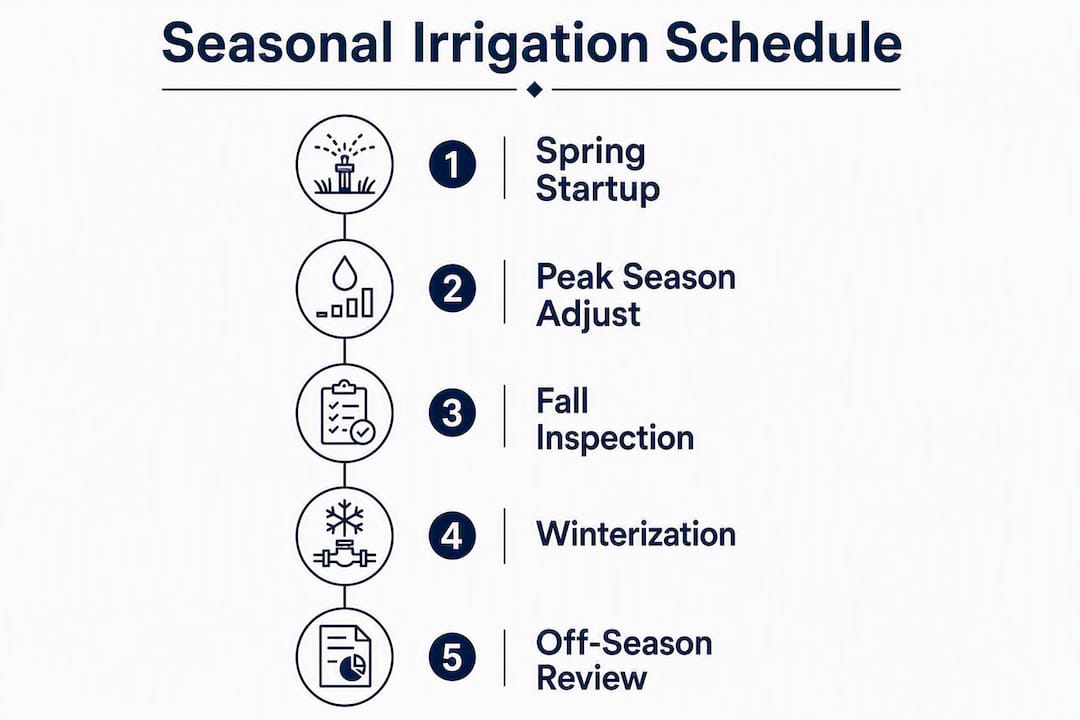
A repeatable calendar is the fastest way to move from reactive to preventive. The table below maps the key tasks by season, who should own them, and how often they recur.
| Season | Key Tasks | Owner | Frequency |
|---|---|---|---|
| Spring (March–April) | Slow-fill startup, controller battery/program check, valve and wiring inspection, flush lateral lines | Contractor | Once, pre-season |
| Peak season (May–August) | Head alignment, leak detection, pressure checks, runtime tuning via ET or soil moisture, cycle-and-soak on slopes | In-house or contractor | Monthly |
| Fall (September–October) | Reduce runtimes, test and close irrigation main, verify backflow prevention device | Contractor | Once, post-peak |
| Winter (November–March) | Blowout or drain procedure keeping pressure within safe limits, recordkeeping, component inspection | Contractor | Once, pre-freeze |
Spring startup is where most pressure damage happens. Rain Bird’s maintenance guidance recommends filling the system slowly over one to two days to reduce stress on PVC and fittings. Rapid pressurization causes fitting failures that are expensive to excavate and repair.
Pro Tip: Monitor pressure with a gauge mounted to a quick coupler during spring startup. If pressure spikes above your system’s rated operating range before all zones have equalized, stop and investigate before continuing the fill.
During peak season, runtime adjustments based on evapotranspiration (ET) data or soil moisture readings prevent overwatering on cooler weeks and underwatering during heat events. Florida’s UF/IFAS guidance requires automatic systems to have a functional rain shut-off device, a standard worth applying regardless of state.
Winterization blowouts must stay at or below 50 PSI. Exceeding that threshold risks cracking heads, valves, and lateral lines, turning a $300 winterization into a $3,000 spring repair bill.
Your on-site inspection checklist: what to check and when
Utah State University Extension recommends monthly in-season checks and immediate replacement of missing or broken heads to prevent runoff and dry spots. Here is a prioritized, field-ready list organized by component.
- Heads and nozzles: Check alignment, pop-up height, and nozzle type. Ensure that irrigation heads in the same zone match in type and precipitation rates to avoid dry spots.
- Valve boxes and solenoids: Look for standing water or soil saturation around valve boxes. Exercise each valve manually at least once per season to confirm the diaphragm seats correctly.
- Mainline and lateral integrity: Wet spots between heads, unexplained pressure drops, or reduced coverage on a zone often indicate a subsurface leak before it becomes visible.
- Controller and sensors: Replace batteries, verify wiring connections, and confirm rain and freeze sensors are functional. A sensor that has been disconnected or bypassed defeats the entire runtime-reduction strategy.
- Backflow prevention: Confirm the test certificate is current. Most jurisdictions require annual testing by a certified tester; keep records on file for compliance audits.
- Drip system filters and emitters: Flush drip laterals at the end caps. For organic clogging, University of Arizona Extension recommends injecting 0.5–1.0 gallon of 35% hydrogen peroxide per 1,000 gallons. Mineral scale requires acid injection to low pH for a period, followed by immediate flushing.
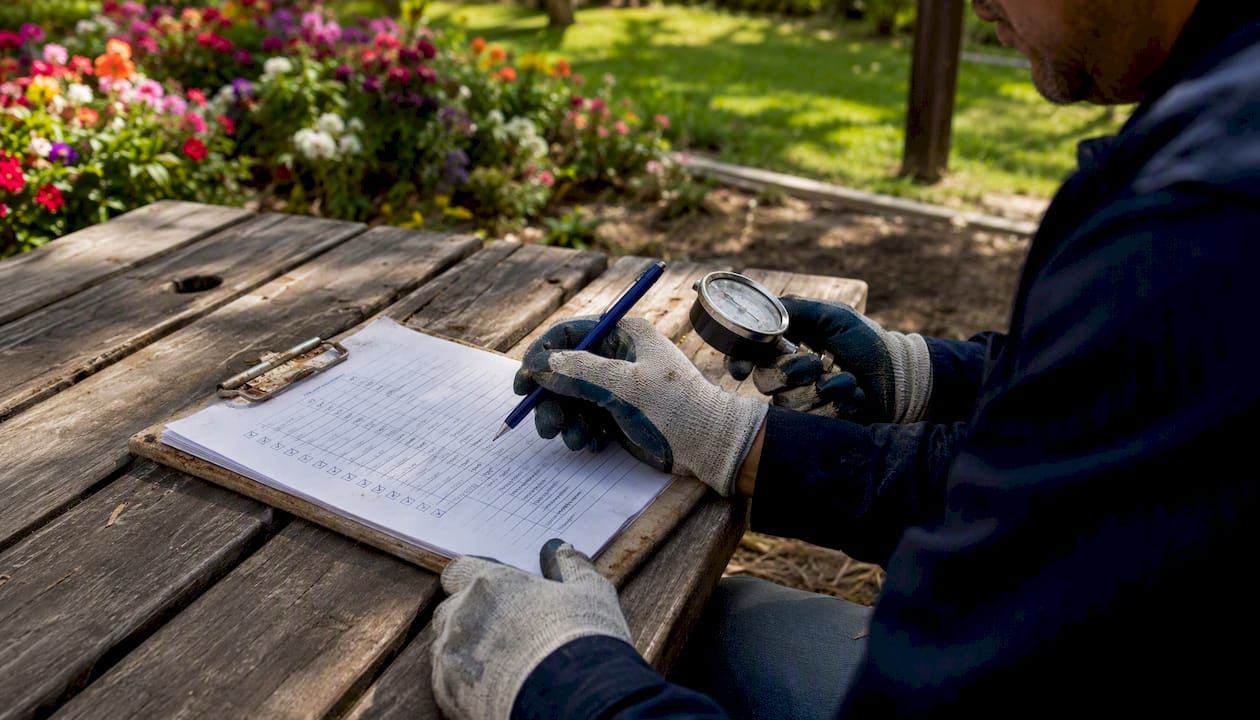
Pro Tip: Use a standardized inspection form that captures zone runtime, measured pressure, and a photo field for each zone. Photo evidence speeds vendor accountability and gives you a timestamped baseline for warranty disputes.
How do you diagnose common irrigation failures at the root cause?
Patching a broken head without understanding why it broke is how systems accumulate chronic problems. Map symptoms to probable causes before ordering parts.
Symptoms and likely root causes:
- Dry spots: Misaligned heads, clogged nozzles, low pressure, or mismatched precipitation rates
- Wet spots or pooling: Subsurface leak, stuck-open valve, or head installed below grade
- Heads that won’t retract: Debris in the body, worn wiper seal, or excessive pressure
- Zone that won’t shut off: Debris on valve diaphragm, solenoid failure, or wiring short
- Unexplained high water bill: Mainline leak, stuck-open master valve, or controller programming error
Stepwise troubleshooting flow:
- Identify the symptom and isolate the affected zone.
- Shut off the zone or master valve to stop active damage.
- Measure static pressure at the mainline and dynamic pressure at the zone lateral.
- Compare readings against design specs. A large gap between static and dynamic pressure points to a leak or partially closed valve upstream.
- Test solenoid resistance with a multimeter (typical range: 20–60 ohms). Out-of-range readings indicate solenoid failure.
- Conduct a meter isolation test: close all zones, read the meter, wait 30 minutes, read again. Any movement confirms a mainline or master valve leak.
- Implement a permanent fix, not a temporary patch. Contractors who diagnose root causes reduce repeated emergency calls; document the repair and update the site map.
Call a contractor immediately if you see:
- Active water flowing from a broken mainline or master valve that cannot be isolated
- A zone that remains on after the controller is powered down
- Pump failure or loss of prime on a booster pump system
- Electrical faults at the controller panel (burning smell, tripped breakers, visible arc damage)
How do you measure irrigation system efficiency with audits and testing?
Colorado State University Extension notes that tune-ups and audits identify where water savings are possible and improve coverage across zones. The catch-can test is the standard field method for measuring distribution uniformity (DU) and coefficient of uniformity (CU).
| Test | Purpose | Acceptable Threshold | Corrective Action |
|---|---|---|---|
| Catch-can (DU/CU) | Measures uniformity of water distribution across a zone | DU ≥ 0.75 for turf; CU — | Adjust head spacing, replace nozzles, or redesign zone |
| Static/dynamic pressure | Identifies pressure irregularities indicating leaks or closed valves | Per manufacturer spec (typically 30–45 PSI at head) | Adjust pressure regulator, locate and repair leak |
| Flow measurement | Detects mainline leaks or oversized zones | Within — of design flow | Inspect mainline, check valve sizing |
| Soil moisture reading | Confirms soil saturation before triggering a run cycle | Below field capacity before irrigation | Adjust controller schedule or install soil moisture sensor |
A full audit, including uniformity testing and precipitation-rate measurement, should be conducted at least every five years per USGA guidance. After major repairs or zone renovations, a spot audit confirms the fix actually restored performance.
Setting up a catch-can test: Place cans in a grid pattern across the zone, run the zone for a timed interval (typically 15 minutes), measure the depth in each can, and calculate the average of the lowest quarter against the overall average. That ratio is your DU. Anything below 0.75 on a turf zone means some areas are receiving less than 75% of the average application, which shows up as dry spots regardless of total runtime.
Which technologies speed up repairs and improve reporting?
GIS site mapping is the single highest-leverage technology investment for multi-site portfolios. A georeferenced layer showing valve locations, mainline routing, backflow device positions, and controller zones cuts diagnostic time on buried-pipe failures from hours to minutes. It also gives new technicians and emergency responders a starting point without relying on institutional memory.
Practical tech investments ranked by impact:
- GIS/site map: Rapid dispatch, buried main location, backflow device documentation
- Smart controllers with ET scheduling: Automatic runtime reduction based on weather data, reducing overwatering without manual intervention
- Soil moisture sensors: Prevent irrigation on already-saturated soil; particularly valuable on clay-heavy sites or slopes
- Rain and freeze sensors: Required in some states; prevent unnecessary cycles during and after precipitation events
- Remote telemetry and fault alerts: Push notifications for zone malfunctions or flow anomalies shorten response time and reduce water waste between inspection cycles
Pro Tip: Start with a GIS layer and a smart controller on your highest-risk zones (slopes, high-traffic turf, zones adjacent to hardscape). Scale the technology investment by criticality rather than trying to retrofit the entire system at once.
Professional acoustic leak detection and certified irrigation audits using standard CU/DU methods are worth contracting separately from routine upkeep. They surface problems that visual inspection misses and provide documented evidence for capital budget requests.
What should you require from an irrigation contractor?
A well-written scope of work prevents the most common vendor failure: a contractor who shows up, replaces visible broken parts, and leaves without addressing the underlying cause.
Required credentials:
- Irrigation Association certification (Certified Irrigation Technician or Certified Irrigation Contractor)
- Backflow testing credentials from a state-approved tester
- Proof of liability insurance and workers’ compensation coverage
Scope-of-work essentials to include:
- Scheduled seasonal tune-ups (spring startup, peak-season monthly visits, fall reduction, winterization)
- Monthly inspection reports with photo documentation and zone-level pressure readings
- Annual audit deliverable including catch-can test results and written repair recommendations
- Emergency response SLA: define maximum response time for active leaks (4 hours is a reasonable commercial standard)
- Parts warranty terms and pricing transparency for common components
- GIS map updates after any repair that changes valve or head locations
When to keep work in-house: Monthly visual inspections, controller programming adjustments, and sensor battery replacements are reasonable in-house tasks if staff have basic training. Backflow testing, pressure and flow diagnostics, winterization blowouts, and full audits require licensed or certified contractors in most jurisdictions.
Commercial providers frequently offer free initial inspections as part of a structured maintenance proposal. Use that inspection deliverable as a baseline document, not just a sales tool.
Key Takeaways
A preventive irrigation maintenance program built around seasonal scheduling, monthly inspections, and five-year audits reduces emergency repairs and keeps water use within budget.
| Point | Details |
|---|---|
| Audit every five years | Conduct full uniformity and precipitation-rate audits, per USGA guidance, to identify inefficiencies before they become costly failures. |
| Slow-fill spring startup | Fill slowly over an extended period to prevent pressure shocks that can crack PVC and fittings. |
| Winterize within recommended pressure limits to avoid the risk of damage to heads, valves, and laterals. | |
| Require certified contractors | Irrigation Association credentials and backflow testing certification are non-negotiable for commercial scopes. |
| Nationwidemaintenance for unified contracts | Nationwidemaintenance integrates irrigation maintenance into a single facility contract covering landscaping, emergency response, and preventive upkeep across the Tri-State area. |
Why the “fix it when it breaks” approach costs more than you think
The conventional wisdom in facility management is that irrigation gets attention when something is visibly wrong: a head spraying the sidewalk, a zone that won’t shut off, a water bill that finally triggers a work order. That reactive posture is understandable given competing priorities, but it consistently costs more than the preventive alternative.
The reason is compounding. A misaligned head that runs for two months before anyone notices has already wasted water, potentially damaged turf, and may have created a subsurface wet spot that accelerates pipe corrosion. A backflow device that hasn’t been tested in three years is a compliance liability that can result in fines or service interruption, not just a maintenance item. A controller running summer schedules in October is adding real dollars to utility costs every week it goes uncorrected.
What the USGA playbook gets right, and what most facility teams underweight, is the uniformity goal. The point of maintaining an irrigation system is not to keep it running. It is to apply water evenly, at the right rate, at the right time. A system that is “running” but delivering 60% DU is failing at its actual job while consuming full water and energy costs. That distinction changes how you evaluate contractor performance, how you write scope-of-work requirements, and how you justify audit spending to ownership.
The managers who get the most out of their irrigation budgets are the ones who treat the catch-can test result as a KPI, not a one-time curiosity.
Nationwidemaintenance covers irrigation maintenance under one contract
Managing irrigation upkeep through a separate specialty vendor adds coordination overhead that compounds across a multi-site portfolio. Nationwidemaintenance eliminates that friction by folding commercial irrigation and seasonal grounds maintenance into the same unified facility contract that covers landscaping, emergency response, and preventive upkeep for commercial, retail, and industrial properties across the Tri-State area.

With over 30 years of facility maintenance experience and clients including Costco and CVS, Nationwidemaintenance delivers photo-verified inspection logs, seasonal controller audits, catch-can test summaries, written repair estimates, and GIS markup updates as standard contract deliverables. Every service is backed by 24/7 emergency response, so an active mainline leak at 2 AM gets the same attention as a scheduled spring startup.
Property managers ready to consolidate vendors can request a site assessment that includes a controller audit, zone-level pressure check, and a written scope proposal. One contract, one point of contact, no gaps between service providers.
Authoritative sources for audits, training, and compliance
These sources back the methods, standards, and schedules referenced throughout this guide.
- USGA Irrigation System Maintenance Playbook: The primary reference for distribution uniformity standards, audit cadence (every five years minimum), and the preventive-maintenance framing used throughout this guide.
- Irrigation Association (Irrigation.org): Certification standards for Certified Irrigation Technicians and Certified Irrigation Contractors; use to verify contractor credentials before signing a scope of work.
- EPA WaterSense: Water-efficiency benchmarks and labeled product standards for controllers and nozzles; useful for procurement specifications and sustainability reporting.
- UF/IFAS Gardening Solutions: Seasonal controller adjustment guidance and rain shut-off device requirements; applicable to warm-climate and year-round irrigation systems.
- Colorado State University Extension: Tune-up and audit benefit documentation; supports the water-savings case for preventive maintenance programs.
- Utah State University Extension: Monthly inspection cadence and head/nozzle replacement guidance for in-season upkeep.
- University of Arizona Extension: Drip system remediation protocols for organic clogging (hydrogen peroxide) and mineral scale (acid flush); applicable to any drip zone regardless of climate.
- Rain Bird Maintenance Check Sheet: Slow-fill startup procedures and winterization pressure limits (50 PSI maximum); a practical field reference for technicians.
- OSU Extension Service: Comprehensive inspection framework covering water intake, pump assembly, electrical components, pipelines, and distribution systems.
Recommended
Need this handled at your facility?
Our crews cover commercial properties across New York, New Jersey, and Connecticut.