Three Decades’ Experience: Infection Control Construction for Hospitals
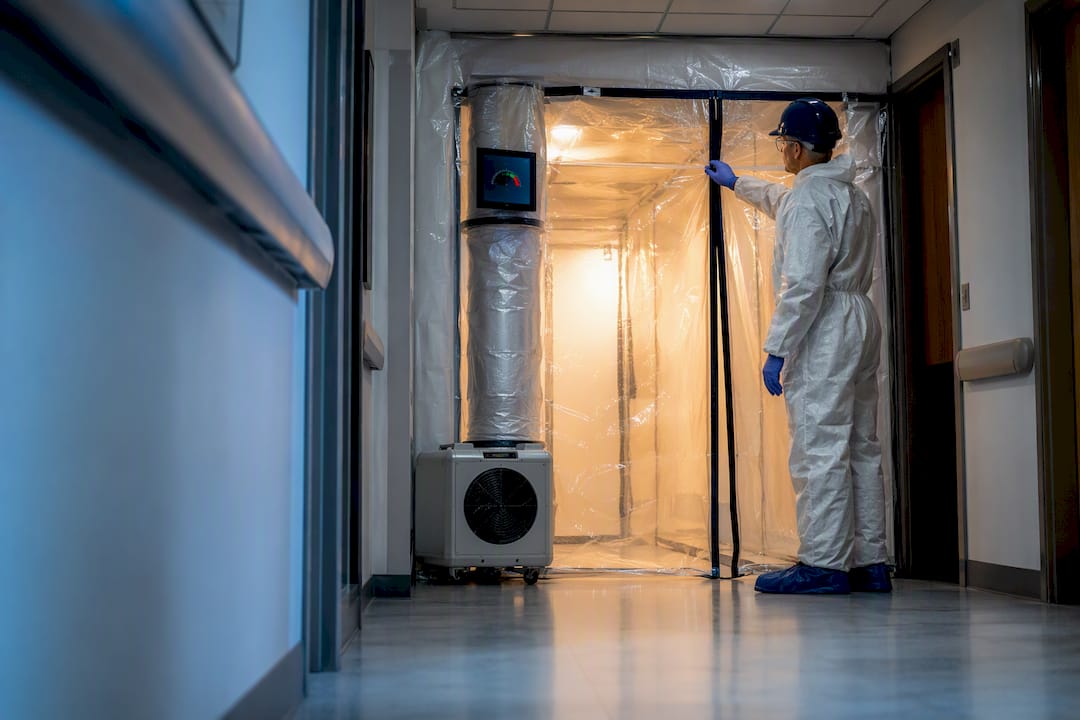
Before any work that could affect patient care areas, perform an Infection Control Risk Assessment (ICRA) and implement the class-based controls it requires. Submit the ICRA to your multidisciplinary team, post the permit, and hold a pre-construction survey for anything landing in Class III or higher. Follow ASHE ICRA 2.0 and CSA Z317.13 as your governing standards. The higher the class, the more containment comes first, not last.
TL;DR:
- Containment must be rigid and floor-to-deck for Class III and higher projects, with continuous HEPA-filtered negative pressure and dedicated debris routes.
- Contractors must receive ICRA-specific training before work begins, with proof required for compliance and refresher triggers for scope changes.
- Building activity needs to be planned and scheduled in advance, including pre-construction surveys, permit posting, and ongoing monitoring to prevent containment breaches.
- Daily checks of barriers, door seals, pressure differentials, and debris management are critical, with work halted immediately upon any breach.
- Integrating construction, cleaning, and monitoring contracts ensures accountability, reducing gaps in containment and post-project infection risks.
Table of Contents
- What Is Infection Control Construction, and Who Runs the Process?
- How Do You Classify Risk for an ICRA?
- Containment and Airflow Controls for Higher-Risk Projects
- Building ICRA Into the Project Timeline
- Monitoring, Air Sampling, and When to Stop Work
- What Belongs in the Construction Contract
- A Working Checklist From Nationwide Maintenance
- Cleaning and Disinfection Protocols During Active Construction
- Training Requirements for Construction Staff
- Waste Management and Removal During Construction
- Post-Construction Decontamination and Clearance
- Publisher Perspective: Why Integrated Contracting Closes ICRA Gaps
- How Nationwide Maintenance Supports ICRA-Compliant Projects
- Standards Worth Bookmarking
- Sources
What Is Infection Control Construction, and Who Runs the Process?
Infection control construction is the discipline of managing dust, moisture, and airflow disruptions from building work so they don’t seed a hospital-acquired infection. The tool that drives it is the ICRA: a documented, risk-based review that ties the type of construction activity to the vulnerability of nearby patients, then assigns matching precautions. ASHE ICRA 2.0 and Canada’s CSA Z317.13 both describe this as a mandatory process, not a courtesy checklist.
An ICRA is never a one-person sign-off. It runs through a multidisciplinary team, usually built from:
- An infection preventionist, who holds stop-work authority when containment fails
- A facilities or engineering lead, who knows the building’s HVAC and duct pathways
- A project manager, who owns schedule and budget trade-offs
- The general contractor, who executes the containment plan on-site
Assigning the infection preventionist real stop-work power isn’t a formality. Plans fail in practice when that person can flag a breach but can’t actually halt the crew, a gap that governance reviews flag as a recurring weak point. Common triggers for a mandatory ICRA include demolition or drilling, any ceiling tile or above-ceiling work, HVAC modifications, water service interruptions, and work adjacent to oncology, transplant, ICU, or NICU units.
How Do You Classify Risk for an ICRA?
Classification runs on a matrix. One axis is construction activity type, ranked by how much dust or water disruption it generates. The other is patient population risk, ranked by how vulnerable those patients are to airborne or waterborne pathogens.
- Activity Type A covers inspection and minor work with no dust, like removing ceiling tiles for a visual check.
- Activity Type B involves small-scale, short-duration work generating minimal dust, such as installing cabling above a ceiling.
- Activity Type C includes work generating moderate to high dust, requiring more than one shift, like sanding walls or removing flooring.
- Activity Type D covers major demolition and construction requiring consecutive work shifts, such as new construction or major renovation.
Population risk groups run from low (office areas, general admin) through medium (patient care areas, physical therapy) to high and highest (ICU, oncology, burn units, any area with severely immunocompromised patients). Cross a high-dust Activity Type D against a highest-risk population, and you land in Class IV or V, the top of the precaution scale. A low-risk population paired with Activity Type A might stay in Class I. The UCSF ICRA guidelines walk through this stepwise, and they’re explicit that scope creep demands a new pass through the matrix. If a Class II job turns into ceiling demolition three weeks in, resubmit before crews touch anything above the tile line.
Containment and Airflow Controls for Higher-Risk Projects
Class III and IV work needs containment that behaves like a sealed room, not a curtained-off corner. Soft barriers (reinforced plastic sheeting, taped and sealed) can cover Class II jobs. Class III and above generally call for rigid, floor-to-deck barriers, because plastic alone doesn’t stop pressure differentials from failing at the edges. ASHE’s guidance on recent ICRA edits specifies hard-wall or floor-to-deck construction, continuous HEPA-filtered negative pressure, and anterooms for these tiers.
Key operational controls include:
- Negative air machines with HEPA exhaust, set to maintain a measurable pressure differential, checked with a manometer and logged continuously
- An anteroom between the work zone and occupied space, so workers change out or clean before crossing the threshold
- Dedicated debris routes that avoid patient corridors, with sealed containers or covered carts
- Tacky mats at every threshold, replaced on a set schedule rather than left until visibly dirty
- PPE protocols specific to the containment zone, not generic site PPE
Sealing matters more than people expect. Toolkits from provincial health authorities point out that fire-rated penetrations, wall junctions, and floor seams are exactly where containment fails silently, long before anyone notices dust in a corridor.
Pro Tip: Don’t rely on a single manometer reading at setup. Negative pressure drifts as doors open, HVAC balances shift, and filters load with dust, so continuous monitoring with a visual indicator catches drift a one-time check will always miss.
Building ICRA Into the Project Timeline
Infection control can’t be a change order bolted onto week six. UCSF’s guidelines call for ICRA submission before work begins, with routine projects often requiring at least two weeks notice to the review team. Earlier is always better; a rushed ICRA on a Class IV job usually means barriers get built after the first cuts, not before.
Build these steps into the schedule, not around it:
- Pre-construction survey scheduled the moment scope hits Class III or higher
- ICRA permit posted at the work site entrance, visible to anyone entering
- Permit expiration date tracked against the actual schedule, with renewal built in for phased or multi-stage work
- Documentation retained for the full project, including any resubmissions triggered by scope changes
Institutions that treat the permit as a living document, rather than a one-time form, catch scope drift before it becomes a containment failure.
Monitoring, Air Sampling, and When to Stop Work
Daily verification is what turns a containment plan into an enforced one. A working inspection routine checks:
- Door and anteroom seals for gaps or tears
- Barrier seams and floor-to-deck junctions for separation
- Manometer reading against the required differential
- Tacky mat condition and replacement schedule
- Debris handling compliance at the exit point
Particle counting or viable air sampling gets triggered for prolonged dust-generating work, particularly near high-risk units, and interpretation should compare readings against your facility’s established baseline rather than a single external benchmark. Failure to enforce these steps carries real clinical weight: construction-adjacent outbreaks of aspergillosis and Legionella have been directly traced to breakdowns in containment and monitoring discipline.
Stop-work authority has to be unambiguous. When a manometer drops below the required differential, a barrier seam separates, or debris tracks past the anteroom, work halts immediately, the breach gets remediated, and the infection preventionist signs off before crews resume.
What Belongs in the Construction Contract
IPC requirements need to be written into the bid, not negotiated after the crane arrives. Contract language should specify:
- An explicit ICRA compliance clause tied to the project’s assigned class
- Barrier construction and maintenance specifications, including inspection frequency
- Monitoring and reporting requirements, with defined stop-work terms and remediation timelines
- Contractor deliverables: proof of ICRA awareness training, daily inspection logs, negative air/HEPA equipment specs, and a debris transport protocol
Price the containment work into the original bid. Facility teams that leave barrier systems, negative air rental, and monitoring out of the scope almost always end up negotiating change orders mid-project, usually at a worse rate than if it had been priced upfront.
A Working Checklist From Nationwide Maintenance
Three decades of running construction and cleaning contracts side by side inside occupied commercial and healthcare facilities has taught us that most containment failures trace back to a missed handoff, not a missing standard.
Pre-construction, confirm five things before the first tool touches the wall:
- ICRA submitted and MDT sign-off documented
- Containment plan matched to the assigned class, not the contractor’s default setup
- Negative air specs (CFM, HEPA rating) confirmed against the room’s actual volume
- Contractor training verification collected, not just promised
- Permit posted and expiration date logged against the schedule
On daily rounds, a “fail” looks specific: a manometer reading below spec, a taped seam with visible separation, tracked debris past the anteroom, or a tacky mat that’s clearly overdue for replacement.
Pro Tip: Photograph every containment setup at installation and log the baseline manometer reading immediately. That baseline is what makes a “drop” measurable instead of debatable three weeks later.
Cleaning and Disinfection Protocols During Active Construction
Standard janitorial cleaning isn’t built for a construction zone, and running the same mop-and-wipe routine risks spreading dust rather than controlling it. Effective protocols separate the work zone’s cleaning from the surrounding occupied space entirely, with dedicated equipment that never crosses back.
Wet-wipe methods, not dry sweeping or dry dusting, are the default for any surface near the containment boundary, since dry methods aerosolize particulates that a barrier alone won’t stop. High-touch surfaces adjacent to the work zone, door handles, handrails, nurse call buttons, need a documented cleaning frequency higher than the facility’s routine schedule for the duration of the project. HEPA-filtered vacuums replace standard vacuums for any dust cleanup, and mop water gets changed far more frequently than typical protocols require, since construction dust loads a mop bucket faster than everyday soil does.
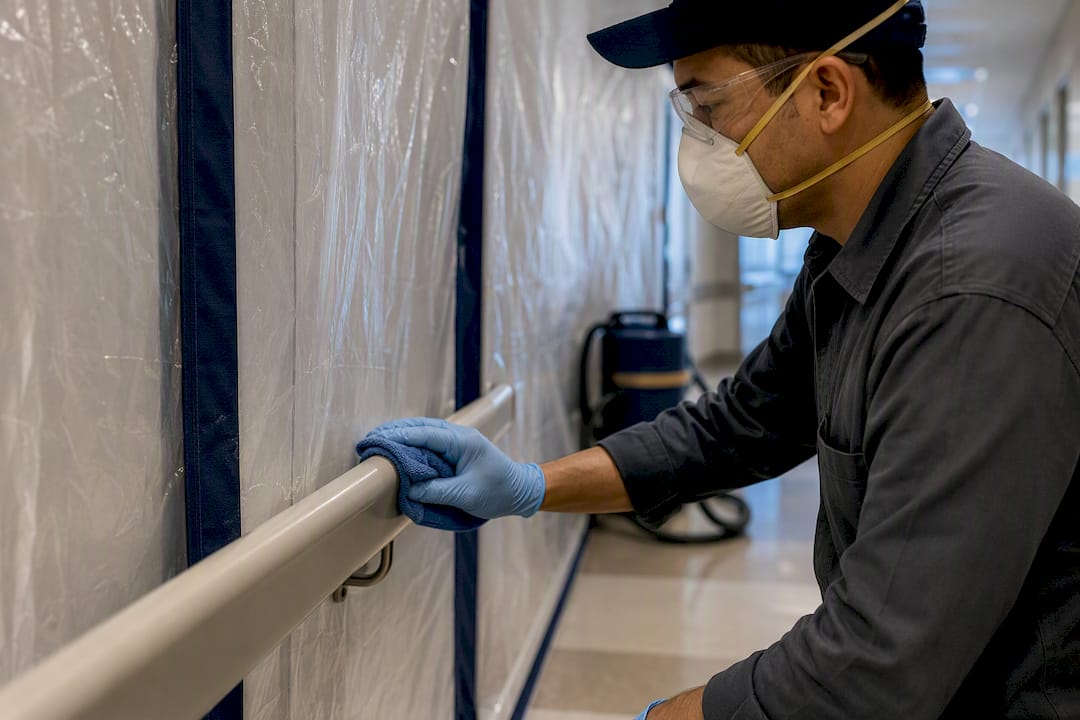
Anteroom cleaning deserves its own attention. Every surface a worker touches transitioning out of containment, floor, walls, PPE storage, needs a cleaning schedule tied to shift changes, not once-a-day service. CDC environmental infection control guidance frames this kind of environmental hygiene as inseparable from airflow control. A sealed barrier with poor cleaning discipline behind it still lets spores travel on shoes, carts, and hands.
Disinfectant selection matters too: EPA-registered hospital-grade disinfectants with documented efficacy against fungal spores, not just bacteria, are the right choice near any Class III or higher project, since aspergillus and similar molds are what construction dust actually carries.
Training Requirements for Construction Staff
A crew that understands barrier mechanics but not why they matter will eventually cut a corner. ICRA awareness training gives contractors and workers a working knowledge of how pathogens travel, why negative pressure has to stay continuous, and how to move through a containment zone without undoing it. Programs like the CPWR ICRA training course cover exactly this: airflow principles, contamination pathways, and safe work practices adjacent to occupied patient care areas.
Every crew member entering a containment zone should be able to demonstrate a few specific competencies before starting work: correct anteroom transition procedure, proper PPE donning and removal sequence, recognition of a barrier or pressure failure, and the facility’s specific stop-work reporting chain. Generic site safety training doesn’t cover any of this, so treat ICRA training as its own requirement, verified with documentation, not assumed because a contractor has done hospital work before.
Facility teams should require training proof as a contract deliverable, not a verbal assurance. Certificates, completion dates, and the specific training provider all belong in the project file. Retraining triggers matter too: a change in project class, a new subcontractor crew, or a documented containment breach should all prompt a refresher before work resumes.
Waste Management and Removal During Construction
Debris handling is one of the most common places containment quietly breaks down, usually because it happens at shift’s end when everyone is focused on wrapping up rather than on protocol. Construction debris, especially from Class III and IV demolition, carries dust loads that can reintroduce contamination the moment a cart rolls through an uncontrolled corridor.
Debris should exit through a dedicated route established before work begins, never improvised because the planned path is inconvenient that day. Containers need sealed lids or covers, not open-top carts, and any debris generated inside a negative-pressure zone should be bagged or covered before it crosses the anteroom threshold. Elevators used for debris transport, if unavoidable, should be dedicated for the duration of the project and cleaned between uses, not shared with patient or visitor traffic.
Timing matters as much as routing. Scheduling debris removal for low-traffic hours, overnight or during defined transport windows, cuts the odds of an uncontained cart passing anywhere near an open patient care corridor. Facilities with strict adjacency requirements, oncology or transplant units especially, often specify transport windows in the ICRA itself rather than leaving it to contractor discretion.
Waste manifests and disposal logs should be part of the same documentation trail as the ICRA permit. If a containment breach ever gets investigated, the debris handling record is often what shows whether protocol was followed or skipped under time pressure.
Post-Construction Decontamination and Clearance
Finishing construction doesn’t clear a space for patients. That happens only after a defined decontamination and verification sequence confirms the environment meets the same standard as any other patient care area.
Terminal cleaning comes first: a full wet-wipe and disinfection pass of every surface in the former work zone, using hospital-grade disinfectant effective against fungal spores, followed by HEPA vacuuming of any remaining dust. HVAC systems that were modified or disrupted need commissioning and verification before the space reopens, checking airflow direction, filter integrity, and duct cleanliness, a step CDC guidance treats as inseparable from environmental clearance. Water systems disrupted during the project need flushing and, where Legionella risk applies, testing before use resumes.
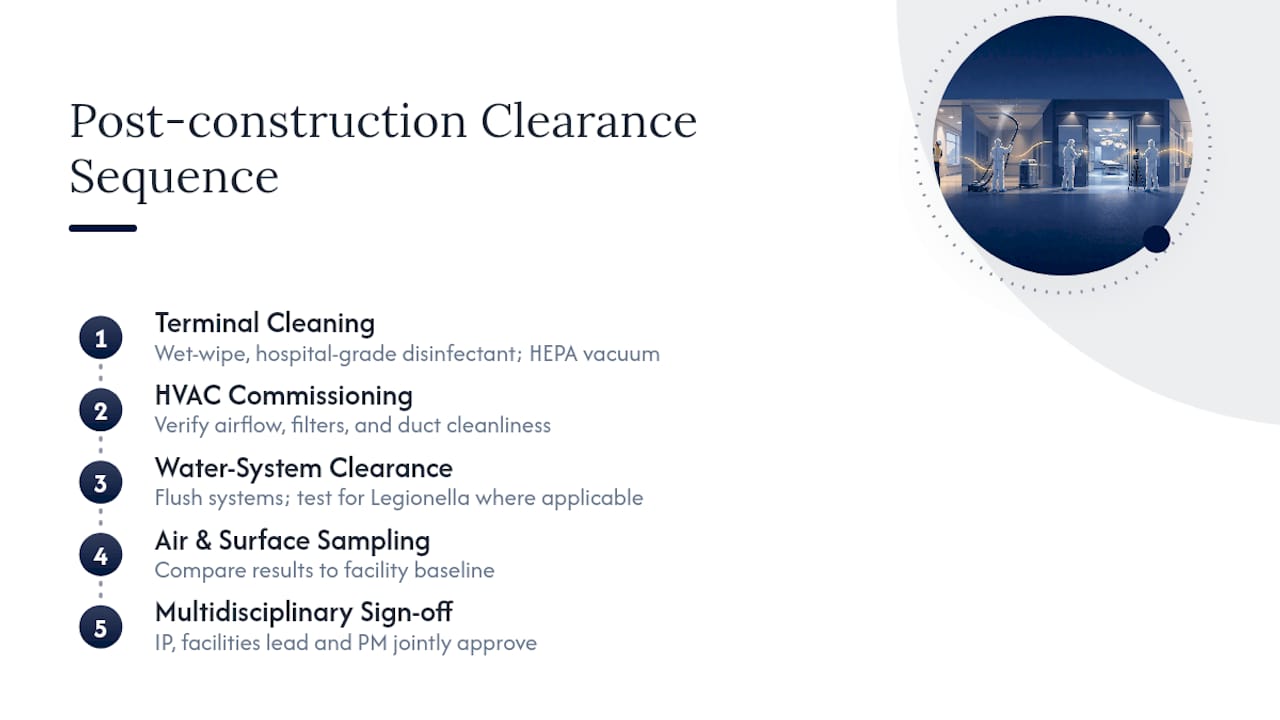
Air and surface sampling often forms the final checkpoint for Class III through V projects, comparing results against the facility’s established baseline rather than an arbitrary pass/fail number. If a facility’s mold risk history is a concern, a targeted assessment before reopening, covered in more depth in guidance on commercial mold remediation, is worth the extra step rather than assuming a clean visual inspection tells the whole story.
Sign-off should require the same multidisciplinary group that approved the original ICRA: infection preventionist, facilities lead, and project manager all confirming the space meets clearance criteria before patients or staff re-enter. Skipping that final joint sign-off, treating clearance as a contractor’s word rather than a verified checkpoint, is where otherwise well-run projects occasionally still produce a post-occupancy infection cluster.
Publisher Perspective: Why Integrated Contracting Closes ICRA Gaps
Most containment failures we’ve seen trace back to a handoff, not a bad standard. When construction, cleaning, and pest control run through separate vendors, barrier maintenance and cleaning discipline fall through the cracks between contracts. An integrated pre-construction assessment closes that gap before it opens.
— Nationwide Maintenance.
How Nationwide Maintenance Supports ICRA-Compliant Projects
Nationwide Maintenance builds ICRA-aware containment, cleaning, and monitoring into a single contract, so your barrier crew and your terminal cleaning team are the same accountable vendor, not two companies pointing at each other when a seam fails. That matters most on multi-phase healthcare projects, where a gap between the contractor’s punch list and the cleaning crew’s schedule is exactly where breaches happen.

Our commercial construction services cover barrier installation, negative air setup, and phased permit management for Class I through V projects, while our cleaning services handle the anteroom protocols and terminal decontamination that get a space cleared for patients again. For facility managers running multiple properties, a single contract also means one point of contact instead of chasing separate vendors for construction, cleaning, and pest control across every location, an approach detailed on our industries served page.
If you’re planning a renovation or expansion in an occupied healthcare facility, request a pre-construction assessment before you finalize your ICRA. We’ll walk the space, review your classification, and scope containment and cleaning as one coordinated plan instead of three separate quotes.
Standards Worth Bookmarking
- ASHE ICRA 2.0: the primary classification framework behind most institutional ICRA forms
- CSA Z317.13: the Canadian standard covering infection control during construction and renovation
- Indoor air quality and mold considerations: useful background for teams building out air-sampling protocols
Sources
Recommended
Need this handled at your facility?
Our crews cover commercial properties across New York, New Jersey, and Connecticut.