Facility Managers: 5 Step Audit Ready Healthcare Cleaning Standards
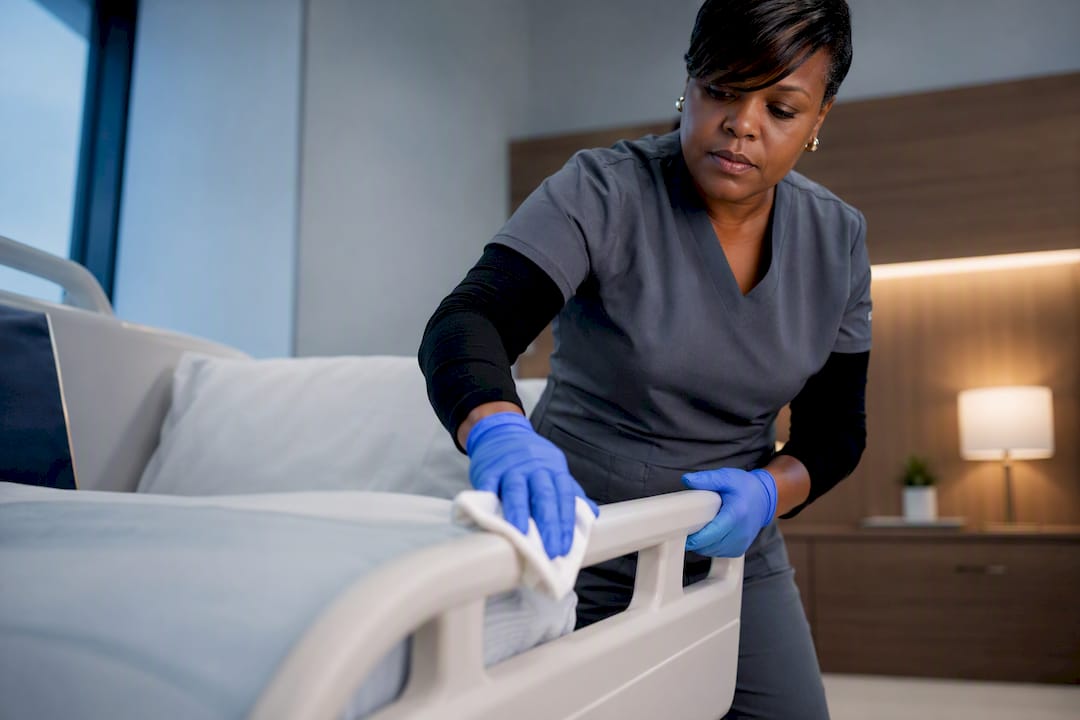
Meeting healthcare cleaning standards means aligning your program with CDC environmental cleaning guidance, Joint Commission infection control requirements where you’re accredited, and any national frameworks that apply in your jurisdiction, such as the NHS National Standards of Healthcare Cleanliness. At minimum, that means written policies, risk-based cleaning frequencies, documented SOPs, trained staff, and objective monitoring with auditable records. Everything below breaks down each piece and how to build it.
TL;DR:
- Healthcare facilities must layer multiple standards, such as CDC, Joint Commission, and NHS, depending on their jurisdiction, accreditation, and facility type.
- Proper cleaning involves risk-based frequency planning, documented SOPs, staff training, and objective monitoring tools like ATP tests and fluorescent markers.
- Disinfection effectiveness depends on thorough cleaning first and correct contact times, with specific disinfectants required for organisms like Clostridioides difficile.
- Audit-ready programs require detailed documentation, regular efficacy checks, staff competency validation, and a governance structure with shared accountability.
- Emergency spill response and waste disposal must follow strict protocols, with real-time coordination to prevent contamination and ensure compliance.
Table of Contents
- Which Healthcare Cleaning Standards Govern Your Facility
- Cleaning, Disinfection, and Risk: The Definitions That Drive Every Decision
- Routine, Terminal, and Scheduled Cleaning: What Each One Actually Covers
- Choosing Disinfectants and Getting Contact Time Right
- What an Audit-Ready Cleaning Program Looks Like on Paper
- How to Monitor Cleaning Efficacy, Not Just Task Completion
- Building Governance That Makes Standards Stick
- A Practical Rollout Plan for Getting Your Program Audit-Ready
- Spill Management and the Terminal Cleaning Steps People Skip
- Medical Waste: Handling and Disposal During the Cleaning Process
- Cleaning’s Role in Preventing Antimicrobial Resistance
- Why Auditable Programs Protect More Than Compliance Scores
- How Nationwide Maintenance Builds Cleaning Programs That Pass Inspection
- Sources
- FAQ
Which Healthcare Cleaning Standards Govern Your Facility
Three sets of rules tend to dominate decisions for healthcare facility managers, and knowing which ones apply to you determines almost everything else about how you build a program.
The CDC’s Core Infection Prevention and Control Practices treat environmental cleaning and disinfection as a non-negotiable component of Standard Precautions, on par with hand hygiene and PPE use. This isn’t guidance you can treat as optional if you want to be taken seriously during a survey. The CDC ties cleaning directly to reprocessing expectations and injection safety, which means your environmental services team can’t operate in isolation from your broader infection prevention program.
Layered on top of that, the CDC’s environmental cleaning procedures spell out a risk-based approach, working clean to dirty and top to bottom, with specific frequency guidance for different area types. This is the document most facility managers reference when building actual cleaning specifications, because it gets granular about waiting areas, consultation rooms, procedural spaces, and toilets.
If your facility carries Joint Commission accreditation, the revised Infection Control chapter effective July 1, 2025, raises the documentation bar considerably. The prepublication IC requirements mandate written infection prevention programs with documented policies, ongoing surveillance, and records covering cleaning, disinfection, and device reprocessing. Surveyors will ask to see the paper trail, not just hear that cleaning happens.
Facilities operating under NHS jurisdiction follow a different but equally rigorous framework. The National Standards of Healthcare Cleanliness 2025 replaced the 2021 version with functional risk categories, mandatory baseline cleaning frequencies, and a three-part audit structure covering technical, efficacy, and external review. It even extends responsibility to ambulance facilities, closing a gap that earlier guidance left vague.
Determining which standards apply to your facility comes down to a few factors:
- Jurisdiction: national or regional public health authority requirements where the facility operates
- Accreditation status: whether Joint Commission, DNV, or another accrediting body reviews your infection control program
- Payer and contract requirements: some insurers and government payers reference specific cleanliness benchmarks in reimbursement agreements
- Facility type: acute care, ambulatory surgery, long-term care, and dialysis centers often carry distinct frequency and documentation expectations
Most facility managers end up layering two or three of these frameworks rather than picking one. A Joint Commission accredited hospital in the United States still needs CDC-aligned environmental cleaning procedures as its operational backbone.
Cleaning, Disinfection, and Risk: The Definitions That Drive Every Decision
Cleaning removes visible soil, organic matter, and a portion of microorganisms from a surface using detergent and physical action. Disinfection kills or inactivates most pathogenic microorganisms on that surface, but it doesn’t sterilize. Sterilization eliminates all microbial life, including spores, and it’s reserved for critical items like surgical instruments.
Here’s the part people skip past: you can’t disinfect effectively without cleaning first. Organic material such as blood, mucus, or biofilm can shield microorganisms from disinfectant contact and neutralize the chemical’s active ingredients. A surface that looks clean but wasn’t properly wiped down first may still harbor pathogens after disinfectant application, because the disinfectant never made contact with what it needed to kill.
The Spaulding classification system, originally built for medical devices, extends naturally to environmental surfaces once you understand the logic:
- Critical items: contact sterile tissue or the vascular system (surgical instruments) and require sterilization
- Semicritical items: contact mucous membranes or non-intact skin (endoscopes, respiratory equipment) and require high-level disinfection
- Noncritical items and surfaces: contact intact skin only (bed rails, blood pressure cuffs, floors) and require low to intermediate-level disinfection
Environmental surfaces get their own risk stratification layered on top of this. Low-risk areas include administrative offices and public corridors. Moderate-risk areas cover general patient rooms and waiting areas. High-risk areas include operating rooms, intensive care units, and isolation rooms housing patients with transmissible infections. This stratification drives everything downstream: how often you clean, what products you use, and how much documentation you generate.
One of the most persistent myths in healthcare cleaning is that a visually clean surface is a safe surface. Peer-reviewed research on hospital cleaning practices makes clear that visual appearance is an unreliable proxy for microbial removal, and that the physical wiping action and correct dwell time matter more than how the surface looks afterward. A rushed wipe-down can look identical to a thorough one while leaving behind a meaningfully different microbial load.
Pro Tip: Train staff to treat wiping direction and pressure as part of the procedure, not an afterthought. A single-direction wipe with adequate pressure removes far more bioburden than a quick circular pass, even when both take the same amount of time.
Routine, Terminal, and Scheduled Cleaning: What Each One Actually Covers
These three cleaning types aren’t interchangeable labels for the same task performed at different times. Each has a distinct scope, and confusing them is one of the more common gaps auditors flag.
-
Routine cleaning happens daily or between patient uses in occupied spaces. It covers high-touch surfaces, floors, and visibly soiled areas, and it’s the baseline maintenance that keeps a space usable between deeper interventions.
-
Terminal cleaning happens after a patient is discharged, transferred, or an isolation precaution ends. This is the deep clean: every surface gets cleaned and disinfected including low-touch and high-touch points, linens are removed and replaced, and noncritical equipment gets reprocessed. Personal items must be cleared before terminal cleaning begins, because failing to coordinate equipment reprocessing with room turnover is a frequent, avoidable source of cross-contamination.
-
Scheduled cleaning covers periodic deep cleans of areas not tied to a specific patient encounter: ceiling vents, curtains, storage rooms, and administrative spaces on a calendar-based interval rather than an event-based trigger.
Frequency guidance should map directly to the risk category discussed earlier. Based on CDC’s environmental cleaning procedures, a reasonable frequency structure looks like this:
| Area | Risk category | Typical frequency |
|---|---|---|
| Operating rooms, procedure rooms | High | Frequent cleaning including between cases and terminal cleaning |
| ICU patient zones | High | Frequent cleaning including daily routine and terminal cleaning |
| Emergency department bays | High to moderate | Cleaning between patients with scheduled deep cleaning |
| General patient rooms | Moderate | Routine cleaning and terminal cleaning on discharge |
| Waiting areas, consultation rooms | Moderate | Regular cleaning of high-touch surfaces multiple times daily |
| Public restrooms | Moderate to high touch frequency | Multiple cleanings daily |
| Administrative offices | Low | Routine cleaning several times per week |
Isolation rooms and areas under transmission-based precautions need escalated frequency and dedicated equipment that doesn’t travel between rooms, following a practical room-by-room touchpoint plan facilities managers can use today. Ambulance and patient transport vehicles carry their own cleaning obligations under frameworks like the NHS 2025 standards, which explicitly extend baseline frequencies to vehicle interiors touching patients between transports.
Certain triggers should override your default schedule regardless of area type: an active outbreak, detection of a multidrug-resistant organism, or visible soiling discovered outside a scheduled cleaning window. When any of these occur, escalate cleaning promptly rather than waiting for the next scheduled pass. A practical office and facility cleaning frequency framework can help translate these risk tiers into a written service specification your team or contractor can follow consistently.
Choosing Disinfectants and Getting Contact Time Right
Not every surface needs a hospital-grade disinfectant, and using one where a detergent would do wastes money and increases chemical exposure for staff and patients. Reserve EPA-registered hospital disinfectants for surfaces in patient care areas and anything touched during clinical activity. General detergent cleaning remains appropriate for low-risk administrative spaces where infection transmission risk is minimal.
For Clostridioides difficile and other spore-forming organisms, standard hospital disinfectants often aren’t enough. Facilities need products from the EPA’s List K, which are specifically registered as sporicidal against C. difficile. Using a standard quaternary ammonium disinfectant on a known C. diff room is a common and serious compliance gap.
Contact time, sometimes called dwell time, is where most cleaning programs quietly fail without anyone noticing. A disinfectant needs to remain wet on the surface for the full duration specified on its label to achieve its claimed kill rate. Wiping a surface dry seconds after application, before the labeled contact time elapses, means the product never did its job even though the task got logged as complete.
A short but important checklist for product selection and use:
- Match the product to the label claim for the specific pathogen of concern (verify EPA registration number and claims list)
- Confirm material compatibility before broad rollout, since some disinfectants degrade certain plastics, upholstery, or electronic touchscreens over repeated use
- Follow manufacturer dilution instructions exactly; over-diluting reduces efficacy and under-diluting increases cost and chemical exposure without added benefit
- Keep Safety Data Sheets accessible at the point of use, not just in a binder in a supply closet
- Store chemicals according to compatibility requirements and dispose of expired or unused product per hazardous waste guidance
- Require full PPE (gloves, and eye protection for splash-risk tasks) whenever handling concentrated disinfectant
No-touch technologies including UV-C devices and vaporized hydrogen peroxide systems have a real but limited role. Guidance on environmental hygiene supports their use for terminal decontamination and outbreak response, but they supplement manual cleaning rather than replace it. A UV-C cycle can’t reach shadowed surfaces or remove organic soil, so manual cleaning still has to happen first.
What an Audit-Ready Cleaning Program Looks Like on Paper
Three distinct audit types exist, and conflating them is a common mistake among facilities newer to formal compliance programs. A technical audit checks whether tasks were performed according to specification (was the room cleaned on schedule, was the checklist completed). An efficacy audit measures whether the cleaning actually achieved the intended result, often using objective tools rather than a visual check. An external audit brings in a third party, whether a regulator, accreditor, or independent inspector, to validate both.
The NHS 2025 standards formalize exactly this three-part structure, and it translates well beyond NHS-governed facilities as a model for any organization serious about demonstrating compliance rather than just claiming it.
Regardless of which regulatory framework applies to you, expect surveyors and accreditors to ask for a defined set of documents. Building this checklist in advance saves considerable stress during survey season:
- Written cleaning specifications for each area and risk category
- Standard operating procedures for routine, terminal, and scheduled cleaning
- Completed daily and weekly cleaning checklists with signatures or digital timestamps
- Staff training and competency validation logs, dated and role-specific
- A current product register listing every disinfectant and cleaning agent in use, with EPA registration numbers
- Audit results, including technical and efficacy findings going back a defined retention period
- Corrective action records showing how failures were addressed and closed out
A well-run program typically reports results at two levels: an internal percentage score from technical audits, and an external pass/fail or star rating from accreditation review. Facilities that only track the internal number tend to get caught flat-footed when an external reviewer applies a stricter standard. Documentation isn’t paperwork for its own sake here; it’s the evidence trail that turns “we clean regularly” into a claim you can actually defend during a survey.
How to Monitor Cleaning Efficacy, Not Just Task Completion
Visual inspection tells you whether a surface looks clean. It tells you almost nothing about whether it’s microbiologically safe, which is why objective monitoring has become a standard companion to visual audits rather than an optional add-on.
ATP (adenosine triphosphate) testing uses a swab and a handheld luminometer to measure organic residue on a surface, producing a numeric reading within seconds. Fluorescent gel or powder markers work differently: a nearly invisible marker gets applied to high-touch surfaces before cleaning, then checked under UV light afterward to confirm whether the surface was actually wiped, not just walked past with a rag. Both methods catch what visual inspection misses, and research on hospital cleaning practices confirms that integrating objective monitoring into routine efficacy audits, rather than deploying it only occasionally, surfaces gaps in staff technique that would otherwise go unnoticed indefinitely.
A workable monitoring cadence looks something like this:
- Run fluorescent marker checks on high-touch surfaces weekly in high-risk areas, monthly in moderate-risk areas
- Perform ATP spot checks after terminal cleaning in operating rooms and isolation rooms, treating any reading above the manufacturer’s pass threshold as a re-clean trigger
- Reserve microbiologic sampling, culturing surfaces for specific organisms, for outbreak investigation or targeted infection cluster review rather than routine monitoring, since it’s slow, costly, and not designed for real-time feedback
- Feed every failed check back into staff retraining within a defined window, and re-test the same surface type to confirm the correction worked
If you outsource cleaning to a contractor, these same tools double as a performance validation method. Requiring documented ATP or fluorescent marker results as part of a contract’s KPI structure gives you an objective basis for renewal or remediation conversations instead of relying on subjective impressions. The same logic applies when commissioning new equipment or a new no-touch technology: validate it with objective testing before trusting it for routine use.
Pro Tip: Set your ATP pass threshold based on the meter manufacturer’s clinical guidance, not an arbitrary round number. Thresholds vary by device and surface type, and using a generic cutoff can produce false confidence.
Our ATP cleaning test guide walks through how to interpret readings and build them into a recurring validation routine.
Building Governance That Makes Standards Stick
Standards fail in practice more often from governance gaps than from a lack of knowledge about what good cleaning looks like. A programmatic approach that ties environmental services, infection prevention, and facility leadership together consistently outperforms a model where cleaning is treated as an isolated task assigned to whoever’s available.
A workable governance structure assigns clear decision rights:
- Infection prevention specialists set risk categories, define outbreak escalation triggers, and review audit data for trends
- Environmental services leadership owns SOP development, staff scheduling, and day-to-day compliance with cleaning specifications
- Facilities management handles engineering controls, including HVAC systems, water quality, and physical space design that affects cleanability
- Executive leadership holds budget and accountability for closing corrective actions identified through audits
Broader environmental infection control guidance reinforces that air and water quality controls, not just surface cleaning, belong in this same governance conversation, since ventilation and plumbing failures can undermine even a perfectly executed cleaning program.
Contract specifications for outsourced cleaning should spell out performance parameters explicitly: cleaning frequencies by area, product requirements, response times for spill events, and audit or remediation clauses that define what happens when performance falls short. Vague contract language (“clean thoroughly, as needed”) creates disputes later. Specific language (“high-touch surfaces in patient rooms cleaned a minimum of twice daily, verified by weekly ATP spot check”) gives both parties something enforceable.
Competency validation should happen at hire, then again on a recurring basis, commonly annually, with additional retraining triggered by failed audits rather than left to a fixed calendar alone.
A Practical Rollout Plan for Getting Your Program Audit-Ready
Standards on paper mean little without a sequence for putting them into practice. A workable rollout follows five stages: risk assessment, cleaning specification development, SOP and checklist creation, pilot audits, then full rollout with ongoing monitoring.
Start by mapping every area in your facility to a risk category, then build a written cleaning specification for each one covering frequency, products, and responsible staff. From there, draft SOPs for every cleanable item type, not just rooms in general. A single SOP should specify the product, dilution, application method, contact time, and drying requirements for one item, such as a bed rail or an IV pump housing.
Each SOP and checklist should include:
- The specific surface or item being addressed
- Product name and EPA registration number
- Required contact/dwell time
- PPE requirements for the staff member performing the task
- A sign-off field, whether paper or digital
Run a pilot audit in one unit or department before rolling the program facility-wide. This surfaces gaps in the SOP language or training before they multiply across every unit.
Training structure matters as much as the SOP content. New staff need documented onboarding covering both the “how” and the “why” behind contact times and wiping technique. Build in periodic refreshers, and treat a failed audit or monitoring result as an automatic retraining trigger rather than something addressed only during the next scheduled session.
Pro Tip: Pair every new SOP rollout with a fluorescent marker spot check within the first week. It’s the fastest way to confirm training actually changed behavior rather than just checking a box on a training log.
Our healthcare facility maintenance page outlines how this rollout structure applies across multi-site healthcare operations.
Spill Management and the Terminal Cleaning Steps People Skip
Blood and body fluid spills require an immediate, specific response, not a folded-in extension of routine cleaning. Staff should don appropriate PPE first, including gloves and, where splash risk exists, eye protection and a gown, before approaching the spill. Absorb the fluid with disposable materials, then clean the area with detergent to remove organic material before applying an EPA-registered disinfectant with an appropriate contact time for bloodborne pathogens.
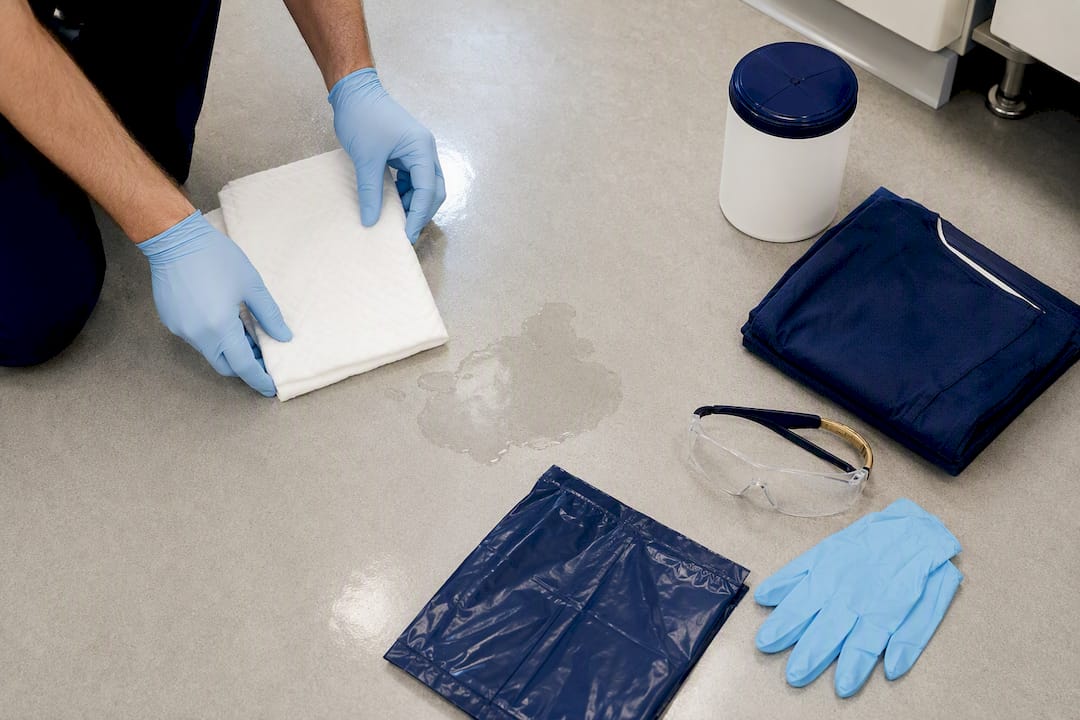
Spill kits should be stationed in predictable, accessible locations across the facility, not centralized in one supply closet that requires a long walk during an active spill. Every kit needs absorbent material, PPE, a disinfectant appropriate for bloodborne pathogen claims, and a dedicated waste bag for disposal.
Terminal cleaning after a spill event, or after any patient discharge, has to include steps that are easy to rush past under time pressure. Every high-touch and low-touch surface gets cleaned and disinfected, not just the obviously soiled ones. Linens get removed and bagged according to facility protocol before new linens are placed. Noncritical patient-care equipment, blood pressure cuffs, IV poles, bedside monitors, needs reprocessing according to its own specification, run in parallel with the room cleaning rather than as an afterthought once the room “looks” done.
The most common failure point isn’t the cleaning itself. It’s the coordination gap between environmental services finishing the room and clinical staff or biomedical engineering completing equipment reprocessing on a separate timeline. When those two processes aren’t synchronized, a room can get marked ready for the next patient while a piece of equipment inside it still carries contamination from the previous occupant.
Medical Waste: Handling and Disposal During the Cleaning Process
Waste generated during cleaning falls into distinct categories, and sorting them incorrectly creates both compliance exposure and physical safety risk for staff. Regulated medical waste, including anything saturated with blood or body fluids, goes into red biohazard bags or rigid containers marked with the biohazard symbol, never into general waste streams.
Sharps encountered during cleaning, needles, broken glass from specimen containers, or blades, require immediate placement into puncture-resistant sharps containers. Staff should never attempt to manually recap or manipulate a sharp found during cleaning; the container comes to the item, not the other way around.
Chemical waste from expired or unused disinfectants follows separate hazardous waste disposal rules, typically requiring a licensed hazardous waste hauler rather than standard trash pickup. Mixing chemical waste streams, combining an oxidizer with an incompatible cleaning agent in the same disposal container, creates a genuine safety hazard beyond just a compliance problem.
Documentation matters here too. Facilities typically need manifests tracking regulated medical waste from generation through final disposal, satisfying both environmental regulations and infection control audit requirements. Staff handling waste need training specific to segregation rules, since a single misplaced item, a used dressing tossed into general waste instead of a biohazard bag, can trigger a reportable incident depending on jurisdictional rules.
PPE requirements for waste handling mirror those for spill response: gloves at minimum, with additional protection based on what’s being handled. Waste containers should never be filled beyond their rated capacity, since overfilled sharps containers are a well-documented source of preventable needlestick injuries among environmental services staff.
Cleaning’s Role in Preventing Antimicrobial Resistance
Antimicrobial resistance doesn’t develop because of cleaning failures directly, but poor environmental hygiene creates the conditions that let resistant organisms persist and spread between patients. A surface contaminated with methicillin-resistant Staphylococcus aureus or a carbapenem-resistant organism can serve as a transmission bridge from one patient to the next if cleaning between uses is inconsistent or incomplete.
This is where the connection between cleaning standards and antimicrobial stewardship becomes concrete rather than theoretical. When environmental transmission is controlled effectively, clinicians face fewer resistant infections requiring last-resort antibiotics, which in turn reduces the selective pressure that drives further resistance development. Cleaning and antibiotic stewardship function as two sides of the same infection prevention strategy, not separate programs run by separate departments.
Facilities managing patients colonized or infected with multidrug-resistant organisms need enhanced cleaning protocols beyond standard precautions. That typically means dedicated cleaning equipment that doesn’t travel to other rooms, increased frequency of high-touch surface disinfection, and disinfectant products with confirmed efficacy claims against the specific resistant organism in question, not just a general hospital-grade label.
Detection of a resistant organism should function as one of the escalation triggers discussed earlier, immediately increasing cleaning frequency and often warranting an efficacy audit using ATP or fluorescent markers to confirm the enhanced protocol is actually being executed, not just documented on paper. Skipping this verification step is a common reason outbreaks of resistant organisms persist longer than they should, even after a facility believes it has responded appropriately.
Why Auditable Programs Protect More Than Compliance Scores
Standards only matter once they’re translated into something you can measure and defend. A written policy that never gets checked against actual practice is a liability disguised as documentation. That gap between what’s written and what’s happening on the floor is where most infection prevention failures actually originate, not in a lack of awareness about what good cleaning looks like.
We think the biggest mistake facilities make is treating cleaning as a task list owned entirely by environmental services, rather than a shared responsibility spanning infection prevention, facilities, and leadership. Continuous measurement, not periodic inspection, is what separates a program that holds up under scrutiny from one that only looks good on the day of a scheduled walkthrough. Objective monitoring tools exist precisely because visual checks and self-reported task completion aren’t reliable enough on their own to catch the gaps that matter.
Facilities that build governance around shared accountability, and that treat every failed audit as a training signal rather than a paperwork problem, tend to hold up far better when a real surveyor or a real outbreak tests the program. If you’re building or refining a cleaning program and want help translating these standards into a working specification, our team has spent decades doing exactly that across complex commercial and healthcare environments.
— Nationwide Maintenance.
How Nationwide Maintenance Builds Cleaning Programs That Pass Inspection
Standards documents tell you what’s required. Getting there consistently, across every shift and every room, is the harder problem, and it’s the one Nationwidemaintenance has spent more than 30 years solving for facilities that can’t afford to get it wrong.
We build healthcare-capable cleaning programs around the same structure this article walks through: risk-based frequency mapping, documented SOPs, and objective validation rather than a checklist that gets signed off without verification. Our integrated model means a single contract covers cleaning, facility maintenance, and the emergency response capacity that healthcare environments need around the clock. You’re not coordinating separate vendors when a spill, an equipment failure, or a surprise survey happens at 2 a.m. Clients across retail and healthcare environments rely on this model because it removes coordination gaps that cause compliance failures.
If your facility needs a cleaning specification built to withstand an actual audit, not just look good on paper, start with our commercial cleaning services page to request a program review.
Sources
The frameworks referenced throughout this article are worth keeping on hand for direct reference: the NHS National Standards of Healthcare Cleanliness 2025, CDC’s environmental cleaning procedures and Core Infection Prevention and Control Practices, the Joint Commission’s revised IC chapter, and the peer-reviewed review of hospital cleaning practices cited across several sections above.
Local and regional regulators frequently layer additional requirements on top of these national frameworks, so confirm jurisdiction-specific rules before finalizing a cleaning specification.
- National standards of healthcare cleanliness 2025 (NHS England)
- Revised Infection Control (IC) Chapter (Prepublication) (The Joint Commission)
- Core Infection Prevention and Control Practices for Safe Healthcare Delivery in All Settings (CDC)
- Hospital cleaning: past, present, and future (PMC review article)
FAQ
What are the national standards for healthcare cleanliness in 2026?
In jurisdictions covered by the NHS, the National Standards of Healthcare Cleanliness 2025 is the governing framework, featuring functional risk categories and mandatory baseline cleaning frequencies. In the United States, facilities typically follow CDC environmental cleaning guidance alongside Joint Commission infection control requirements where accredited.
What are the three levels of cleaning in healthcare?
Routine cleaning covers daily maintenance of occupied spaces, terminal cleaning is the full deep clean performed after discharge or transfer, and scheduled cleaning addresses periodic deep cleans of areas like vents and curtains on a calendar basis rather than a patient-event trigger.
What are the CDC guidelines for hospital cleaning?
The CDC recommends a risk-based approach working clean to dirty and top to bottom, with specific frequency guidance by area type, detailed in its environmental cleaning procedures. These sit alongside the Core Infection Prevention and Control Practices, which treat cleaning as a required element of Standard Precautions.
What are the 7 standards of housekeeping?
There’s no single universally cited standards list in the major frameworks referenced here; definitions vary by organization and region. Facilities generally build their housekeeping standards around risk-based frequency, documented SOPs, trained staff, correct product selection with proper contact time, objective monitoring, auditable records, and multidisciplinary governance.
How often should high-touch surfaces be cleaned in a hospital?
Frequency depends on risk category: high-risk areas like ICUs and operating rooms need high-touch surface disinfection multiple times daily and between every case, while moderate-risk areas like general patient rooms typically require daily routine cleaning plus terminal cleaning at discharge.
Recommended
Need this handled at your facility?
Our crews cover commercial properties across New York, New Jersey, and Connecticut.