Use the 4 Week Trap Benchmark: German Cockroach IPM for Facilities
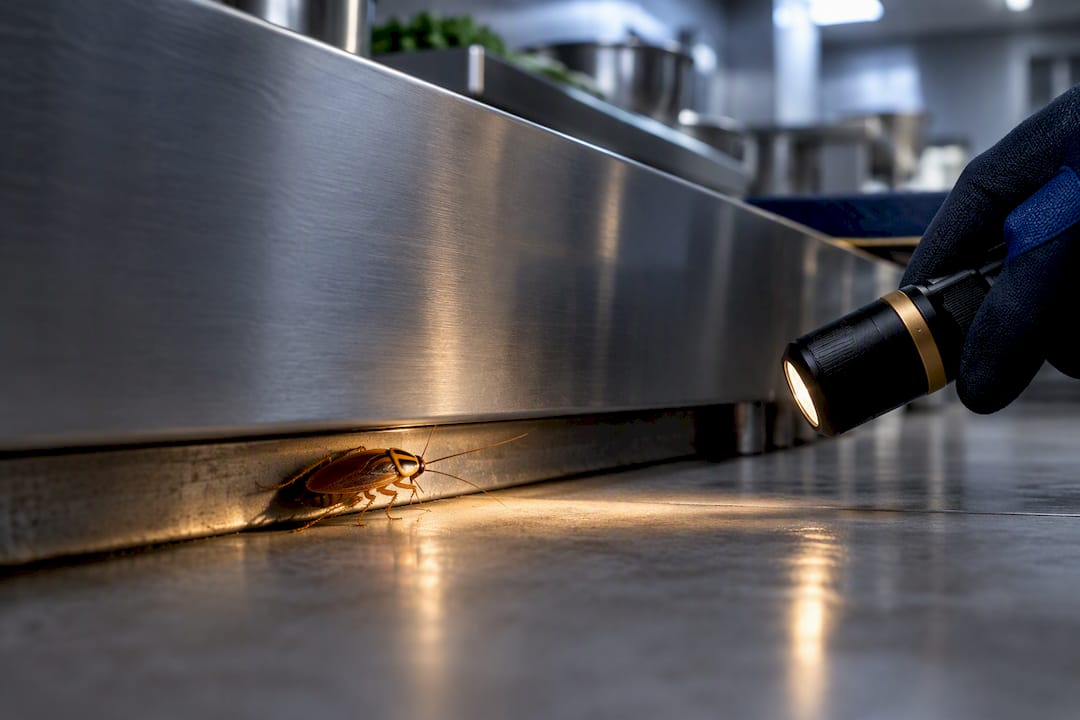
The fastest reliable way to handle German cockroach control is sanitation combined with targeted gel baits and consistent monitoring, not sprays or foggers. Start by removing food and water sources, place gel bait in small amounts at harborages, and set sticky traps to track results. Expect to re-treat every 2 to 4 weeks until you catch zero roaches for a full month.
TL;DR:
- Consistent sanitation and targeted gel bait placement are essential, with re-treatments every 2 to 4 weeks until traps remain clear for four weeks.
- Heavy infestations, especially more than five roaches per inspection, require sanitation escalation and professional pest control intervention.
- Using foggers or broad sprays is ineffective because they fail to reach roaches hiding in cracks and may scatter them, worsening the problem.
- Monitoring with sticky traps and tracking trap counts are crucial to assess progress and decide when to escalate or stop treatment.
- Long-term control depends on ongoing sanitation, bait rotation, and professional services in complex or high-pressure environments.
Table of Contents
- What Do German Cockroaches Look Like, and How Bad Is the Infestation?
- What Should You Do in the First 48 to 72 Hours?
- How Do You Run a Full IPM Protocol From Start to Finish?
- Which Products Actually Work, and How Do You Use Them Safely?
- How Do You Monitor Progress, and When Should You Call a Professional?
- How Does an Integrated Facilities Approach Improve Long-Term Results?
- What Actually Moves the Needle on German Cockroach Control?
- When Should You Bring in Nationwide Maintenance for Pest Control?
- Sources
- FAQ
What Do German Cockroaches Look Like, and How Bad Is the Infestation?
German cockroaches are small, tan to light brown, and roughly a half inch to five-eighths of an inch long as adults. Two dark parallel stripes run lengthwise down the area just behind the head, which is the fastest visual tell separating them from larger, darker species like American or Oriental cockroaches. They cannot fly well, but they run fast, and nymphs (the immature stage) are darker and smaller, sometimes mistaken for a different insect entirely.
They hide because light and open space stress them. Look in the tight, warm, humid cracks near food and water: under refrigerator motors, behind stove control panels, inside microwave housings, beneath sinks, in cabinet hinges, and along baseboards near dishwashers. In commercial kitchens, check the underside of prep tables, inside equipment control boxes, and around floor drains.
You rarely see the roach before you see its evidence. Watch for:
- Fecal droppings that look like coarse black pepper or coffee grounds, often smeared along edges where roaches travel repeatedly.
- Ootheca (egg cases), small brown capsules about a quarter inch long, often glued in cracks or dropped near food sources; each one can carry 30 to 40 nymphs.
- Shed skins from molting nymphs, translucent and fragile, tucked into the same harborages as live roaches.
- Smear marks, greasy brown streaks along walls or cabinet edges where roaches have rubbed against surfaces.
- Nymphs at multiple life stages, a sign the population is actively breeding rather than a single stray adult that wandered in.
Severity matters because it changes your strategy. One roach spotted at night, especially near the kitchen, justifies starting a full baiting and monitoring program immediately. If a single inspection turns up more than five roaches, that signals a heavy infestation, according to the IPM action plan for German cockroaches from TAMU School IPM, and you should treat it as a trigger to escalate: tighten sanitation immediately, increase bait density, and consider bringing in a professional.
Biology explains why numbers can jump so fast. German cockroaches produce three to six generations a year and spread almost entirely through human activity, riding in on grocery bags, secondhand furniture, or shared laundry rooms, according to the same TAMU School IPM plan. They also carry allergens and pathogens linked to asthma triggers, particularly in children, which is one more reason a small sighting deserves a fast response rather than a wait-and-see approach.
What Should You Do in the First 48 to 72 Hours?
Speed matters here because early action protects your bait investment later. Every crumb you clean up now is one less competing food source once you put down gel bait, and every crack you seal is one less place roaches can retreat to avoid it.
- Clear dishes and standing water immediately. German cockroaches can survive weeks without food but only days without water, so a dry sink overnight does more than most sprays.
- Take out garbage daily and switch to a lidded bin. Loose trash under the sink is one of the most reliable roach magnets in any kitchen.
- Move pet food into sealed containers and pick up bowls overnight. Pet food left out is a free buffet that undercuts every bait station nearby.
- Store dry goods (cereal, flour, pasta) in airtight containers. Cardboard boxes are both a food source and a favorite hiding spot.
- Place sticky traps to map activity before you bait. Put one in each corner of the kitchen, one under the sink, one behind the refrigerator, and one in any bathroom with plumbing runs. In a small apartment, five to eight traps is usually enough; a commercial kitchen may need one every 10 to 15 feet along walls and equipment lines.
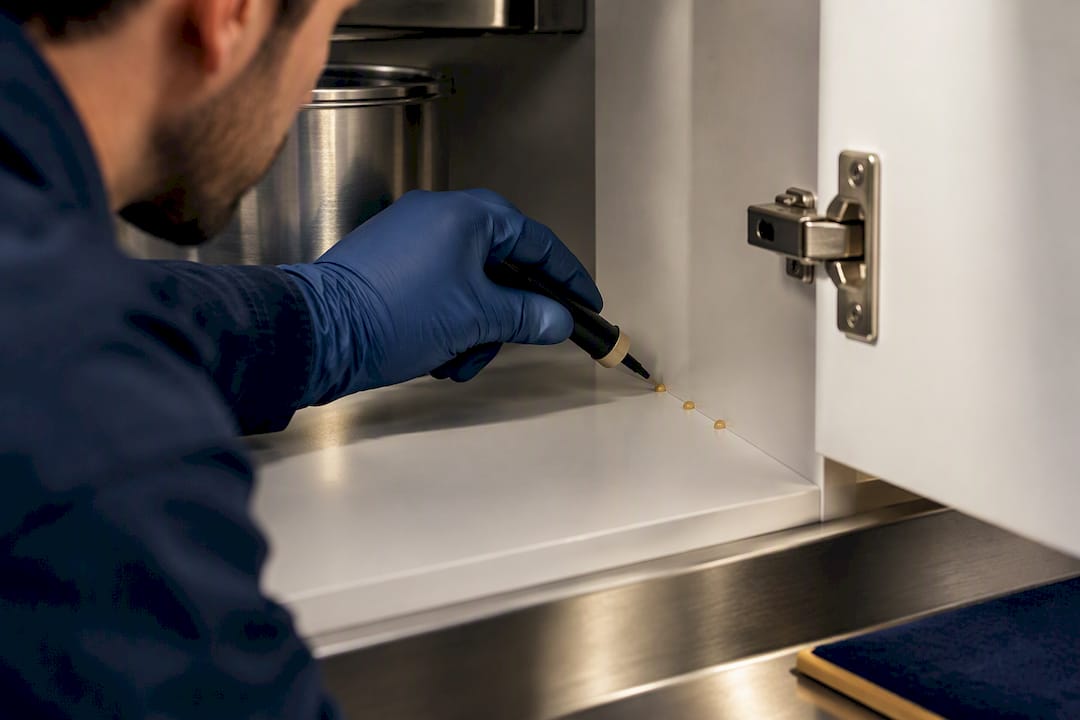
- Apply gel bait in pea-sized dots at harborage points, not in open areas. Target cabinet hinges, under-sink pipe runs, behind appliance motors, and along baseboard cracks. For a typical one-bedroom apartment, plan on roughly 10 to 30 grams of bait total, spread across many small placements rather than a few large blobs. Smaller, more frequent placements get eaten faster and use less active ingredient overall than a handful of large dabs.
- Use boric acid or diatomaceous earth only in dry voids that people and pets cannot reach, such as inside wall cavities behind switch plates or in the back of a dead outlet, since boric acid dust remains effective when applied lightly in inaccessible spaces but loses potency fast if it gets damp or is disturbed.
- Wear gloves when placing bait or dust, wash hands afterward, and keep all products out of reach of children and pets by sticking to voids, not open floors or countertops.
Pro Tip: Skip the caulk gun until after your first bait cycle. Sealing every crack on day one can trap roaches inside walls with no way to reach the bait, which just prolongs the infestation. Seal the obvious gaps that let roaches travel between units, but save deep caulking for after the population has crashed.
What you should not do matters just as much as what you should. Total-release foggers do not work against German cockroaches. Because these roaches hide deep in cracks and voids, fogger particles rarely reach them, and foggers carry real fire and inhalation risks along with limited residual effect, according to NC State Extension’s guidance on German cockroach surveillance and management. Broad surface sprays cause a second problem: many contain repellents that make roaches avoid treated areas entirely, including the bait you just placed, which can undo days of progress in a single spray session.
How Do You Run a Full IPM Protocol From Start to Finish?
Integrated Pest Management works because it stacks multiple pressures on the roach population at once instead of relying on a single tactic. The protocol runs in four phases: survey, treat, monitor, and prevent, and each phase feeds the next.
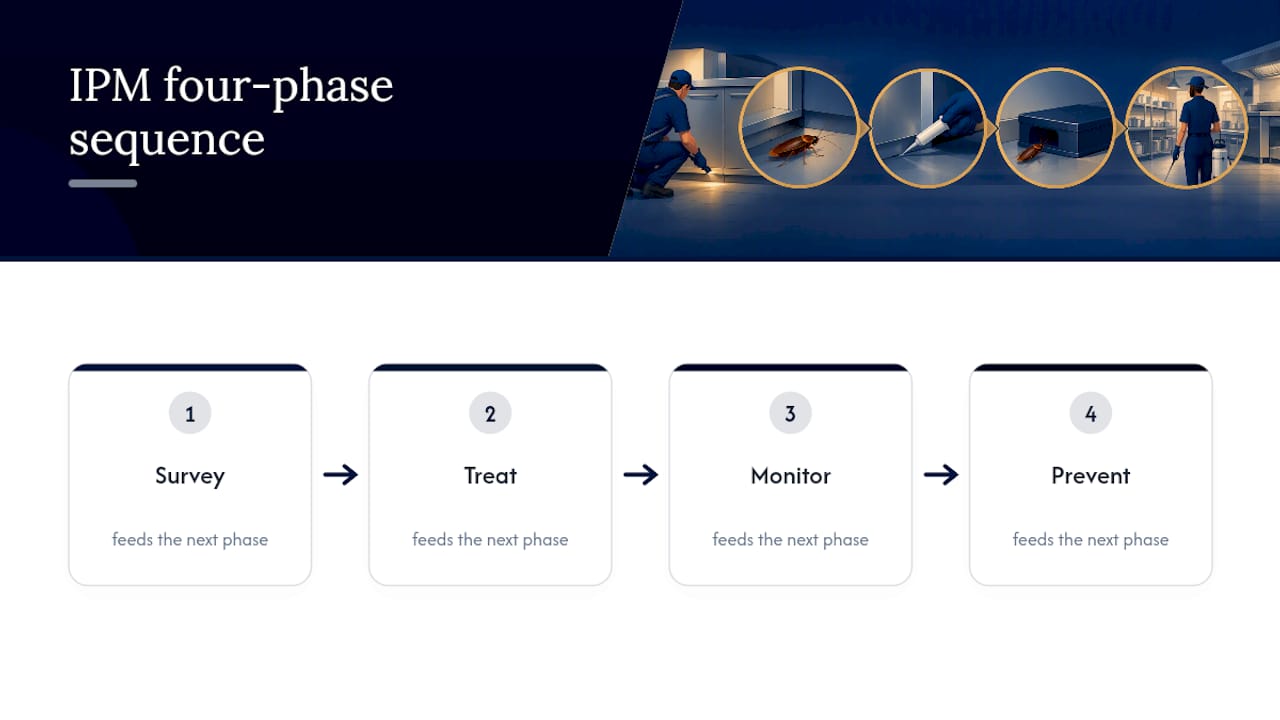
Phase 1: Baseline survey (week one)
Place sticky traps throughout the space before any treatment, and leave them for a full week undisturbed. This baseline count is what you will compare every future reading against. In a single-family home, six to ten traps covering kitchen, bathrooms, and any utility closets is typical. In a multi-unit building or restaurant kitchen, expect to need traps in every unit or station bordering plumbing and food prep, since German cockroaches move along shared pipes and wall voids.
Phase 2: Sanitation and exclusion
This phase runs continuously, not as a one-time cleanup. According to NC State Extension, sanitation is an ongoing management activity, not a single event, and it is what determines whether your bait actually gets eaten instead of competing with food debris.
- Seal cracks around pipes, baseboards, and cabinet backs with caulk, focusing on entry points shared between units in multifamily buildings.
- Remove cardboard boxes and paper clutter, both prime harborage material that also holds moisture.
- Fix leaking faucets, dripping ice makers, and condensation lines, since water is the resource roaches need most urgently.
- Store food, including pet food, in sealed hard-plastic or glass containers rather than bags or boxes.
- Clean under and behind large appliances monthly, not just the visible counters and floors.
Phase 3: Chemical strategy
Bait is the backbone of chemical control, but it works better layered with other tools. Place gel bait in small, frequent dots at harborages and check them every two weeks, refreshing spots that show heavy consumption and adding new placements where trap counts stay high, following the placement approach recommended by UF/IFAS’s assessment-based pest management guidance.
Add an insect growth regulator (IGR) alongside the bait rather than instead of it. IGRs do not kill adult roaches quickly; they disrupt molting and reproduction, which shrinks the next generation even while bait handles the current one. Rotate bait active ingredients roughly every three months. This matters because German cockroach populations under sustained bait pressure can develop behavioral resistance, sometimes called glucose aversion, where roaches learn to avoid the sugar-based attractant in a bait even though the poison itself would still kill them, according to NC State Extension. Switching to a protein-based bait or a different active ingredient breaks that learned avoidance.
For heavy infestations, a HEPA vacuum pass through visible harborages before baiting removes a large chunk of the population immediately and clears away fecal-aggregation pheromones that otherwise keep attracting new roaches to the same spots, a technique detailed in the University of Nebraska-Lincoln cockroach management manual.
Phase 4: Follow-up and success metrics
- Re-treat every 2 to 4 weeks, refreshing bait and checking IGR placements at each visit.
- Read sticky trap counts at each visit and compare them against your baseline; a declining trend confirms the protocol is working.
- Declare success only after zero roaches are caught on sticky traps for four consecutive weeks, the benchmark cited in Rutgers NJAES’s German cockroach fact sheet.
- Continue monthly monitoring for at least six months after that, since a single missed egg case can restart the whole cycle.
Which Products Actually Work, and How Do You Use Them Safely?
Gel baits and bait stations outperform every other chemical tool against German cockroaches, and it isn’t close. Baits let the roach carry the poison back to the harborage and pass it to others through grooming and feeding on dead roaches, a chain reaction sprays can’t replicate. Common active ingredients in consumer and professional gel baits include fipronil, indoxacarb, and abamectin, each working through a different mode of action, which is exactly why rotating between them delays resistance.
Baits are safer and more effective than broad sprays for German cockroach control. Sprays and aerosols carry limited residual effect because of repellency and resistance, and they can actually scatter cockroaches into neighboring units, according to Penn State Extension.
That scattering effect is worth sitting with for a moment: a spray that “works” in one apartment can push survivors straight into the unit next door, turning a contained problem into a building-wide one.
Insect growth regulators (IGRs) like hydroprene or pyriproxyfen don’t kill on contact. They interrupt the molting process in nymphs and reduce egg viability in females, so their value shows up over weeks, not hours, as the population’s reproductive capacity collapses even while adults still wander around. Pairing an IGR with bait attacks both the current generation and the next one at the same time.
Desiccant dusts fill a narrower role. Boric acid, applied as a light, barely visible dusting in dry wall voids, behind switch plates, or inside equipment housings, kills by damaging the roach’s outer cuticle and digestive tract on contact, and it stays effective indefinitely as long as it stays dry. Diatomaceous earth works on the same mechanical principle but is generally less effective against German cockroaches specifically and carries inhalation risks if applied heavily in open areas, according to Rutgers NJAES. Keep both products in voids only, never on open counters, floors, or anywhere a child or pet could contact or ingest them.
Why sprays and foggers underperform:
- Repellent formulations push roaches away from treated surfaces and toward untreated harborages, including areas with bait.
- Contact sprays have almost no residual effect once dry, so they miss roaches that emerge hours later.
- Foggers cannot penetrate the deep cracks and voids where German cockroaches actually live.
- Both can disperse a contained infestation into a wider area, especially in multi-unit buildings.
Before applying any pesticide product, read the label completely, including the signal word, application sites, and re-entry interval. Wear gloves when handling concentrated gels or dust formulations, wash your hands after every application, and store all products in their original, labeled containers away from children and pets. Commercial operators should confirm that whoever applies pesticides holds the applicator licensing their state or municipality requires; residential DIY products sold over the counter generally don’t require a license, but always check the label for restrictions specific to your product and location.
How Do You Monitor Progress, and When Should You Call a Professional?
Sticky traps are your scoreboard. Check them every two weeks during active treatment and log the count each time, comparing it against your baseline survey. A steady decline over three or four checks means the protocol is working; a flat or rising count means something is wrong, usually insufficient bait density, missed harborages, or bait aversion.
The thresholds that matter are simple:
- One roach spotted is enough justification to start or continue baiting and monitoring, according to TAMU School IPM.
- More than five roaches in a single inspection should trigger a review of sanitation practices and likely a more aggressive treatment escalation.
- Rising nymph counts on traps, even if adult counts stay flat, signal active breeding you haven’t reached yet.
- Low bait consumption despite visible activity suggests resistance or aversion, meaning it’s time to switch active ingredients.
Professionals bring three things most households and small businesses can’t easily replicate: access to formulated products not sold over the counter, the training to place dust safely and precisely inside wall voids and equipment, and structural exclusion work that closes off the shared voids and utility penetrations letting roaches travel between units. A licensed pest control service will typically also build a documented IGR rotation schedule, which matters most in multi-unit residential buildings and food-service operations where reinfestation risk from neighboring spaces never fully goes away. If your DIY protocol hasn’t moved the trap count after two full monitoring cycles, or if you’re managing a commercial kitchen where a health inspection is on the line, that’s the point to bring in professional pest control services rather than keep troubleshooting alone.
How Does an Integrated Facilities Approach Improve Long-Term Results?
Most German cockroach infestations don’t fail because the bait was wrong. They fail because sanitation lapses between visits, and nobody catches the slip until the trap counts climb back up. That’s the gap an integrated facilities approach is built to close. Many experienced facility maintenance providers have found that pest control succeeds or fails based on what happens in the kitchen and the trash room every single day, not just on the days a technician shows up.
Combining pest control with commercial cleaning under one contract removes the coordination gap that usually undermines DIY or single-vendor efforts. When the same provider handles enzyme cleaning for drains, grease traps, and floor surfaces, food residue that would otherwise feed a roach population between bait services simply doesn’t accumulate. That’s a meaningful advantage in restaurants and multi-tenant food-service settings, where one unit’s sanitation lapse becomes every neighboring unit’s infestation.
For small business operators, the practical advice is straightforward: schedule sanitation and pest monitoring on the same recurring calendar, not as separate, disconnected vendor visits. Coordinate exclusion work (sealing utility penetrations, fixing leaks) with your bait rotation so you aren’t caulking over active harborages before the bait has had time to work. A managed contract earns its cost over DIY follow-up specifically when you’re running a food-service kitchen, a multi-tenant building, or any operation where a health inspection or brand reputation is riding on the outcome.
What Actually Moves the Needle on German Cockroach Control?
Most advice on this topic buries the two things that actually decide the outcome: consistency and patience. Homeowners and small business operators tend to over-invest in the initial treatment, buying every product on the shelf, and under-invest in the follow-up visits two and four weeks later that determine whether the infestation actually dies or just goes quiet for a month.
The conventional wisdom oversells sprays and dusts as quick fixes. They aren’t. Bait works because it’s slow and social, spreading through the colony as roaches groom each other and scavenge dead bodies. That means the real skill isn’t picking the right product; it’s sticking to the recheck schedule long after the visible roaches disappear. If there’s one place DIY protocols quietly fail, it’s stopping treatment the moment sightings drop instead of continuing until sticky traps confirm four clean weeks.
Prioritize sanitation first, bait placement second, and product selection a distant third. Get those first two right and almost any labeled gel bait will finish the job.
— Nationwide Maintenance.
When Should You Bring in Nationwide Maintenance for Pest Control?
If you’ve worked through sanitation, bait placement, and two full monitoring cycles and the trap counts still aren’t dropping, that’s usually a sign the infestation has outgrown a DIY approach, especially in multi-unit buildings or commercial kitchens where reinfestation pressure never really stops. Some companies offer integrated contracts covering inspection, enzyme cleaning, targeted baiting, exclusion work, and recurring maintenance, instead of juggling separate vendors for cleaning and pest control while roaches slip through the cracks between their schedules.

That integrated setup matters most for food-service operations, property managers overseeing several units, and any business where a health inspection or client walkthrough is on the calendar. A pest inspection from Nationwidemaintenance identifies harborage points and sanitation gaps specific to your facility, then builds a bait and monitoring schedule around them, backed by commercial pest control and prevention services designed for retail, healthcare, hospitality, and industrial properties. If you manage a kitchen or food-service space, ask about coordinating pest control with restaurant-specific pest programs built around health code compliance. Request an assessment through Nationwidemaintenance to get a facility-specific inspection and treatment plan started.
Sources
- FS1322: German Cockroach (Rutgers NJAES)
- German cockroach surveillance and management (NC State Extension)
- Cockroach management manual (University of Nebraska-Lincoln)
- IPM action plan for German cockroaches (TAMU School IPM)
- German cockroaches (Penn State Extension)
FAQ
How Do You Get Rid of German Roaches Permanently?
Permanent control comes from combining ongoing sanitation with targeted gel baiting and monthly monitoring, not a one-time treatment. Continue re-treating every 2 to 4 weeks until sticky traps catch zero roaches for a full month, then keep monthly checks going for at least six months, per Rutgers NJAES.
What Kills German Cockroaches the Fastest?
Gel baits placed at harborages work fastest because roaches feed on them immediately and spread the active ingredient to others through grooming and scavenging. Sprays and foggers work slower in practice since roaches often avoid or outlast them, according to NC State Extension.
How Do You Fully Eliminate a German Cockroach Infestation?
Full elimination requires the complete IPM cycle: baseline sticky-trap survey, aggressive sanitation, bait placement at every harborage, IGR use for reproduction control, and bait rotation every three months to prevent resistance. Success is confirmed only after four consecutive weeks with zero trap catches.
How Fast Can You Get Rid of German Cockroaches?
Visible population drops often show up within the first two weeks of consistent baiting and sanitation, but full elimination typically takes several treatment cycles over one to three months. Heavier infestations, especially over five roaches per inspection, take longer and may need professional intervention to reach zero.
Is Professional Pest Control Necessary for German Cockroaches?
Not always. A disciplined sanitation and baiting protocol handles light to moderate infestations in most households. Professional pest control services become worthwhile for heavy infestations, multi-unit buildings, or food-service operations, since technicians access formulated products and exclusion techniques not available over the counter.
Recommended
Need this handled at your facility?
Our crews cover commercial properties across New York, New Jersey, and Connecticut.