Make Safe First: Emergency Maintenance Response for Facility Managers
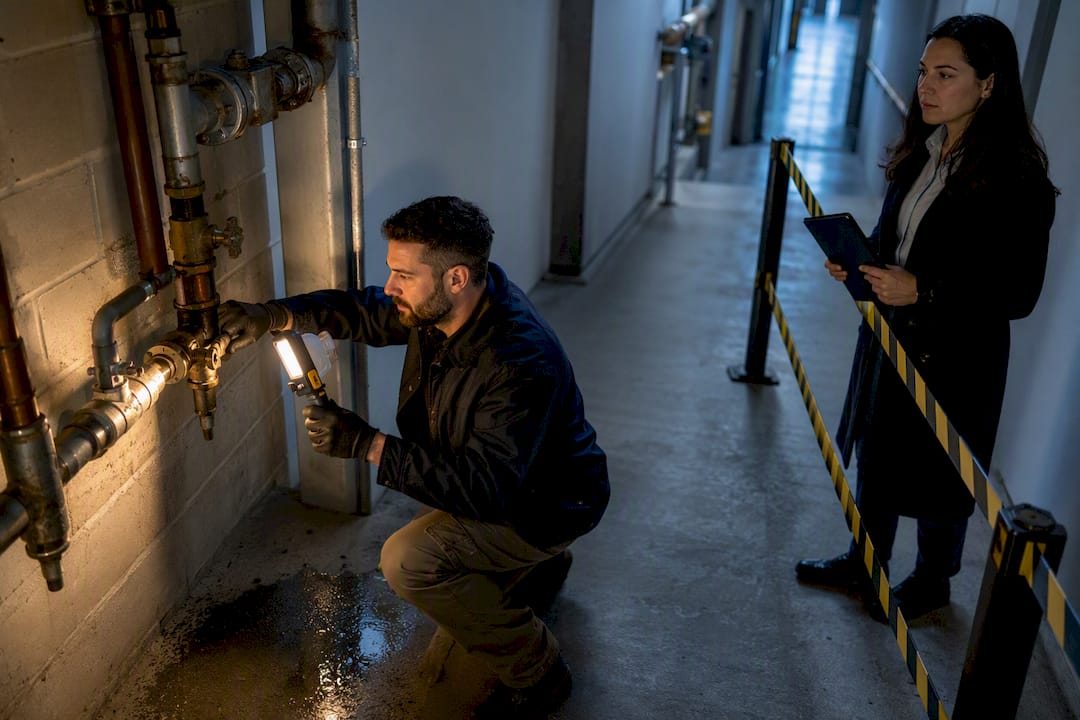
Emergency maintenance response is the immediate action taken to protect people and stop loss when a facility failure threatens safety, damages property, or halts operations. If anyone is in danger, evacuate them and call 911 or activate the building alarm before you do anything else. Once people are safe, isolate the hazard (water, power, gas) and call your emergency line to dispatch a technician.
TL;DR:
- Immediate hazards like flooding, electrical arcing, or gas leaks require containment and shutoff within the first 60 minutes to prevent injury or further damage.
- Clear roles and a pre-established incident commander streamline response times, with detailed documentation ensuring effective communication and follow-up.
- Building maps, updated contact lists, and routine drills are essential parts of an emergency action plan that can prevent errors during real incidents.
- Preventive maintenance, such as roof inspections and electrical testing, can reduce emergency calls by catching issues before they escalate.
- Partnering with a comprehensive emergency support provider cuts response times and ensures coordinated, efficient resolution across multiple sites.
Table of Contents
- What Counts as an Emergency vs. Urgent or Routine Maintenance
- The Emergency Maintenance Response Sequence That Actually Works
- Who Answers, Who Decides, and What Gets Documented
- How to Build an Emergency Action Plan That Holds Up Under Pressure
- What to Do First for the Five Most Common Facility Emergencies
- Why Preventive Maintenance Cuts Emergency Calls in Half
- Thirty Years of Emergency Calls Taught Us One Thing
- Get 24/7 Emergency Support From Nationwide Maintenance
- Sources
What Counts as an Emergency vs. Urgent or Routine Maintenance
An emergency is any condition that threatens life safety, is actively getting worse, or has already knocked out occupancy. Urgent maintenance can wait hours without anyone getting hurt. Routine work can wait days or weeks. The test isn’t how annoying the problem is. It’s whether it’s progressing right now and whether anyone’s safety depends on the next 15 minutes.
Three questions separate the categories fast:
- Is there an immediate threat to life or health (fire, gas leak, structural failure, exposed electrical)?
- Is the damage actively spreading (a burst pipe, an active roof leak during a storm)?
- Has the facility lost occupancy or a critical system (no heat in winter, no power, blocked emergency exits)?
Common facility emergencies include burst supply lines flooding a server room, electrical panels arcing or smoking, HVAC failure during extreme heat or cold with vulnerable occupants on site, roof collapse or major storm breach, elevator entrapment, gas odor anywhere in the building, and forced entry or broken storefront glass after hours. A slow drip under a sink is urgent, not an emergency. The same drip behind a wall soaking insulation and threatening a ceiling collapse is.
The Emergency Maintenance Response Sequence That Actually Works
Every credible response model follows the same order: protect people, triage the situation, stabilize the hazard, document what happened, then schedule the permanent fix. Speed matters, but sequence matters more. Skipping straight to repair before a hazard is contained is how technicians get hurt and how insurance claims get denied.
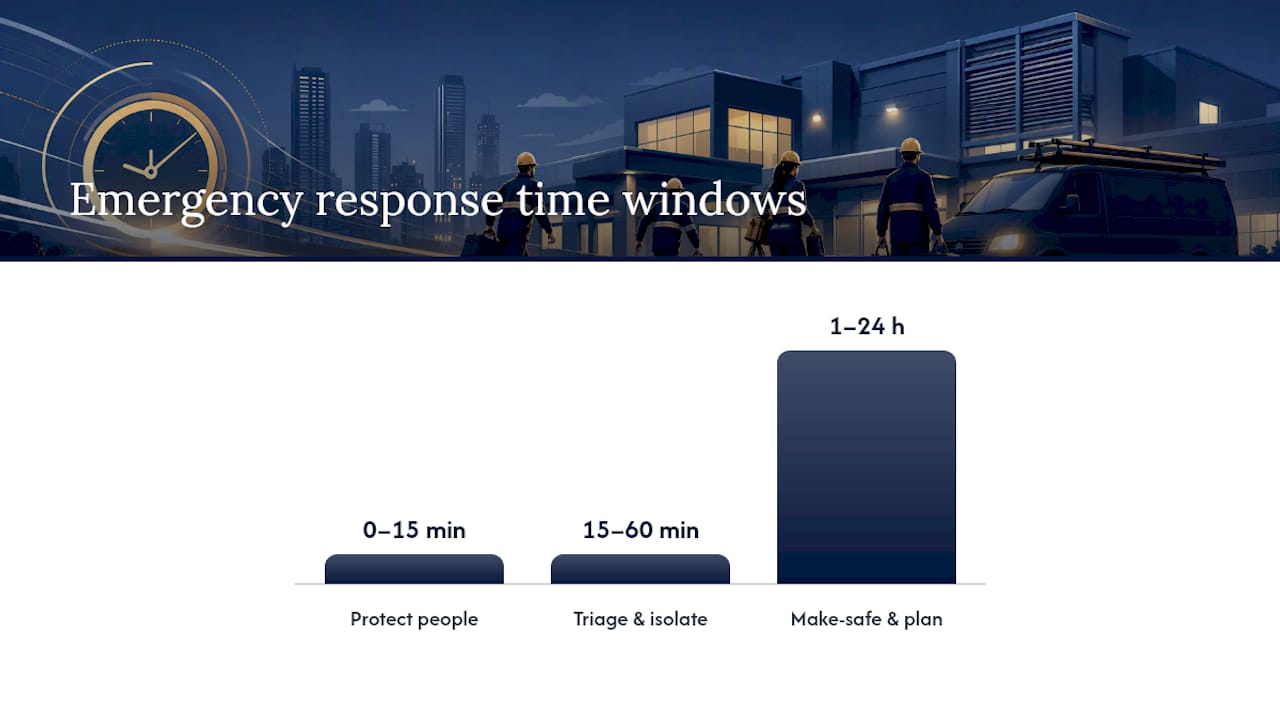
Minutes 0 to 15: Clear the area if there’s any life-safety risk, call 911 if needed, and notify your emergency dispatch line. Whoever answers needs four facts fast: what happened, where, whether anyone is injured, and what’s already been shut off or contained.
Minutes 15 to 60: Dispatch prioritizes based on that triage. A gas leak or active flooding jumps ahead of a dead HVAC unit in mild weather. On-site staff should isolate the hazard wherever safely possible, meaning shutting off water at the nearest valve or killing power at the breaker, without touching anything energized or submerged.
- Confirm the area is safe to approach.
- Contain the hazard at its source, not just its symptom.
- Photograph the scene before anyone starts cleanup.
- Open a work order with timestamps for every action taken.
Hours 1 to 24: This is the make-safe window. The goal is stopping further loss, not finishing the job. A phased response that protects people first, then stabilizes systems, then plans permanent restoration, prevents the kind of rushed repair that fails again in a month. Permanent restoration gets scoped and scheduled separately, often at standard project rates instead of emergency rates.
Pro Tip: Keep a laminated “first five minutes” card at every reception desk and security post. In a real event, nobody remembers a binder. They remember a card taped to the desk.
Who Answers, Who Decides, and What Gets Documented
A repeatable response depends on clear roles, not heroics. Someone has to answer the phone at 2 a.m. and know what to ask. Someone has to decide which trade gets dispatched. Someone has to own the incident until it’s closed.

The call flow typically runs: front desk or an after-hours call-answering and message handling service takes the call and captures hazard type, exact location, and injury status. Dispatch cross-references that against triage rules to prioritize the response. A designated on-site coordinator, sometimes called the incident commander, has authority to evacuate, shut off utilities, and greenlight emergency spending without waiting for a committee. Activation procedures that assign this role in advance move faster than plans that figure it out on the fly.
Every response needs a paper trail:
- Timestamped photos before, during, and after make-safe work.
- A written work order noting who isolated what and when.
- Names and contact info of everyone notified, including public emergency services if called.
- A record of temporary measures so the permanent-repair crew isn’t guessing.
Structured intake before dispatch, hazard type, exact location, injuries, what’s already contained, determines which trade and equipment show up, and it’s the single biggest reason wrong-crew dispatches happen at all. Facilities that preload building access codes, shutoff locations, and equipment history with their maintenance provider consistently see faster first-visit resolution, because the technician isn’t hunting for a valve in the dark.
How to Build an Emergency Action Plan That Holds Up Under Pressure
A written Emergency Response Plan aligned with Ready.gov guidance is the backbone of any serious emergency maintenance response, and it needs more than a binder on a shelf.
- Map the building. Include utility shutoff locations, evacuation routes, assembly points, and fire suppression equipment on a single diagram every supervisor can find in seconds.
- List every contact that matters. Emergency coordinators, backup coordinators, trade vendors, and local fire and police non-emergency lines, updated at least twice a year.
- Assign a trained emergency coordinator and at least one backup for every shift, including nights and weekends when most emergencies actually happen.
- Write decision protocols, not vague intentions. Spell out who can authorize evacuation, who can approve emergency spending, and at what dollar threshold.
- Drill it. OSHA guidance calls for training coordinators and reviewing the plan with staff whenever it’s created or changed, with periodic practice drills to confirm people actually remember the steps under pressure.
Run tabletop drills regularly and a full-scale drill periodically, and invite your local fire department or mutual-aid partners to at least one session annually. NFPA’s occupant protective-action guidance is worth building directly into your warning procedures, especially for fire and carbon monoxide scenarios where seconds matter.
Pro Tip: The most common reason an EAP fails during a real event isn’t a missing procedure. It’s a phone number that’s two years out of date. Set a recurring calendar reminder to verify every contact on the list.
What to Do First for the Five Most Common Facility Emergencies
Each hazard has a “do this first” move, and getting it wrong wastes precious minutes.
- Water events: Shut off the source valve, contain with barriers or wet vacuums, and start air movement immediately; call a restoration crew if standing water sits more than a few hours.
- Electrical failures: Keep everyone clear, never touch a wet or smoking panel, and wait for a licensed electrician even if the fix looks simple.
- HVAC or heat loss: Move vulnerable occupants to a safe temporary space before troubleshooting equipment, especially in extreme cold or heat.
- Roof and storm damage: Board or tarp only what’s safely reachable from solid footing; don’t send anyone onto a wet or damaged roof deck.
- Security breaches: Secure the building, board broken openings, and coordinate directly with police before touching anything that could be evidence.
Why Preventive Maintenance Cuts Emergency Calls in Half
Most emergencies trace back to something predictable: a roof membrane nobody inspected, a sump pump nobody tested, an electrical panel nobody thermal scanned. Preventive maintenance catches these before they become 2 a.m. calls.
- Quarterly roof and gutter inspections prevent the leaks that turn into ceiling collapses.
- Sump pump and backflow valve testing before storm season prevents flooded mechanical rooms.
- Annual electrical panel inspections catch loose connections before they arc.
Contracts with priority dispatch and stored building data, access codes, shutoff maps, equipment history, shave real time off every response, because the crew isn’t arriving blind. Specialty situations, major structural damage or hazardous material spills, still require calling in dedicated specialty vendors or mutual-aid partners rather than a general maintenance crew.
Thirty Years of Emergency Calls Taught Us One Thing
Buildings that recover fastest from a crisis aren’t the ones with the fanciest equipment. They’re the ones where cleaning, repairs, pest control, and construction already run through a single point of contact who knows the building. Integrated service delivery can cut the coordination lag that turns a burst pipe into a multi-day shutdown. When one team has your shutoff maps and access codes, the first technician through the door isn’t starting from zero.
— Nationwide Maintenance.
Get 24/7 Emergency Support From Nationwide Maintenance
Nationwidemaintenance is the practical alternative to juggling separate vendors for cleaning, repairs, and construction when an emergency hits. One call reaches a team that already has your building’s access details, shutoff locations, and service history on file, so the first technician isn’t guessing. Our 24-hour emergency maintenance service covers make-safe response for water, electrical, roof, and security incidents across facilities in New York, New Jersey, and Connecticut.

The first visit focuses entirely on stopping the loss: isolating the hazard, protecting occupants, and documenting the damage with timestamped photos. Permanent repair gets scoped and scheduled once the site is safe, at standard project rates instead of emergency pricing. If you manage property across multiple sites, our property management maintenance program can put your building data on file before you ever need to make that call. Reach out today to get your facility onto our emergency response line.
Sources
- Ready
- eTool: Develop & implement an Emergency Action Plan (EAP) | OSHA
- Emergency response services | Merrick
- EMERGENCY OPERATIONS PLAN (Premier Genesee)
- Carbon monoxide safety | NFPA
Recommended
Need this handled at your facility?
Our crews cover commercial properties across New York, New Jersey, and Connecticut.