Design Build vs Design Bid Build: What Owners Need to Know

Design-Build (DB) is usually the better choice when speed, integrated accountability, and early cost certainty are your top priorities. Design-Bid-Build (DBB) earns its place when statutes require low-bid procurement, when you need close design control, or when your project demands a fully prescriptive set of documents before a contractor touches the site. According to a 2026 analysis by the Design-Build Institute of America (DBIA), DB projects deliver roughly 102% faster, with 3.8% less cost growth and 0.3% lower unit costs than comparable DBB projects.
Pick Design-Build when:
- Schedule compression is non-negotiable (fast-track retail build-out, tenant fit-out, infrastructure replacement)
- You want a single point of accountability and are willing to define performance outcomes rather than prescriptive drawings
- Early cost certainty via a Guaranteed Maximum Price (GMP) matters more than lowest-bid price transparency
Pick Design-Bid-Build when:
- Public procurement statutes require competitive low-bid selection
- Your design is fully developed and you want maximum owner control over every specification
- A funder, lender, or regulatory body requires separate design and construction contracts
Nationwidemaintenance has supported commercial and institutional owners across the Tri-State area through both delivery methods for over 30 years. If you are still deciding which path fits your project, Nationwidemaintenance’s construction services are a practical starting point for a no-obligation conversation.
Table of Contents
- How design-bid-build and design-build actually work
- Weighing the pros and cons of each delivery method
- Contract structures, AIA forms, and procurement implications
- How cost and schedule actually compare between the two methods
- Who bears which risks, and how disputes get resolved
- How to choose: a decision checklist for owners
- Running a project under each method: practical next steps
- What the 2026 data actually says, and what it does not
- Key Takeaways
- The delivery method decision is more strategic than most owners treat it
- Nationwidemaintenance can help you move from decision to delivery
- Authoritative sources and where to find sample contract language
How design-bid-build and design-build actually work
Design-Bid-Build (DBB)
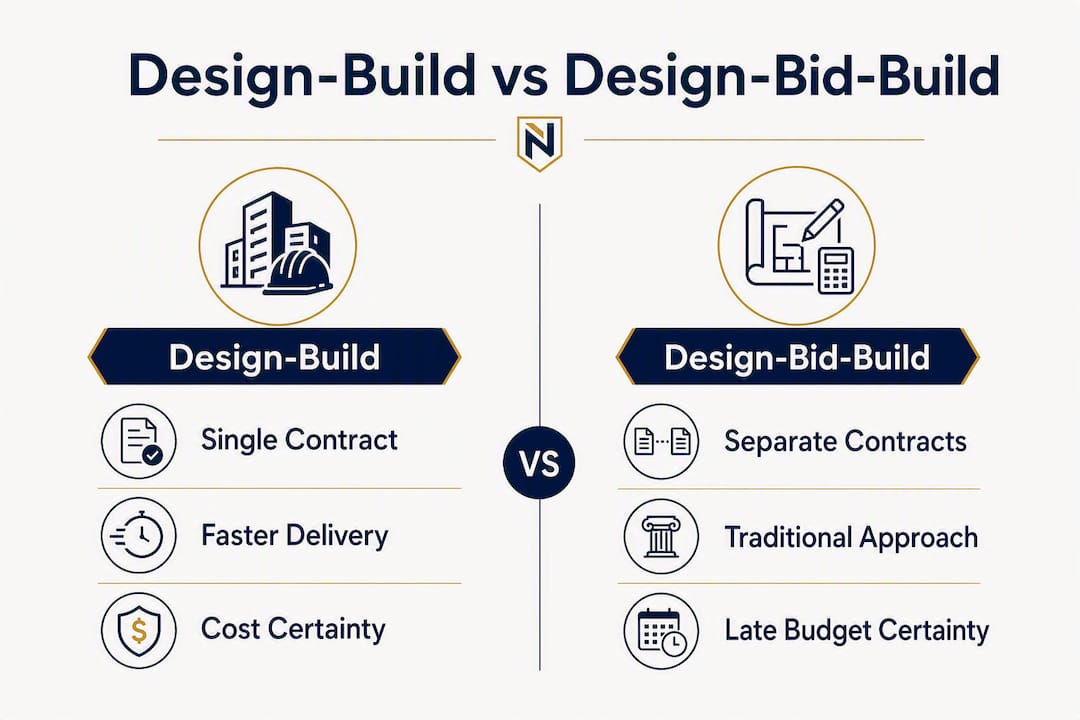
DBB is the traditional, linear delivery model. The owner hires a designer (architect or engineer) under one contract, waits for design to reach 100% completion, then issues an Invitation for Bids (IFB) or Request for Proposals (RFP) to general contractors. The lowest responsible bidder wins a second, separate construction contract. The owner sits between two independent parties and manages the interface between them.
Because construction costs are not firmly established until design is complete, budget certainty arrives late. If bids come in over budget, the owner typically pays for redesign, value engineering, and rebidding before a shovel enters the ground.
Design-Build (DB)
DB collapses those two contracts into one. A single design-build entity, whether a contractor-led team, an architect-led team, or a joint venture, holds a single contract with the owner and is responsible for both design and construction. The process runs roughly as: owner issues a performance-based RFP, selects a DB team on qualifications and price, then the team develops design and construction concurrently.

Under this single-contract model, the design-builder carries primary accountability for both scope and delivery. GMP pricing can be established early, often at schematic design, giving owners a cost ceiling before full drawings exist. FMI Corporation projects design-build to represent a large share of U.S. construction spending in the coming years, which reflects how broadly the industry has already shifted.
Parties and their contractual relationships
In DBB, the owner holds Contract A with the designer and Contract B with the general contractor. The designer and GC have no direct contractual relationship, which means disputes about design errors or constructability gaps land squarely on the owner to resolve.

In DB, the owner holds one contract with the design-builder. The design-builder then subcontracts design work (often to an architect of record) and construction work internally or through subcontractors. The owner’s exposure to inter-party disputes drops significantly, though it does not disappear entirely.
Weighing the pros and cons of each delivery method
Design-Build advantages and disadvantages
Pros:
- Faster total delivery through overlapping design and construction phases
- Single point of accountability reduces finger-pointing between designer and contractor
- Early GMP or lump-sum pricing provides budget certainty before full design
- Fewer change orders because the design team and construction team share the same financial incentive
- Constructability input from the contractor is built into design from day one
Cons:
- Owner has less direct control over design details once the contract is signed
- Scope must be clearly defined upfront; a vague performance spec leads to disputes about what was actually required
- Professional liability insurance requirements are more complex (the design-builder must carry adequate E&O coverage)
- Less price competition than a hard-bid DBB process
Micro-scenario (DB): A regional retailer needs a 12,000-square-foot store build-out completed in 14 weeks before a lease commencement date. A DB team locks in a GMP at schematic design, overlaps structural and MEP design with site work, and delivers on time. Under DBB, the same project would have required complete drawings before bidding, likely adding 8–10 weeks to the front end alone.
Design-Bid-Build advantages and disadvantages
Pros:
- Owner retains full design control through the entire design phase
- Hard-bid pricing creates genuine price competition and transparency at bid time
- Widely accepted by public agencies, lenders, and grant funders that require competitive procurement
- Owner can select the designer and contractor independently based on separate qualifications
Cons:
- Separation of design and construction creates silos that increase change orders when constructability issues surface during construction
- Total delivery timeline is longer because phases are sequential
- Any delay in one phase cascades through the entire schedule
- Adversarial relationships between architect and contractor are more common because they hold separate contracts with the owner
Micro-scenario (DBB): A municipal government needs a new public works facility. State statute requires competitive low-bid selection, and the city council wants full design review before any contractor is selected. DBB is the only legally compliant path, and the prescriptive drawings protect the city’s interests during the bid process.
Contract structures, AIA forms, and procurement implications
Single contract vs. split contracts
The structural difference between DB and DBB is not just administrative. In DBB, the owner manages two separate contracts and absorbs the risk that sits in the gap between them. When a design error causes a construction problem, the owner typically owns that liability because the owner holds the design documents. In DB, that gap closes: the design-builder owns both the design and the construction, so design errors are the design-builder’s problem to fix.
AIA contract forms
The American Institute of Architects (AIA) publishes the most widely used standard contract forms in U.S. construction:
- AIA A101 is the standard owner-contractor agreement for a stipulated sum (lump sum), used in DBB when the owner and GC agree on a fixed price after competitive bidding.
- AIA A201 is the General Conditions document that accompanies A101 and governs the three-party relationship between owner, contractor, and architect in a DBB arrangement.
- AIA A141 is the owner-design-builder agreement, the DB equivalent of A101. It consolidates design and construction obligations under one contract and includes provisions for GMP, performance specifications, and design-builder professional liability.
Owners should review AIA contract language carefully before signing. The AIA documents are available through AIA Contract Documents and can be modified with attorney review to reflect project-specific risk allocations.
Procurement implications for public owners
Public owners face constraints that private owners do not. Many state statutes default to low-bid DBB procurement. DB is allowable in most states, but it typically requires a qualifications-based selection process (often called Best Value or Qualifications-Based Selection), which takes longer than a standard IFB. The FHWA’s design-build effectiveness study confirms that DB procurement RFPs generally take longer than DBB IFBs, even though total project delivery remains faster for DB.
For public owners, the practical question is whether your enabling statute permits DB and whether your agency has the internal capacity to evaluate qualifications-based proposals. If the answer to either is no, DBB is your default.
GMP, lump-sum, and negotiated RFP
In DB, a GMP is typically negotiated after schematic design, giving the owner a cost ceiling with a defined contingency. In DBB, the hard-bid lump sum is established after 100% design documents are complete. The hard bid offers price transparency and genuine competition. The GMP offers earlier certainty but requires the owner to trust the design-builder’s cost estimating. Procore’s guidance notes that delivery-method choice affects everything from contractor profit margin to overall timeline, and that owners must weigh expertise, risk tolerance, and project size before committing to either pricing structure.
How cost and schedule actually compare between the two methods
Key figures from the 2026 DBIA analysis: Design-Build projects deliver approximately 102% faster, with 3.8% less cost growth and 0.3% lower unit costs compared to Design-Bid-Build projects of similar scope.
Those numbers deserve context. The 102% speed advantage reflects total delivery time from project authorization to substantial completion, not just construction duration. The 3.8% cost growth advantage means DB projects tend to stay closer to their original budget, largely because the integrated team resolves scope questions before they become change orders.
A worked example
Consider two hypothetical office renovation projects, each with an identical $4 million scope:
Project A (DBB): Design takes 6 months. Bidding and award take 2 months. Construction takes 10 months. Total: 18 months. During construction, two design omissions generate change orders totaling $160,000 (4% cost growth).
Project B (DB): The DB team begins design and long-lead procurement simultaneously. Design and construction overlap by 3 months. Total delivery: 11 months. The integrated team catches the same constructability issues during design coordination, avoiding the change orders. Final cost lands within 0.5% of the GMP.
The numbers are illustrative, but they reflect the pattern the DBIA data describes. The corroborating industry analysis from Finfrock emphasizes that integrated teams produce fewer change orders and better schedule compression, which is exactly what drives the cost growth differential.
Contingency budgeting by delivery method
| Delivery Method | Recommended Design Contingency | Recommended Construction Contingency | Notes |
|---|---|---|---|
| Design-Build (GMP) | 5%–10% of construction cost | 3%–5% of GMP | Lower construction contingency because scope is defined before GMP is set |
| Design-Bid-Build (hard bid) | 10%–15% of construction cost | 5%–10% of contract value | Higher contingency needed to cover design gaps that surface during construction |
| DBB (public, low-bid) | 15%+ of construction cost | 8%–12% of contract value | Public projects carry additional exposure from low-bid contractors finding scope gaps |
These ranges are general guidance. Your project’s complexity, site conditions, and design completeness at contract execution will shift them.
When early cost certainty is realistic
GMP pricing in DB is most reliable when the owner has invested in a solid program brief and performance specifications before the RFP. A vague scope produces a vague GMP with a large contingency that erodes the cost certainty advantage. In DBB, the hard-bid price is only as reliable as the completeness of the design documents. Incomplete drawings at bid time are the single biggest driver of change orders in DBB projects.
Who bears which risks, and how disputes get resolved
Risk allocation comparison
| Risk Type | Design-Bid-Build | Design-Build | Notes |
|---|---|---|---|
| Design errors and omissions | Owner (holds design contract) | Design-builder | In DBB, owner owns the documents and absorbs liability for errors |
| Scope gaps in documents | Owner / designer | Design-builder | DB team is incentivized to close gaps before construction |
| Unforeseen site conditions | Shared (owner typically bears subsurface risk) | Shared (owner typically bears subsurface risk) | Geotechnical risk allocation is similar under both methods |
| Cost escalation | Owner (hard bid locks price, but scope gaps add cost) | Design-builder up to GMP; owner above GMP | GMP provides a ceiling; hard bid provides a floor with change-order exposure |
| Schedule delay | Contractor (liquidated damages clauses) | Design-builder (single entity accountable) | DB accountability is cleaner; DBB disputes often involve both designer and contractor |
Design ownership and liability
In DBB, the owner’s architect of record stamps the drawings. If those drawings contain errors, the owner is the party who provided defective documents to the contractor. Change orders and claims follow. Bonding and insurance rarely cover scope gaps caused by design omissions, which means the owner often absorbs those costs directly.
In DB, the design-builder consolidates responsibility and reduces the owner’s exposure to inter-party disputes. But that consolidation only protects the owner if the design-builder carries adequate professional liability (Errors and Omissions) insurance. Without it, a design failure by the design-builder’s architect of record may leave the owner with a judgment against an entity that cannot pay.
Dispute pathways
In DBB, disputes typically follow this path: contractor submits a change order request, owner or architect rejects it, contractor files a claim, parties negotiate, and unresolved claims go to mediation or arbitration. The designer is often pulled into the dispute as a third party, even though they hold a separate contract.
In DB, the single-contract structure means disputes stay between the owner and one entity. Change orders still happen, but the design-builder cannot blame the architect because they are the same team. Mediation and arbitration clauses in AIA A141 provide a structured resolution path.
Pro Tip: Require the design-builder to carry a minimum professional liability limit appropriate to your project size, name you as an additional insured on the general liability policy, and include explicit flow-down provisions to subconsultants. For DBB projects, require the architect to carry E&O coverage through the construction administration period, not just through design completion. For both methods, consult a builders risk insurance guide to confirm your coverage aligns with the delivery model.
How to choose: a decision checklist for owners
Work through these questions before committing to a delivery method. They are ordered by the weight most owners assign them.
- Is your schedule the primary constraint? If yes, DB’s phase overlap is a structural advantage.
- Does your procurement statute or funder require competitive low-bid selection? If yes, DBB may be your only option.
- How complete is your program brief and scope definition? Incomplete scope favors DB (the team helps develop it); complete, prescriptive scope favors DBB.
- How much design control do you need? If you have specific aesthetic or technical requirements that must be preserved exactly, DBB gives you more leverage.
- What is your risk tolerance for cost growth? DB’s GMP limits upside exposure; DBB’s hard bid is transparent but vulnerable to change orders.
- Does your organization have the internal capacity to manage two separate contracts and the interface between designer and contractor? If not, DB’s single-contract model reduces management burden.
- Is the project technically complex or fast-track? Complex, fast-track projects (hospitals, data centers, infrastructure) benefit most from DB’s integrated problem-solving.
- Are you a public owner subject to transparency and competition requirements? DBB’s open bidding process is easier to defend to oversight bodies.
- What is your contingency budget? If contingency is tight, DB’s GMP structure offers more predictable cost exposure.
- Do you have a preferred designer you want to retain independently? DBB lets you select your architect before any contractor is involved.
Interview questions to ask DB teams or DBB bidders
- What is your approach to scope gaps discovered after contract execution?
- How do you handle design changes requested by the owner after GMP is set?
- What professional liability limits does your design team carry, and through what policy period?
- Can you provide references from projects of similar size and complexity delivered under this method?
- What is your change-order rate on your last five comparable projects?
- How do you structure your design-construction coordination meetings, and how often does the owner participate?
- What bonding capacity can you demonstrate, and who is your surety?
- How do you handle unforeseen site conditions, and what is your standard contract language for differing site conditions?
- What is your approach to owner-requested value engineering after GMP?
- How do you manage subcontractor default risk, and what insurance flow-downs do you require?
Red flags by delivery method
Avoid DBB when: Your scope is incomplete, your schedule is tight, and you are required to take the lowest bid. That combination is the highest-risk scenario in construction: an underdeveloped design handed to a low-bid contractor produces change orders almost by default.
Avoid DB when: You cannot define performance outcomes clearly, you need to retain your own architect of record with full design authority, or your project is subject to a procurement statute that does not permit qualifications-based selection.
Decision flow
If speed is primary and you can define performance outcomes: choose DB. If statute or funder requires low-bid and your design is complete: choose DBB. If you are a private owner with a complex, fast-track project and adequate scope definition: DB. If you are a public owner with a fully designed project and a transparency mandate: DBB. When in doubt, Procore’s guidance recommends treating delivery-method selection as a strategic decision aligned to project priorities, not internal procurement habit.
Running a project under each method: practical next steps
Design-Build: operational steps
Step 1: Develop your program brief and performance specifications. Before issuing an RFP, document what the project must achieve: functional requirements, performance standards, schedule milestones, and budget parameters. This document drives the entire DB procurement. A weak brief produces a weak GMP.
Step 2: Issue a qualifications-based RFP. Shortlist DB teams based on relevant experience, financial capacity, and key personnel. Evaluate proposals on both technical approach and price. The handyman vs. general contractor distinction matters here: you want a team with genuine design-build integration, not a GC who subcontracts design as an afterthought.
Step 3: Negotiate the GMP and finalize the contract. Once you select a team, work through schematic design to establish the GMP. Use AIA A141 or a comparable form reviewed by construction counsel. Lock in the contingency, the change-order procedure, and the professional liability requirements before you execute.
Step 4: Establish progress milestones and owner sign-offs. Define the design review checkpoints where you, as owner, must approve before the team proceeds. These are your control points. Missing them means losing the schedule advantage DB is supposed to deliver.
Pro Tip: Appoint an independent owner’s project representative (OPR) or owner’s PM for any DB project above $2 million. The OPR reviews submittals, attends coordination meetings, and protects your interests without disrupting the design-builder’s integrated workflow. For public owners, an OPR is almost always worth the cost. Review your construction project insurance setup with your broker before the contract is signed.
Design-Bid-Build: operational steps
Step 1: Complete 100% design documents. Do not issue for bid until drawings and specifications are genuinely complete. Incomplete documents at bid time are the single biggest source of DBB change orders and disputes.
Step 2: Issue the IFB or RFP and evaluate bids. For public projects, follow your jurisdiction’s procurement rules exactly. Evaluate the lowest responsible bidder, confirm bonding and insurance, and check references. For private projects, you may negotiate with a short list of prequalified contractors.
Step 3: Execute the construction contract and secure bonds. Use AIA A101 with A201 General Conditions, or your agency’s standard form. Require performance and payment bonds. Confirm the architect’s construction administration scope is fully funded and defined.
Step 4: Manage the design-construction interface actively. In DBB, you own the gap between your designer and your contractor. Establish a clear RFI and submittal process, define who has authority to approve field changes, and document every decision. Budget timing note: if your project is tied to a fiscal-year appropriation cycle, complete design in the prior fiscal year so you can bid and award at the start of the new cycle.
Required documents for either method: program brief, baseline schedule, GMP or lump-sum contract, performance and payment bonds, certificates of insurance (GL, workers’ comp, professional liability, builders risk), and a written dispute-resolution clause specifying mediation before arbitration.
What the 2026 data actually says, and what it does not
From the 2026 DBIA analysis: Design-Build projects deliver faster, with less cost growth and lower unit costs compared to Design-Bid-Build.
Those figures come from a dataset that skews toward larger, more complex projects where DB’s phase-overlap advantage is most pronounced. Smaller, simpler projects may not show the same differential. The dataset also mixes public and private projects, and public DB projects often involve more procurement overhead than private ones, which can compress the speed advantage.
The FHWA’s design-build effectiveness study adds an important nuance: DB procurement RFPs take longer than DBB IFBs. If your project timeline starts at procurement authorization rather than design authorization, the DB speed advantage narrows. Owners who need to move fast on procurement, not just on construction, should factor that in.
The cost growth differential (3.8% less for DB) is more consistent across project types. It reflects the structural advantage of having the design and construction team share financial accountability. That advantage holds even on smaller projects where the schedule benefit is modest.
How to use these numbers: treat the 102% speed figure as a directional signal, not a guarantee. Use it to justify DB selection when speed is your primary argument to stakeholders. Use the 3.8% cost growth figure to set contingency expectations. Do not apply either number as a precise forecast for your specific project without adjusting for project type, size, and procurement context.
Key Takeaways
Design-Build typically delivers faster and with less cost growth than Design-Bid-Build, but the right choice depends on your procurement constraints, scope clarity, and how much design control you need.
| Point | Details |
|---|---|
| DB speed and cost advantage | DBIA analysis shows DB delivers notably faster with less cost growth than DBB. |
| DBB is often required for public work | Low-bid procurement statutes in many states mandate DBB; DB requires qualifications-based selection authority. |
| Design ownership drives liability | In DBB, the owner holds the design documents and absorbs liability for design errors; in DB, the design-builder carries that exposure. |
| Scope clarity is the deciding factor | Incomplete scope favors DB; fully prescriptive, complete design favors DBB and hard-bid pricing. |
| Nationwidemaintenance as your partner | Nationwidemaintenance delivers integrated construction and facility services in the Tri-State area under unified contracts, supporting both delivery approaches. |
The delivery method decision is more strategic than most owners treat it
Most owners pick a delivery method out of habit or because their procurement department has always done it one way. That is a mistake. The DBIA data is clear that DB outperforms DBB on speed and cost growth at a population level, but population-level data does not decide your project. What decides your project is the intersection of your schedule pressure, your scope clarity, your procurement authority, and your internal capacity to manage the owner’s role.
The underappreciated risk in DBB is not the change orders themselves. It is the adversarial dynamic that develops when a contractor finds scope gaps in documents the owner provided. That dynamic is structural: the contractor has a financial incentive to find gaps, and the owner has a financial incentive to deny them. The designer is caught in the middle with a separate contract and limited authority to resolve the dispute. DB does not eliminate conflict, but it removes the structural incentive for the contractor to weaponize design gaps.
The underappreciated risk in DB is the opposite: owners who assume the single-contract model means they can disengage from design decisions. It does not. The owner’s sign-off at each design milestone is the primary control mechanism. Owners who skip those checkpoints and then object to the finished product have limited contractual recourse. The DB contract gives the design-builder wide latitude to make design decisions within the performance spec. If you want to influence those decisions, you have to show up at the design review meetings.
The practical advice: match the method to your actual priorities, not your stated ones. If you say schedule is the priority but you cannot staff an owner’s rep, DB will frustrate you. If you say design control is the priority but your scope is underdeveloped, DBB will cost you more than DB ever would.
Nationwidemaintenance can help you move from decision to delivery
Choosing between delivery methods is one decision. Executing the project is another. Nationwidemaintenance brings over 30 years of integrated construction and facility service experience to commercial, retail, healthcare, and government clients across New York, New Jersey, and Connecticut, handling everything from interior build-outs and kitchen and bath renovations to landscaping, maintenance, and 24/7 emergency response under a single contract.
For owners who want the accountability of a single-source partner without the complexity of managing multiple vendors, Nationwidemaintenance’s model mirrors the core advantage of Design-Build: one relationship, one contract, one team that owns the outcome. Whether your project calls for a fast-track fit-out or a phased renovation alongside ongoing facility maintenance, the team is built to handle both.
Before you reach out, have these ready: your project scope summary, target completion date, procurement constraints (public or private), and a rough budget range. That prep makes the first conversation productive. Request a consultation with Nationwidemaintenance’s construction team to discuss which delivery approach fits your next project.
Authoritative sources and where to find sample contract language
The table below lists the primary references used in this article, with a note on what each one offers owners.
| Source | What it provides |
|---|---|
| DBIA — What Is Design-Build? | Industry definition, 2026 performance analysis, and advocacy resources for DB procurement |
| FHWA Design-Build Effectiveness Study | Federal highway data on DB vs DBB procurement timelines and delivery performance |
| Procore — Design-Build vs Design-Bid-Build | Practical owner guidance on delivery-method trade-offs and selection criteria |
| Porter Hedges — Legal Considerations | Legal analysis of DB vs DBB liability, insurance, and bonding requirements |
| Colliers Project Leaders — DBB Ins and Outs | Practitioner perspective on DBB risks, change-order mechanics, and silo effects |
| LISC — DBB Pros and Cons | Community development finance perspective on cost certainty and procurement trade-offs |
| AIA Contract Documents | Standard contract forms (A101, A141, A201) available for purchase and customization |
For state-specific procurement questions, particularly around DB enabling statutes for public owners, consult a construction attorney licensed in your state. AIA contract language is a starting point, not a final document. Every project warrants attorney review before execution.
Recommended
Need this handled at your facility?
Our crews cover commercial properties across New York, New Jersey, and Connecticut.