Audit Ready Commercial Cleaning Checklist for Facility Managers
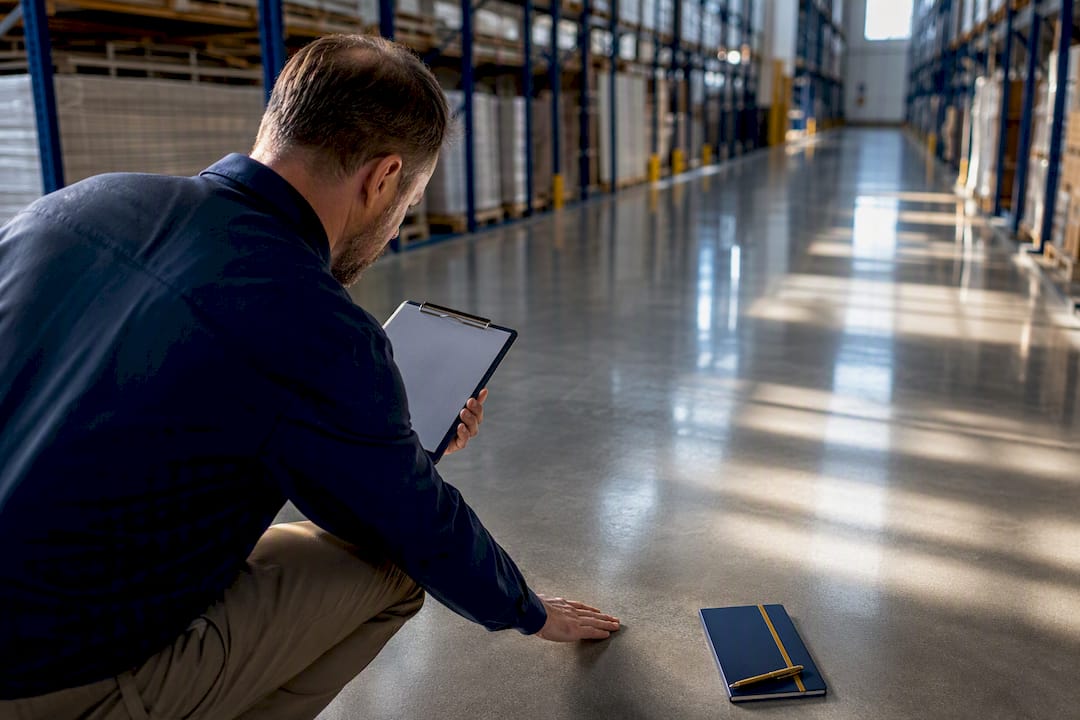
A commercial cleaning checklist is a task-by-task scope of work, broken down by area and cleaning frequency, that tells your team or vendor exactly what “clean” means for your building. Print it, attach it to your service contract, and use it as the standard you audit against. If you take one action after reading this, convert your current mental checklist into a written one this week and assign a frequency to every line.
TL;DR:
- Most warehouse floors require daily sweeping and weekly scrubbing, with quarterly deep cleans for high-traffic zones to prevent grinding grit into finishes.
- OSHA’s standard mandates floors be kept clean and dry but does not specify a written checklist; proper documentation with logs improves inspection outcomes.
- Weekly tasks should include detailed dusting, deep cleaning appliances, and vacuuming under furniture, rotating tasks across a set schedule to avoid neglect.
- Monthly cleaning requires specialized equipment for ceiling dusting, HVAC cleaning, and upholstery, with records signed off by supervisors to ensure accountability.
- Digital tools offering photo proof, timestamps, and GPS location enhance compliance and streamline audits for multi-site facilities.
Table of Contents
- What Belongs on a Daily Commercial Cleaning Checklist?
- What Should a Weekly Cleaning Checklist Cover?
- Which Monthly Tasks Need Special Equipment or Vendors?
- How Often Should You Schedule Deep Cleaning and Floor Restoration?
- What Cleaning Supplies, Equipment, and PPE Do You Actually Need?
- How Do You Keep Cleaning Records Audit-Ready?
- How Do You Adapt the Checklist to Your Facility and Vendors?
- Should You Use a Paper Checklist or a Digital One?
- Why Nationwide Maintenance’s Approach Shapes This Checklist
- How Do You Handle Data Centers, Labs, and Other Sensitive Areas?
- What the Checklist Debate Gets Wrong
- How Nationwide Maintenance Puts This Checklist to Work for You
- Where to Verify These Standards
- Sources
- FAQ
What Belongs on a Daily Commercial Cleaning Checklist?
Daily tasks are the ones that keep a building sanitary and presentable between deeper cleanings. Skip them for even one day and visitors notice, germs spread on high-touch surfaces, and floors start collecting grit that scratches finishes over time. The goal on any given day is not perfection. It’s consistency: the same tasks, done the same way, every single day, so nothing slips through.
Here’s how a solid daily office cleaning checklist breaks down by area.
Reception and lobby
- Empty trash and replace liners
- Wipe down the front desk, glass doors, and handrails
- Spot-clean glass entry doors and interior windows at eye level
- Vacuum or dust-mop entry mats and hard floors
- Straighten seating and reading materials
Workstations and cubicles
- Empty trash and recycling bins
- Disinfect shared high-touch points: phones, keyboards left unlocked for cleaning, light switches, shared printers
- Spot-clean visible smudges on partitions and desks
- Vacuum carpet in main walkways
Conference rooms
- Wipe down tables, chairs, and touch panels or remotes
- Disinfect doorknobs and light switches
- Empty trash and reset chairs to a standard layout
- Check whiteboards and markers, and wipe down any smudges
Kitchens and break rooms
- Wipe counters, tables, and appliance exteriors
- Disinfect sink, faucet handles, and refrigerator door handles
- Empty trash and recycling; replace liners
- Restock paper towels, soap, and coffee supplies
Restrooms
- Clean and disinfect toilets, urinals, and sinks
- Restock toilet paper, soap, and paper towels
- Mop floors with a disinfectant solution
- Wipe mirrors and check for any leaks or clogs
Hallways, entry, and exterior
- Sweep or vacuum main traffic paths
- Wipe down interior entry glass
- Police the entrance area for trash, cigarette butts, and debris
- Check exterior mats and door thresholds for tripping hazards
Restrooms and kitchens carry the highest sanitation risk in any building, so sequence your team there early, before other tasks eat up the visit. The WHO’s guidance on disinfecting surfaces recommends letting disinfectant sit on a surface for the manufacturer’s stated dwell time rather than wiping it off immediately, a step most crews skip because it feels slow. It’s the difference between a surface that looks clean and one that’s actually disinfected.
Every daily checklist line needs four fields to be useful as a record rather than a memory aid: the task itself, the cleaner’s initials, the time completed, and a notes column for anything unusual (a broken dispenser, a stain that needs follow-up, low supply levels). Without those fields, you have a task list. With them, you have a document you can hand to an auditor or a new vendor.
Pro Tip: Train new hires on sequence, not just tasks. Working top to bottom in a room, and clean to dirty across a building (lobby before restrooms), cuts cross-contamination and rework by a wide margin.
What Should a Weekly Cleaning Checklist Cover?
Weekly tasks catch what daily wiping misses. Dust settles on surfaces daily cleaning doesn’t reach, carpets accumulate soil below what a quick vacuum lifts, and small appliances need a closer look than a daily wipe-down provides. Think of weekly tasks as the layer that keeps a building from sliding into “it’s clean but it doesn’t feel clean” territory.
A weekly janitorial cleaning checklist typically includes:
- Reception and lobby: Dust all horizontal surfaces including window sills, edge-vacuum carpet along baseboards, clean interior glass fully (not just smudges)
- Workstations and cubicles: Dust monitors, shelving, and partition tops; vacuum under desks where reachable; wipe down chair arms
- Conference rooms: Deep-clean tables and chairs, dust AV equipment and disinfect remotes/touch panels thoroughly, vacuum under the table
- Kitchens and break rooms: Check and clean out the refrigerator of expired items, degrease the microwave interior, deep-clean the sink and faucet, wipe down cabinet fronts
- Restrooms: Descale fixtures, clean partition walls, disinfect trash receptacles inside and out
- Hallways and entry: Edge-vacuum carpet, dust wall-mounted signage and fire extinguisher cabinets, clean exterior entry glass top to bottom
“Done” for a weekly task means the surface or area looks the way it did on move-in day, not just free of visible dirt. A weekly dusting pass that only hits desktops and skips monitor tops and shelf edges isn’t actually weekly dusting. It’s daily dusting that happened on a different day.
Rotate weekly tasks across a fixed schedule rather than doing everything every Friday. Assign refrigerator checks to Monday, detailed floor edge work to Wednesday, and glass to Friday. This spreads labor evenly and makes it obvious when a task gets skipped, since the calendar tells you what should have happened on any given day.
Which Monthly Tasks Need Special Equipment or Vendors?
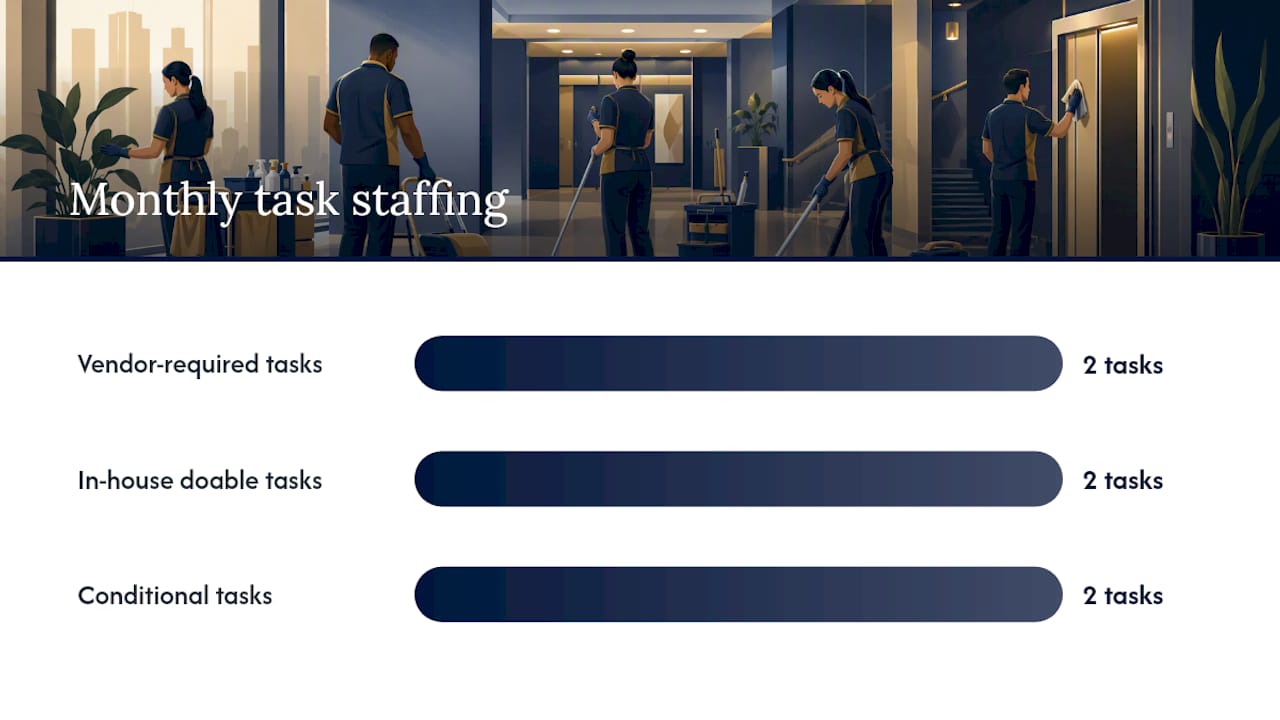
Monthly tasks target the buildup that weekly cleaning can’t reach: ceiling-height dust, HVAC components, and fabric surfaces that trap allergens and odors. Some of these in-house team can handle with the right tools. Others genuinely need a specialist, and knowing the difference saves you from either overpaying for a vendor visit or under-delivering with staff who lack the right equipment.
Monthly task list by area:
- High dusting: ceiling corners, light fixtures, exposed pipes, and top-of-cubicle surfaces
- HVAC vents and diffusers: vacuum and wipe down visible grilles
- Baseboards throughout the facility: wipe down and spot-treat scuff marks
- Upholstery vacuuming in lobbies, break rooms, and conference seating
- Elevator tracks and door interiors (if applicable)
- Interior window cleaning beyond eye level, including tall glass partitions
High dusting and baseboard work are usually doable in-house with an extension pole and a good HEPA vacuum. HVAC vent cleaning beyond a surface wipe, and any upholstery work involving a hot-water extractor rather than a handheld vacuum, tend to work better through a vendor with the right machine and training. If your team is using a shop vac to attempt what needs a proper extraction unit, you’re spending labor hours to get a worse result than a 90-minute vendor visit would deliver.
Monthly completion records should carry a sign-off field beyond the standard initials and time. Add a supervisor or manager sign-off line confirming the full monthly pass was completed, plus a field noting any deferred items and why. If the HVAC vent cleaning got pushed because a lift wasn’t available, that belongs in the record, not just in someone’s memory. This is also where a broader preventive maintenance checklist earns its keep, since monthly cleaning tasks often overlap with equipment inspection cycles.
How Often Should You Schedule Deep Cleaning and Floor Restoration?
Quarterly and annual tasks are restorative rather than maintenance. They exist to protect the assets you’ve already paid for, carpet, flooring, glass, and upholstery, from the kind of gradual wear that ends in an expensive early replacement. Skip these long enough and you’re not saving money. You’re deferring a bigger bill.
| Task | Recommended Frequency | Why |
|---|---|---|
| Carpet extraction (hot water) | Quarterly | Removes embedded soil that daily vacuuming can’t lift; extends carpet life |
| VCT strip and refinish | Twice yearly to annually | Restores the wax finish that protects tile from scratching and yellowing |
| Exterior window cleaning | Quarterly to twice yearly | Maintains curb appeal and prevents mineral buildup on glass |
| Upholstery deep extraction | Annually | Removes odor-causing soil and allergens from fabric seating |
| Air duct inspection | Annually | Confirms HVAC components aren’t recirculating dust into cleaned spaces |
High-traffic buildings, retail storefronts, healthcare facilities, or any space running through an event season should accelerate these frequencies rather than stick to the calendar default. A carpet in a lobby that sees 500 people a day needs quarterly extraction at minimum; the same carpet in a rarely used conference room might stretch to twice a year without visible wear.
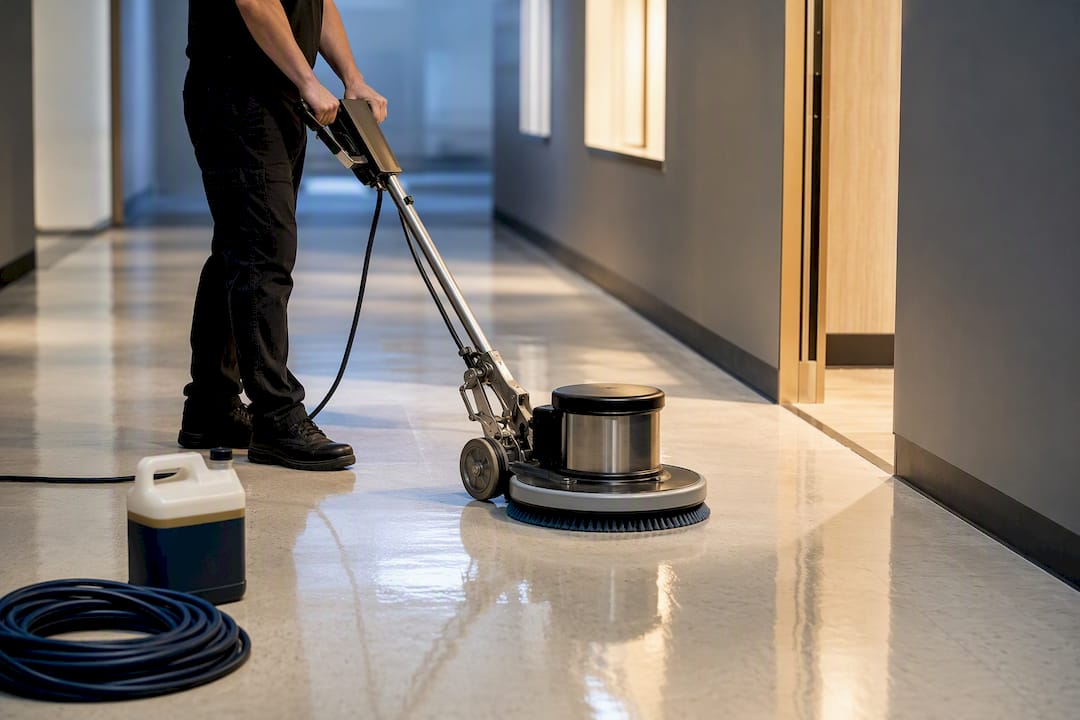
Carpet extraction and VCT refinishing both require equipment most facilities don’t own outright, hot-water extractors, floor buffers, and the chemical stripping agents that go with them, which is why these tasks are typically contracted out rather than handled in-house. Trying to strip and refinish VCT with the wrong stripper strength or without proper rinsing tends to leave a hazy finish that fails inspection faster than the original wear did.
What Cleaning Supplies, Equipment, and PPE Do You Actually Need?
Matching your supply and equipment list to the size and type of your facility prevents two common mistakes: underequipping a large warehouse with consumer-grade tools, or overspending on industrial equipment a small office will never need.
Essential supplies by tier:
- Daily tier: microfiber cloths, all-purpose cleaner, glass cleaner, disinfectant wipes or spray, trash liners
- Weekly tier: degreaser, descaler, dusting tools with extension handles, carpet spot cleaner
- Deep-clean tier: hot-water extraction solution, floor finish stripper and sealer, upholstery shampoo
Equipment scales with square footage and floor type. A single-floor office under 10,000 square feet generally does fine with an upright HEPA vacuum, a mop and bucket system, and a compact wet/dry vac for spills. A distribution center or warehouse floor cleaning program needs a ride-on scrubber or combination sweep/scrub machine, since manufacturer guidance from Kärcher recommends sweeping loose debris before scrubbing, and doing that by hand across a large facility eats labor hours a machine handles in a fraction of the time. Trade coverage on warehouse floor maintenance best practices backs the same sequencing: sweep first, scrub second, every time, because skipping the sweep grinds grit into the finish during scrubbing.
Chemical selection comes down to pH. Acidic cleaners (low pH) handle mineral deposits and rust but can etch certain stone and metal surfaces. Alkaline cleaners (high pH) cut grease and organic soil but can dull some finishes with repeated use. Neutral-pH cleaners are the safest daily default for finished floors and most surfaces. Every chemical on-site needs its Safety Data Sheet (SDS) accessible to staff, not filed away in a binder nobody opens.
Pro Tip: A crew wearing gloves rated for the wrong chemical class is a hidden injury risk. Match glove material (nitrile vs. neoprene vs. latex) to the SDS recommendation for each product, not to whatever’s cheapest in bulk.
One detail that surprises new facility managers: OSHA’s housekeeping standard for walking and working surfaces doesn’t specify particular chemicals or equipment at all. It requires the outcome, clean, orderly, dry floors, and leaves the method to you. That flexibility is useful, but it also means the documentation proving you met the standard matters as much as the cleaning itself.
How Do You Keep Cleaning Records Audit-Ready?
Documentation turns a cleaning program from “we think it gets done” into “here’s proof it gets done.” That distinction matters if you ever face a slip-and-fall claim, a client audit, or a corporate compliance review.
Your daily and weekly completion logs should capture:
- Date and shift
- Area or zone cleaned
- Task completed with cleaner initials
- Time of completion
- Any deviations, deferred tasks, or notes (a locked office, a spill, low supplies)
Keep completion logs for a minimum of one year, longer if your industry or insurer requires it. Digital logs make this easy since storage is nearly free; paper logs need a physical filing system that doesn’t get tossed at year-end cleanup.
OSHA 1910.22 becomes directly relevant here for any facility with warehouse or dock areas. The standard implies documentation expectations beyond the basic cleaning itself: inspectors expect to see daily floor inspection logs, spill response records, and evidence that slip-resistance gets checked periodically, not just assumed. A facility that can produce three months of daily floor inspection logs and a spill log with response times documented is in a dramatically stronger position during an OSHA visit than one relying on “we clean every day, trust us.”
Spill response deserves its own quick-reference card near high-risk zones: wet floor signage placement, who to notify, and how the incident gets logged. Slip-resistance verification, a simple periodic check with a slip-test device or even a documented visual and tactile inspection, closes the loop between cleaning and safety compliance.
Pro Tip: Photograph problem areas before and after a deep clean, especially for VCT refinishing or carpet extraction. It’s the fastest way to prove work was done to a client, insurer, or your own boss.
How Do You Adapt the Checklist to Your Facility and Vendors?
No two buildings need the identical checklist. A 24-hour call center and a Monday-to-Friday professional office generate wildly different amounts of soil and wear, even if they’re the same square footage.
Rules of thumb for setting frequency:
- High foot traffic (retail, healthcare, schools): default to daily for tasks other facilities handle weekly
- Under 50 occupants in a standard office: many weekly tasks can shift to biweekly without visible decline
- Visible, client-facing areas (lobbies, conference rooms): keep frequencies higher than back-office space regardless of headcount
Turning your checklist into a bid-ready scope of work for vendors takes four steps:
- Lock the task list first. Finalize every daily, weekly, and monthly item before you send anything to a vendor, so every bidder prices the identical scope.
- Attach frequencies and square footage per zone. A vendor pricing “restrooms, daily” without knowing there are six restrooms across three floors will underbid or overbid blindly.
- Request itemized pricing, not a flat number. This lets you compare which vendor is strong on daily janitorial work versus quarterly floor care, since few vendors excel equally at both.
- Build the checklist into the contract as an exhibit. This is what Jobber’s commercial cleaning checklist guide gets right: the same document that trains your staff becomes the yardstick you hold a vendor to, so there’s no ambiguity about what “included in scope” means later.
For training and quality assurance, run a weekly supervisor walkthrough using the same checklist your cleaners follow, and set a clear re-clean policy (typically, any missed task gets addressed within 24 hours at no extra charge if it’s contracted work). Consistency in the walkthrough cadence matters more than its length. Ten minutes every week beats an hour once a quarter.
Should You Use a Paper Checklist or a Digital One?
Both formats work. The right choice depends on how many locations you’re managing and how much proof you need on hand.
A printable checklist needs six columns to function well: zone, task, frequency, cleaner initials, notes, and a supervisor sign-off box at the bottom. Clipboard-mounted, it’s cheap, requires no training, and works even during a power outage or Wi-Fi dead zone. It’s a poor fit if you’re running the program across multiple sites, though, since paper logs live in filing cabinets that nobody in the corporate office can see.
| Factor | Printable checklist | Digital checklist |
|---|---|---|
| Best for | Single-site, small facilities | Multi-site programs, vendor accountability |
| Proof of completion | Signature only | Photo, timestamp, GPS location |
| Setup effort | Minimal | Requires software setup and training |
| Real-time visibility | None | Managers see completion status remotely |
| Audit defensibility | Moderate | High |
Digital checklist tools worth prioritizing offer photo proof of completed work, automatic timestamps, GPS confirmation that the cleaner was physically on-site, and integration with your existing facility management or maintenance software. A photo of a stocked restroom paired with a GPS-stamped timestamp is far harder to dispute in an audit than a signature on a clipboard. Digital logs also make it far easier to spot a pattern, like the same zone getting skipped every Friday, that a paper trail would bury in a filing cabinet.
Single-location facilities under moderate complexity often do fine on paper. Once you’re managing three or more sites, or answering to a corporate compliance team, digital is worth the setup cost.
Why Nationwide Maintenance’s Approach Shapes This Checklist
A facility maintenance company with over 30 years of experience managing cleaning programs for commercial, retail, and industrial clients across the Tri-State area. That volume of daily, weekly, and quarterly work across different facility types is exactly what informs a checklist built on real operational patterns rather than generic templates.
An integrated model, combining commercial cleaning with pest control, construction, and landscaping under one contract, means the checklist approach here isn’t built in isolation. A restroom sanitation issue, a pest entry point, and a broken exterior door often show up in the same walkthrough, and treating them as separate problems handled by separate vendors slows everything down. One unified scope-of-work document, covering cleaning frequencies alongside maintenance and pest prevention, keeps a building’s upkeep from falling into silos.
Eco-friendly practices can be built into cleaning approaches, and facilities can be supported with 24/7 emergency response for incidents a standard checklist can’t predict, such as burst pipes, after-hours spills, or unexpected inspections. For readers looking to dig deeper into environmentally responsible supply choices, the green commercial cleaning guide covers how to swap in lower-impact chemistries without sacrificing results. That combination of scale, integrated scope, and sustainability commitment is what turned an internal operating standard into the checklist framework laid out across this guide.
How Do You Handle Data Centers, Labs, and Other Sensitive Areas?
Standard checklist rules don’t transfer directly into high-risk or sensitive spaces, and treating them the same way you treat a break room creates real risk. Data centers, laboratories, and similar environments need modified protocols before a single surface gets wiped.
Data centers require static-safe cleaning practices: no standard feather dusters or dry cloths that generate static discharge near equipment, and vacuum units need HEPA filtration with anti-static hosing to avoid damaging sensitive electronics. Access should be logged separately from your general completion log, since most data centers restrict who can physically enter, and your cleaning schedule needs to work around that access control rather than assume open entry.
Laboratories bring chemical compatibility into play. A disinfectant that’s perfectly safe in a break room can react badly with residual lab chemicals, so any cleaning product used in a lab space needs sign-off from the lab’s own safety officer, not just a facilities decision. Biohazard or chemical waste in these spaces also follows separate disposal rules from standard trash, and mixing the two is a compliance problem waiting to surface.
The practical fix is a separate checklist tier for sensitive zones, one that names the specific approved products, the required PPE, and who has authorization to even be in the room during cleaning. Treating a server room or a lab like a standard office space isn’t a shortcut. It’s a liability.
What the Checklist Debate Gets Wrong
Most advice on commercial cleaning checklists treats them as a hygiene tool first and a business document second. That’s backwards. The real value of a written checklist shows up in disputes, budget conversations, and vendor negotiations, not in whether a desk got dusted on Tuesday.
The conventional wisdom oversells frequency and undersells documentation. Plenty of guides obsess over exactly how often to vacuum a hallway while saying almost nothing about keeping a signed record of it. A facility that cleans perfectly but can’t prove it on paper is in a weaker position during an OSHA visit or an insurance claim than one with a slightly less frequent schedule and airtight logs.
The other overlooked point: equipment mismatched to facility size wastes more money than most managers realize. A warehouse team scrubbing floors without sweeping first isn’t just doing it wrong, they’re accelerating equipment wear and buying replacement gear years early.
If you take one thing from this guide, prioritize the paper trail before the polish. A documented, moderately clean building beats an undocumented, spotless one every time a real dispute lands on your desk.
— Nationwide Maintenance.
How Nationwide Maintenance Puts This Checklist to Work for You
A service provider can turn everything covered in this guide into a running program instead of a document sitting in a drawer. Commercial cleaning, floor care, window cleaning, and 24/7 emergency response can map directly onto the daily, weekly, and restorative tiers laid out above, delivered under one contract instead of multiple separate vendor relationships.
Getting started is straightforward. Share your current checklist, or the frequency tiers you’ve sketched out from this guide, and request a walkthrough of your facility. That walkthrough becomes the basis for a proposal scoped to your actual square footage, occupancy, and traffic patterns, not a generic quote. For buildings that need floor restoration work specifically, VCT strip and refinish or carpet extraction, the interior floor care team can fold that into the same service agreement.
Most first engagements start with a site visit and a scoped proposal built around your checklist, so you’re comparing an actual plan against your current vendor rather than guessing at value. Visit the commercial cleaning services page to request a walkthrough and get a proposal started.
Where to Verify These Standards
For regulatory and technical details referenced throughout this guide, consult the primary sources directly rather than relying on secondhand summaries. OSHA’s walking and working surfaces standard covers the housekeeping requirement behind floor safety programs. The WHO’s disinfection guidance explains safe product use and dwell times for non-healthcare settings. For equipment specifics on warehouse floor machines, Kärcher’s warehouse cleaning resources break down machine selection by floor type and facility size.
Sources
- OSHA - Walking Working Surfaces and Personal Protective Equipment (1910.22)
- WHO — Cleaning and disinfecting surfaces in non-health-care settings
- Kärcher — Warehouse cleaning solutions
- Material Handling & Logistics — Best practices: Warehouse floor maintenance
- Jobber — Commercial cleaning checklist: 15 lists + free template
FAQ
What Is a Commercial Cleaning Checklist Used For?
A commercial cleaning checklist standardizes what gets cleaned, how often, and to what standard across a facility. It doubles as a scope-of-work document you can attach to a vendor contract and as an audit trail when you need to prove work was completed, as Jobber’s checklist guide outlines for vendor comparisons.
How Often Should Warehouse Floors Be Cleaned?
Most warehouse floors need a daily sweep and a weekly scrub at minimum, with quarterly deep cleans for high-traffic zones. Trade guidance on warehouse floor maintenance recommends sweeping before scrubbing every time to avoid grinding grit into the finish.
Does OSHA Require a Written Cleaning Checklist?
OSHA’s 1910.22 standard requires floors to be kept clean, orderly, and dry, but it doesn’t mandate a specific written checklist format. Documentation still matters heavily during an inspection, since inspectors expect to see evidence of a consistent cleaning and inspection schedule, not just a clean floor on the day they visit.
What’s the Difference Between a Daily and Weekly Cleaning Task?
Daily tasks handle immediate sanitation, trash, high-touch disinfection, and restroom cleaning, so a space stays usable and hygienic day to day. Weekly tasks go deeper, full dusting, edge vacuuming, and appliance checks, catching what daily wiping alone would eventually let build up.
How Much Does Commercial Cleaning Cost?
Pricing depends heavily on square footage, frequency, and the specific service mix a facility needs. Nationwide Maintenance provides pricing directly based on a facility walkthrough rather than a flat rate, and current details are available through the commercial cleaning services page.
Recommended
Need this handled at your facility?
Our crews cover commercial properties across New York, New Jersey, and Connecticut.