A Zone-Based Program Is the Right Way to Buy Commercial Carpet Cleaning
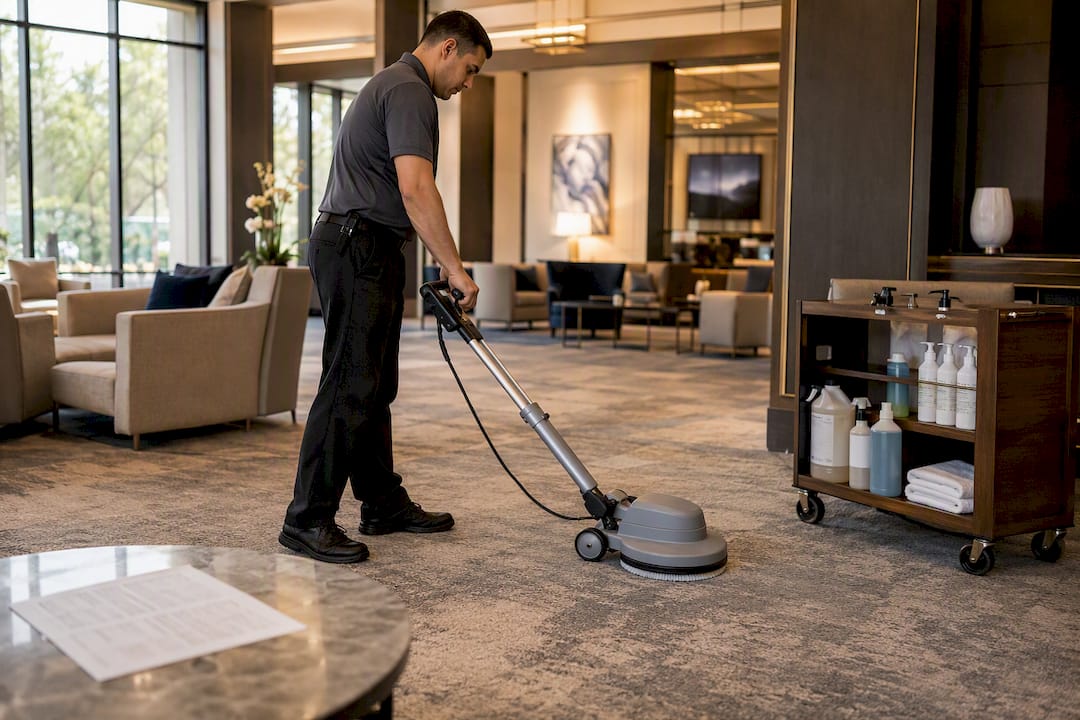
The most cost-effective way to manage commercial carpet is a zone-based maintenance program that pairs interim encapsulation with scheduled hot water extraction, backed by a vendor who can prove IICRC training and CRI Seal of Approval products. Three moves this week get you there:
- Map your facility into traffic zones (entries, corridors, workstations, conference rooms).
- Require proof of CRI SOA products, IICRC-trained technicians, insurance, and service logs before you sign anything.
- Schedule a walkthrough with a provider who can run both interim and restorative methods under one contract, such as Nationwide Maintenance.
Key Takeaways
A zone-based hybrid program combining interim encapsulation with scheduled hot water extraction, backed by documented IICRC credentials and CRI SOA products, delivers the most cost-effective commercial carpet care.
| Point | Details |
|---|---|
| Match method to zone | Use encapsulation for daily interim upkeep and hot water extraction for periodic restorative deep cleaning. |
| Set frequency by traffic tier | Range from quarterly interim service in low-traffic offices to weekly service in entrances and lobbies. |
| Require documentation upfront | Demand CRI SOA product proof, IICRC technician certificates, insurance, and dated service logs before signing. |
| Verify drying before reoccupancy | Use moisture meter readings and air movers to confirm safe reoccupation and prevent mildew disputes. |
| Choose an integrated provider | Nationwide Maintenance delivers carpet care alongside full facility maintenance under one contract for multi-site clients. |
Table of Contents
- Carpet Cleaning Commercial Checklist for Your Next RFP
- Which Carpet Cleaning Methods Work Best for Each Zone?
- How Often Should Commercial Carpet Be Cleaned by Traffic Zone?
- What Should Be in Your Commercial Carpet Cleaning Contract?
- When Should You Schedule Carpet Cleaning to Limit Downtime?
- What Drives the Cost of Commercial Carpet Cleaning?
- How Do You Roll Out a Commercial Carpet Cleaning Program?
- Get a Commercial Carpet Cleaning Program Built Around Your Facility
- Why Most Carpet Maintenance Plans Fail Before Year Two
- Sources
Carpet Cleaning Commercial Checklist for Your Next RFP
Paste this into your request for proposal and you’ve covered the requirements that separate a serious bidder from a truck-and-vacuum operation.
- Traffic-zone map with inspection cadence. Document entries, corridors, elevator lobbies, and low-traffic offices separately, with a monthly visual inspection schedule.
- Daily and weekly vacuuming standards. Require certified upright equipment with agitation and HEPA filtration, and specify vacuum passes for medium and high-traffic zones.
- Interim and restorative intervals. Set encapsulation frequency for appearance zones and a fixed schedule for full hot water extraction.
- Documentation package. Demand CRI SOA product listings, IICRC technician certificates, current insurance, and dated service logs with every visit.
Pro Tip: Ask bidders to submit a sample service log from an existing client. If they can’t produce one, they’re not tracking performance the way your warranty protection requires.
Which Carpet Cleaning Methods Work Best for Each Zone?
Not every square foot of your facility needs the same treatment, and treating it that way wastes budget or wears out fiber faster than it should.
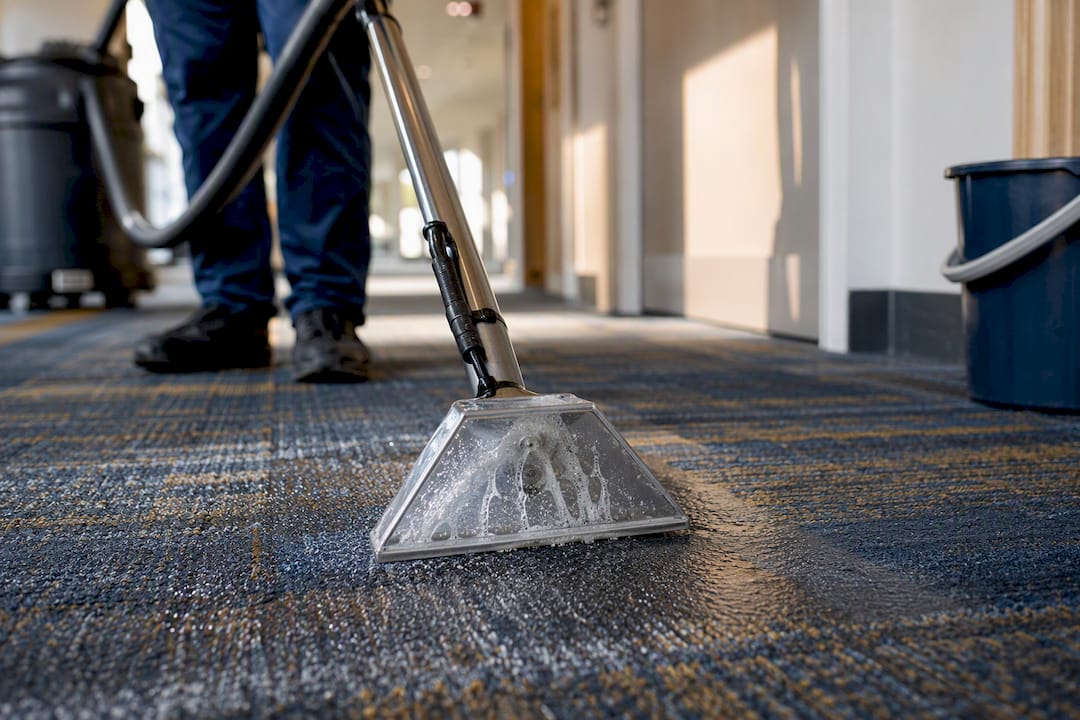
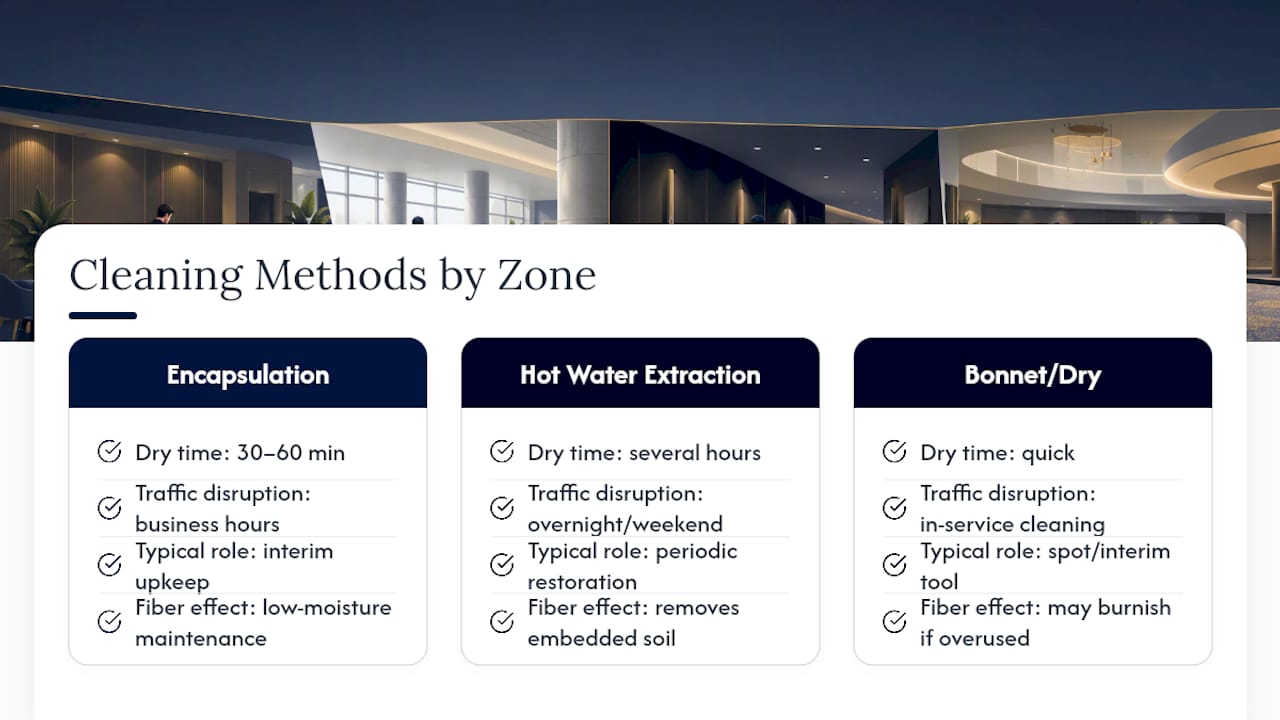
Hot water extraction is the restorative method. It flushes embedded soil and residue out of the pile, which is why the Carpet and Rug Institute recommends professional deep cleaning every 12 to 18 months, more often in high-traffic areas. The tradeoff is dry time, often several hours, which means overnight or weekend scheduling in occupied buildings.
Encapsulation is the low-moisture workhorse for routine appearance maintenance. It typically dries in 30 to 60 minutes, letting crews clean lobbies and corridors during business hours without shutting down foot traffic. It doesn’t replace deep extraction. It buys you time between restorative cleanings while keeping carpet looking presentable.
Dry compound and bonnet methods have a narrower role. Bonnet cleaning skims surface soil and can burnish fibers if overused, so treat it as an interim, spot-level tool rather than a primary strategy.
The pattern that shows up across industry guidance is a hybrid approach: encapsulation for interim upkeep, extraction for periodic restoration. That combination balances appearance, indoor air quality, and the reality that most facilities can’t close for a full day every month.
How Often Should Commercial Carpet Be Cleaned by Traffic Zone?
Frequency should track traffic, not the calendar. A lobby and a back-office conference room age at completely different rates, and a flat annual schedule wastes money on one and starves the other.
| Traffic Tier | Example Areas | Interim Cleaning | Restorative Extraction |
|---|---|---|---|
| Low | Private offices, storage rooms | Quarterly | Every 12 months or more |
| Moderate | General workstations, meeting rooms | Monthly | Every 12 to 18 months |
| High | Corridors, break rooms, retail floors | Weekly to biweekly | Every few months |
| Very high | Entrances, lobbies, elevator banks | Daily to weekly | Monthly or quarterly |
Healthcare and school facilities generally sit at the high end of their tier because of stricter indoor air quality expectations and heavier foot traffic during peak hours. Retail floors near entrances often need interim attention daily during wet-weather seasons.
- Tie every interval to manufacturer warranty language before finalizing a schedule.
- Revisit frequencies quarterly rather than locking in a static annual plan.
What Should Be in Your Commercial Carpet Cleaning Contract?
A vague SOW is how facilities end up with a vendor who shows up with a rental extractor and no documentation. Specify these clauses before you sign:
- Credentials. Require IICRC-certified technicians and CRI SOA-listed cleaning products in writing, not just verbally confirmed.
- Insurance minimums. General liability and workers’ compensation coverage should be attached as exhibits, not just referenced.
- Equipment standards. Ask whether the provider uses truck-mounted extraction for restorative jobs. Truck-mounted systems generally deliver higher water temperature and suction than portable units, which shortens dry time on large floor plates.
- QA metrics. Specify vacuum passes for high-traffic zones, moisture readings after extraction, and photographic before/after records for lobbies and entrances.
- Operational clauses. Address crew consistency (same lead technician when possible), after-hours access, furniture moving responsibilities, and waste disposal.
- Price transparency. Require separate line items for interim versus restorative work so you can negotiate volume pricing on recurring visits without renegotiating the whole contract.
Pro Tip: Add a clause requiring neutralization treatment after any alkaline pre-conditioner application. Skip this and you’ll see rapid re-soiling and dark edges near vents within weeks.
When Should You Schedule Carpet Cleaning to Limit Downtime?
Restorative extraction with several hours of dry time belongs overnight or on weekends in occupied buildings. Encapsulation’s fast dry window makes it viable during business hours, which is a real scheduling advantage for lobbies and corridors you can’t shut down.
- Coordinate with building engineering to position air movers and open HVAC returns during and after extraction.
- Verify dry time with a moisture meter before removing caution signage or reopening a zone. Documented moisture verification prevents wicking and mildew disputes down the line.
- Notify tenants or department heads 48 hours ahead for any zone requiring furniture moves or after-hours access.
- Run a final visual inspection before handing the space back to occupants.
What Drives the Cost of Commercial Carpet Cleaning?
Square footage is the obvious driver, but soil load, furniture density, and access constraints move the price more than most managers expect. A cafeteria with grease and food soil costs more per square foot than an equivalent office floor, and a floor with fixed cubicle furniture that needs moving adds labor time bidders should price separately.
Interim encapsulation runs cheaper per visit than restorative extraction, which is exactly why the hybrid model works financially: frequent low-cost interim visits stretch the interval between expensive deep cleans.
- Multi-site contracts typically get volume pricing when interim and restorative work are scheduled together across locations.
- Skipped maintenance doesn’t save money. Deferred cleaning accelerates fiber wear and pushes facilities toward premature replacement, which costs far more than a maintenance contract ever would.
- Ask for pricing broken out by method so you can adjust frequency without renegotiating the whole rate card.
How Do You Roll Out a Commercial Carpet Cleaning Program?
- Days 1 to 30: Walk the facility with your finalist vendor, finalize the SOW with zone maps and frequencies attached, and confirm equipment and technician credentials in writing.
- Days 31 to 60: Run baseline interim and restorative services, log moisture and dry-time readings, and send tenant notices ahead of any scheduled after-hours work.
- Days 61 to 90: Review performance against the SOW, adjust frequencies for zones that show heavier or lighter wear than projected, and set a recurring quarterly walkthrough with your account manager.
- Ongoing: Keep service logs and photographic records current, maintain a tenant feedback channel, and treat the quarterly walkthrough as a standing checkpoint, not an afterthought.
Get a Commercial Carpet Cleaning Program Built Around Your Facility
Most facility teams end up juggling separate vendors for carpet care, janitorial work, and everything else that keeps a building presentable. Nationwide Maintenance removes that split. One contract covers commercial carpet cleaning alongside the rest of your facility maintenance program, so your zone-based schedule doesn’t depend on coordinating three separate service calls.
Over 30 years of Tri-State experience means the credentials your SOW should require, IICRC-trained technicians, CRI SOA products, documented service logs, are already standard practice, not a special request. Clients like Costco and CVS have relied on that consistency across multi-location contracts where a missed visit at one site creates a visible problem at every site. Nationwide Maintenance also brings eco-friendly product options and 24/7 emergency response, so a flooding incident or an unplanned deep clean doesn’t require a separate vendor search. Explore the interior floor care services built for exactly this kind of program, or reach out to request a no-cost walkthrough and a sample SOW built around your traffic zones.
Why Most Carpet Maintenance Plans Fail Before Year Two
Static annual contracts are the most common mistake I see in this industry, and it’s rarely the vendor’s fault. A facility signs a one-size cleaning schedule, occupancy patterns shift six months later, and nobody revisits the frequencies until the carpet already looks worn in the entry zones.
The fix isn’t more frequent cleaning across the board. It’s tying frequency to actual traffic and revisiting that assessment on a quarterly cadence, which is exactly what a zone-based program is built to do. Facility teams that skip the walkthrough step, treating the initial SOW as permanent, end up either overspending on low-traffic offices or under-cleaning the lobby that every visitor and every employee walks through daily. Combining carpet care with the rest of a facility’s maintenance needs under one provider also closes a gap that separate vendor contracts leave open: nobody owns the full picture of how the building actually wears.
Request a proprietary case study or a site walkthrough if you want to see how this plays out across a multi-location portfolio.
— Nationwide Maintenance.
Sources
- Carpet-rug
- A Complete Guide To Commercial Carpet Cleaning — Nilfisk
- Commercial Carpet Cleaning — Allied Facility Care
Recommended
Need this handled at your facility?
Our crews cover commercial properties across New York, New Jersey, and Connecticut.