ATP Cleaning Test: How to Verify and Validate Surface Hygiene
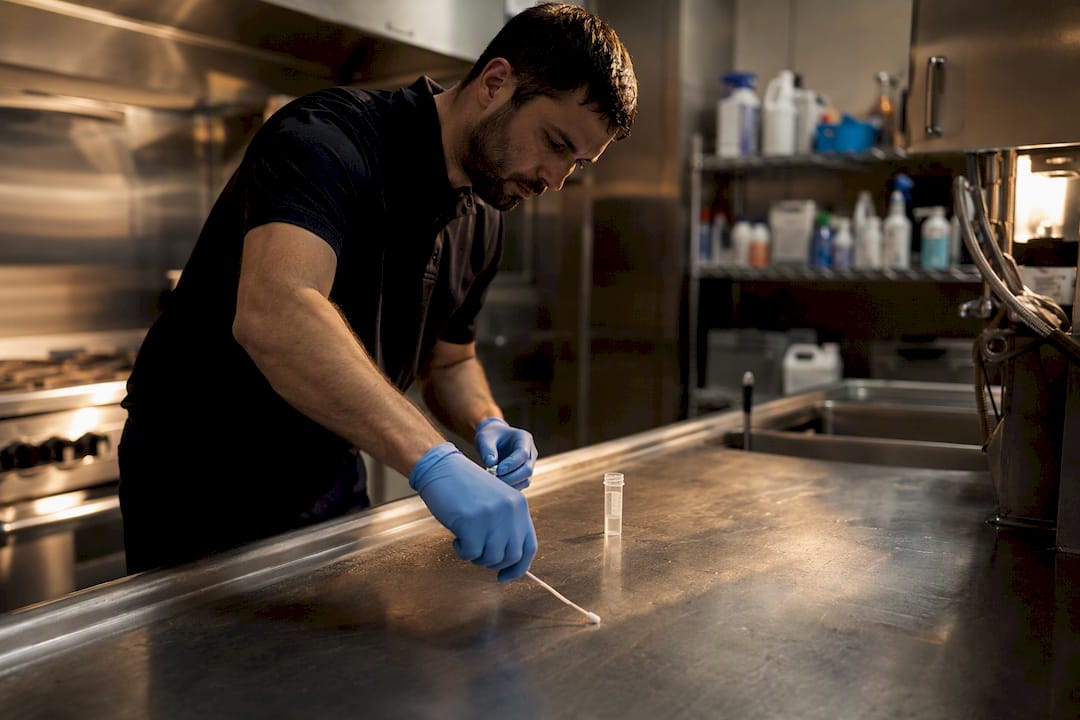
An ATP cleaning test measures organic residue left on a surface after cleaning by detecting adenosine triphosphate, the energy molecule present in food particles, cells, and microbes. Results come back as a relative light unit (RLU) reading in roughly 15 to 30 seconds, giving you an immediate, objective signal on whether a surface passed cleaning or needs to be recleaned right now. It’s a verification tool, not a pathogen test, and treating it that way is where most hygiene programs go wrong.
TL;DR:
- ATP testing provides immediate, objective data with RLU thresholds that need to be validated locally, as results vary by device and site.
- High-risk surfaces such as food contact areas, high-touch controls, and hard-to-clean geometries require swabbing after cleaning and before reuse to ensure hygiene.
- Repeated fails at a site indicate procedural issues or equipment problems that need targeted corrective actions and close monitoring over time.
- ATP is effective as a final verification step for routine cleaning but should trigger microbiological or pathogen-specific tests in outbreak or compliance situations.
- Integrating ATP testing into standard operating procedures and consolidating corrective actions under one vendor improves response times and overall hygiene management.
Table of Contents
- Why ATP verification matters in professional hygiene programs
- How ATP testing works: chemistry, swab technique, and timing
- Where and how often to swab: building a risk-based sampling plan
- Interpreting RLUs: how to set pass/caution/fail bands and required actions
- Limitations and complementary tests: when ATP isn’t enough
- Devices and instrument selection: choosing swabs, meters, and data systems
- Embedding ATP testing in an SSOP and validating cleaning processes
- Nationwide Maintenance perspective and practitioner notes
- When ATP should be the final sign-off versus a screening tool
- Turning ATP results into a maintained facility program
- Sources
Why ATP verification matters in professional hygiene programs
Visual inspection tells you if a surface looks clean. It doesn’t tell you if it’s actually clean. A stainless prep table can look spotless under fluorescent lighting and still carry enough protein and microbial residue to fail an ATP swab by a wide margin. That gap between “looks fine” and “tests fine” is the entire reason ATP monitoring exists.
The technology gives facility teams something visual checks never could: a number. Reviews of ATP bioluminescence in hospital hygiene monitoring consistently find it catches organic residue that visual inspection misses, and it does it fast enough to support real-time corrective action instead of waiting on lab results.
ATP testing shows up across several industries, each with its own stakes:
- Food processing and food service — verifying line cleandowns before production restarts, especially around allergen changeovers
- Healthcare facilities — checking high-touch surfaces and terminal cleaning in patient rooms and operating suites
- Hospitality — spot-checking housekeeping turnover in hotels and shared-use spaces
- Multi-site retail and commercial facilities — standardizing verification across locations that don’t share a cleaning crew
In regulated environments, ATP fits inside a larger compliance structure rather than replacing it. The FDA’s environmental sampling guidance treats environmental monitoring as a core piece of food safety programs, and ATP is one of the rapid tools commonly folded into that monitoring plan. On the healthcare side, the CDC lists ATP among accepted options for evaluating cleaning effectiveness, provided it’s paired with visual checks and, when needed, microbiological sampling.
How ATP testing works: chemistry, swab technique, and timing
The science behind the number is straightforward bioluminescence. A swab collects residue from a surface, gets loaded into a device with a luciferase reagent, and that reagent reacts with any ATP present to produce light. A handheld luminometer measures that light and converts it into an RLU value. More residue means more ATP, which means more light, which means a higher RLU reading.
The technique matters as much as the chemistry. Here’s the sequence that produces consistent, defensible results:
- Select the site based on your sampling plan, not convenience.
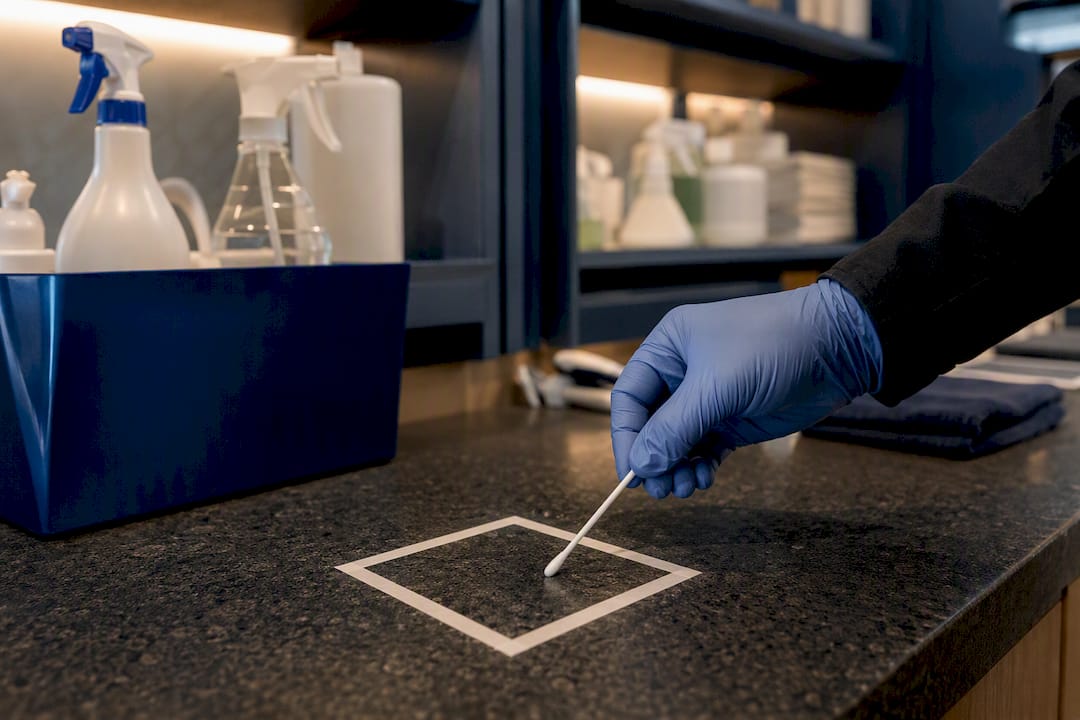
- Swab a defined area, typically 10 by 10 centimeters, using an S-pattern that covers the full surface with firm, even pressure.
- Rotate the swab tip slightly at the end of the pass to pick up residue from the swab’s edges too.
- Insert and activate the swab in the device per the manufacturer’s instructions, usually snapping a reagent ampoule.
- Read the result after 15 to 30 seconds, per a food-facility study tracking ATP against microbial indicators.
- Log the reading immediately with site ID, operator, time, and any corrective action taken.
That same study found ATP results agreed with microbiological indicators in a substantial majority of samples overall, and ATP alone would have correctly verified hygiene status or triggered cleaning action in most cases. That’s a strong enough signal to build a program around, but not strong enough to skip documentation or operator training.
Pro Tip: Swab the same exact footprint every time at a given site. If your team swabs a 10cm square one week and eyeballs a bigger area the next, your RLU trend becomes meaningless because you’re comparing different sample sizes, not different cleanliness levels.
Where and how often to swab: building a risk-based sampling plan
Not every surface deserves the same attention. Sampling plans that treat a doorknob and a food-contact conveyor belt identically waste swabs on low-risk sites and under-monitor the ones that actually matter.
Prioritize sites in this order:
- Direct product or patient contact surfaces — cutting boards, prep tables, bed rails, IV poles
- Hard-to-clean geometry — equipment seams, valve interiors, conveyor belt joints, grout lines
- High-touch controls — light switches, door handles, elevator buttons, shared equipment panels
- Harborage points — drains, gaskets, and anywhere moisture and organic matter tend to collect
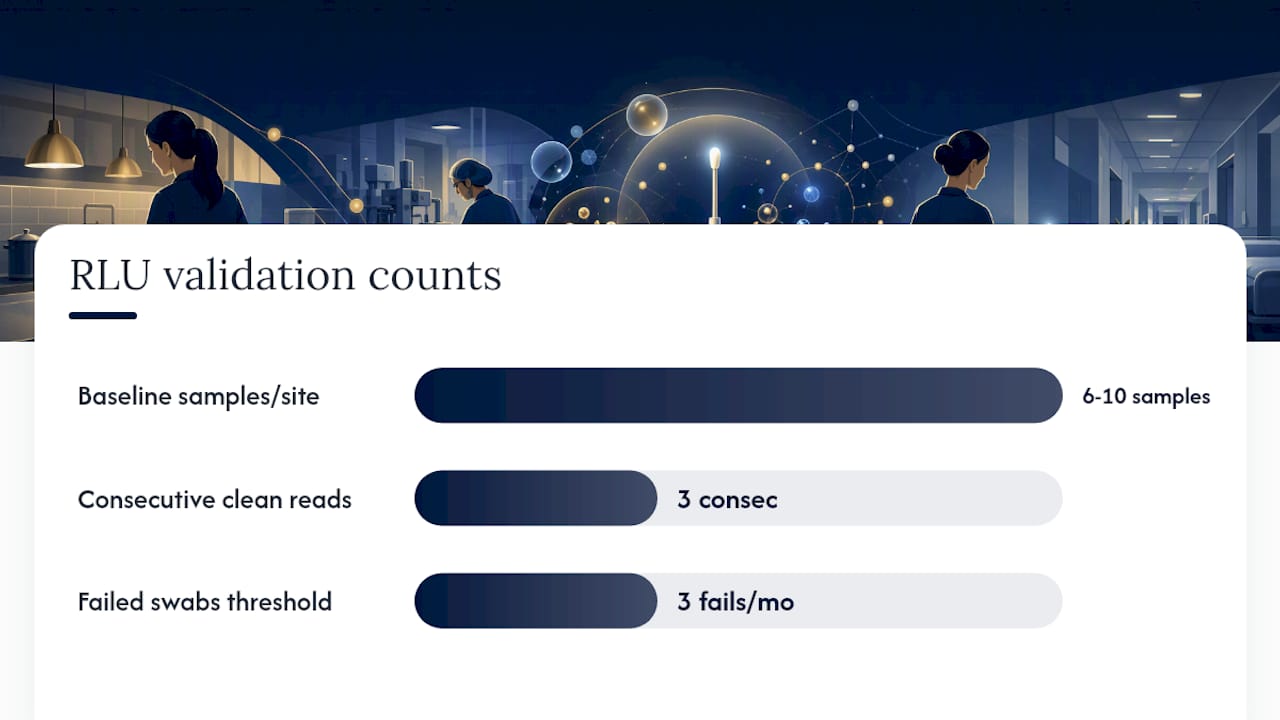
Before you can call a reading a “pass” or “fail,” you need a baseline. The ATP hygiene handbook from Hygiene Diagnostics recommends collecting 6 to 10 samples per test site as a minimum starting point, comparing readings from known-clean surfaces against known-soiled ones to establish a realistic range for that specific site and device combination.
Frequency should track risk. High-risk food-contact surfaces get swabbed after cleaning and before production resumes each time. Environmental sites like door handles or waiting-room chairs can be tested on a regular schedule, adjusted based on traffic and past failure rates. Once you’ve built a solid trend history for a low-risk site, you can often stretch the interval between checks without losing control of the program. That trending data is also what eventually lets you cut testing frequency at stable sites and redirect swabs toward locations that keep failing.
Interpreting RLUs: how to set pass/caution/fail bands and required actions
RLU numbers are not universal. A reading of 250 on one manufacturer’s device might represent a clean pass, while the same number on a different swab and luminometer combination could mean a failed surface. Manufacturer guidance from Neogen is blunt about this: RLU outputs are device-specific, and thresholds published for one system should never be copied onto another. Every facility needs to validate its own bands using its own equipment.
Building those bands follows a clear sequence:
- Collect baseline data (the 6 to 10 samples per site mentioned earlier) across known clean and known soiled conditions.
- Plot the resulting RLU values to see where clean readings cluster and where soiled readings separate from them.
- Set three bands from that curve: pass (consistent with verified clean), caution (borderline, warrants a recheck), and fail (consistent with inadequate cleaning).
- Require repeated passing results, commonly three consecutive clean readings at a site, before locking in that threshold as your working standard.
When a swab comes back in the fail range, the response needs to be automatic, not discretionary:
- Hold the surface or area from further use or production.
- Reclean using the specified SSOP procedure, not a quick wipe.
- Reswab the identical footprint to confirm the reclean worked.
- Document the failure, the corrective action, and the reswab result.
- Escalate to a supervisor or quality lead if the same site fails repeatedly, since a recurring fail usually points to a procedure problem, not a one-off lapse.
A single failed swab is a data point. Three failed swabs at the same site in a month is a pattern that needs a different cleaning method, not another reswab.
Limitations and complementary tests: when ATP isn’t enough
ATP testing has a specific job, and it’s not the job people sometimes assume it does. Understanding the boundary matters as much as understanding the technique itself.
- ATP does not identify which pathogens, if any, are present on a surface.
- ATP does not detect allergen proteins like milk, peanut, or gluten residue.
- A passing ATP result does not mean a surface is sterile or pathogen-free.
- ATP measures total organic ATP, so it can’t tell you whether the source is food debris, microbial cells, or something else entirely.
When the question is “is this pathogen present” or “is this allergen gone,” ATP is the wrong tool for the final answer. Aerobic plate counts and PCR-based methods confirm microbial presence and identity. Lateral-flow or ELISA kits confirm allergen residue. ATP can flag a surface as worth investigating further, but it should trigger that targeted testing rather than substitute for it.
Reading errors happen too. Surface texture, leftover disinfectant residue, and the natural breakdown of ATP into ADP and AMP over time can all skew results. Where old residue or high-heat cleaning cycles are common, total adenylate tests that detect ATP plus its breakdown products reduce the false negatives that straight ATP swabs can produce.
Devices and instrument selection: choosing swabs, meters, and data systems
Picking an ATP system comes down to a handful of practical tradeoffs, and the right answer depends on how many sites you’re managing and what you’re doing with the data afterward.
Portable handheld meters work well for single-site operations or spot checks, while integrated systems that sync to cloud dashboards make more sense once you’re running verification across a dozen locations and need centralized trend visibility. Consumable cost adds up fast at scale, so price per swab deserves real scrutiny before you commit to a device family.
Beyond the base hardware, look for:
- Data logging that timestamps and stores every reading automatically, not just the failures
- Sample-area adapters or templates that keep swab footprint consistent across operators
- Straightforward operation that doesn’t require extensive retraining when staff turn over
- Trend-analytics software that can flag a site drifting toward failure before it actually fails
Device variability is real even within a single brand. Two meters from the same manufacturer can read slightly differently on an identical sample, which is exactly why calibration checks and periodic cross-validation between units matter for any facility running more than one device.
Pro Tip: If you manage multiple sites, standardize on one device and swab type across the entire portfolio before you build your RLU bands. Mixing hardware makes cross-site comparisons meaningless, even when every site is using the same SSOP.
Embedding ATP testing in an SSOP and validating cleaning processes
An ATP program that lives in a drawer and only gets used when something goes wrong isn’t a program. It’s a reactive checklist. The value comes from building ATP into your standard sanitation operating procedure (SSOP) as a required verification step, not an optional add-on.
That looks like this in practice:
- Write the test plan into the SSOP itself, naming exact test sites, swab frequency, and the person responsible for each check.
- Attach corrective-action thresholds directly to the documented pass, caution, and fail bands for that site.
- Validate before locking in any procedure change by rerunning the site through the same baseline process and requiring three consecutive passing results before accepting the new SSOP as final.
- Feed results into staff training, using failed swabs as concrete teaching moments rather than punitive events.
- Report trends to operations stakeholders on a regular cycle so ATP data informs staffing, scheduling, and budget decisions instead of sitting in a binder.
Larger studies back the value of this feedback loop specifically. Cluster-randomized trials in intensive care units found that feeding ATP results back to cleaning staff through structured audits lowered bioluminescence readings and reduced environmental cultures positive for multidrug-resistant organisms. The test itself didn’t do that. The loop connecting the test to accountability did.
Nationwide Maintenance perspective and practitioner notes
Running facility maintenance across commercial, retail, and industrial sites for over 30 years has taught us one consistent lesson: ATP testing only earns its keep when it’s tied to a corrective-action workflow someone actually owns. A number on a screen means nothing without a documented next step.
We’ve seen ATP verification reshape SSOPs at multi-site retail accounts where a recurring caution-band reading at a single prep station turned out to be a training gap, not an equipment problem. Once staff switched cleaning sequence, the site cleared into consistent passes within two weeks. In pest-sensitive environments, we frequently pair ATP checks with enzyme cleaning, since enzyme formulas break down organic residue that standard detergents leave behind, which shows up directly in lower RLU readings on the next swab.
For property managers juggling cleaning, pest control, and repairs across separate vendors, the practical advice is simple: consolidate verification and corrective action under one contract. When the team running the ATP swab is the same team authorized to fix what it finds, the gap between detecting a problem and resolving it shrinks from days to hours.
When ATP should be the final sign-off versus a screening tool
ATP works as the final sign-off for routine cleaning verification. A passing swab on a prep table between shifts, a hotel room turnover, or a retail floor before opening is enough to move forward. That’s what the test is built for, and it does that job well.
It stops being sufficient the moment risk escalates: an outbreak investigation, a confirmed allergen complaint, a regulatory inspection trigger, or any incident where a specific pathogen or allergen needs to be ruled in or out. At that point, ATP should prompt a call to your quality or lab team, not replace their work.
For recurring service contracts, this distinction shapes resource allocation directly. Routine sites can run on a lighter, trend-based testing cadence with straightforward documentation. Higher-risk sites justify tighter cadence, more detailed reporting, and a lower tolerance for caution-band results before escalation. Getting that balance right is what keeps a verification program affordable without leaving real risk unmonitored.
— Nationwide Maintenance.
Turning ATP results into a maintained facility program
Testing tells you where you stand. Fixing what the test finds is a different job, and it’s the one that actually protects your brand and your compliance record. Nationwidemaintenance built its service model around exactly that gap: commercial cleaning and janitorial services crews trained on SSOP execution, paired with enzyme cleaning where organic residue is the recurring problem, all under one contract instead of three separate vendor relationships.
That single-contract structure matters most at the corrective-action stage. When a swab fails, you don’t want to be coordinating between a cleaning company, a pest control company, and a repair crew to figure out who owns the fix. With cleaning, pest control, and facility repairs under one vendor, the recleaning, reswabbing, and documentation happen without a handoff delay. If your facility spans multiple locations, our property management program is built to standardize that verification and corrective-action loop across every site on your portfolio. Reach out through our service areas page to scope a site assessment and see where an ATP-backed cleaning program fits your facility.
Sources
The claims in this guide draw on peer-reviewed research and regulatory guidance, including a food-facility study on ATP and microbial indicator agreement, a comprehensive review of ATP bioluminescence in hospital hygiene monitoring, and technical notes on ATP’s scope and limitations. For regulatory context, see the FDA’s environmental sampling guidance and CDC cleaning verification procedures. For baseline and validation methodology, consult the ATP Hygiene Handbook and, for building-level documentation practices, Vista Drone Cleaning’s guide on facade cleanliness.
- The role of ATP bioluminescence in monitoring surface hygiene in hospital settings: a comprehensive review (PMC13032431)
- FDA — Environmental sampling to protect the food supply
- CDC — Environmental cleaning procedures and verification
Recommended
Need this handled at your facility?
Our crews cover commercial properties across New York, New Jersey, and Connecticut.